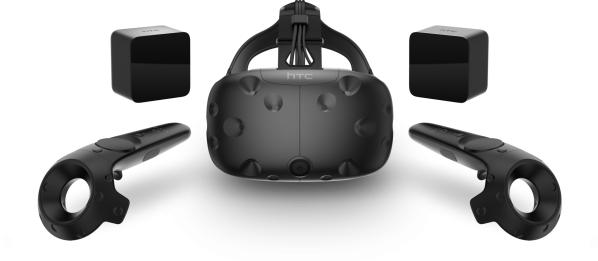
HTC Vive Gives Autonomous Robots Direction

The HTC Vive is a virtual reality system designed to work with Steam VR. The system seeks to go beyond just a headset in order to make an entire room a virtual reality environment by using two base stations that track the headset and controller in space. The hardware is very exciting because of the potential to expand gaming and other VR experiences, but it’s already showing significant potential for hackers as well — in this case with robotics location and navigation.

Autonomous robots generally utilize one of two basic approaches for locating themselves: onboard sensors and mapping to see the world around it (like how you’d get your bearings while hiking), or sensors in the room which tell the robot where it is (similar to your GPS telling you where you are in the city). Each method has its strengths and weaknesses, of course. Onboard sensors are traditionally expensive if you need very accurate position data, and GPS location data is far too inaccurate to be of use on a smaller scale than city streets.

[Limor] immediately saw the potential in the HTC Vive to solve this problem, at least for indoor applications. Using the Vive Lighthouse base stations, he’s able to locate the system’s controller in 3D space to within 0.3mm. He’s then able to use this data on a Linux system and integrate it into ROS (Robot Operating System). [Limor] hasn’t yet built a robot to utilize this approach, but the significant cost savings ($800 for a complete Vive, but only the Lighthouses and controller are needed) is sure to make this a desirable option for a lot of robot builders. And, as we’ve seen, integrating the Vive hardware with DIY electronics should be entirely possible.

Continue reading “HTC Vive Gives Autonomous Robots Direction”
One Man, A Raspberry Pi, And A Formerly Hand Powered Loom

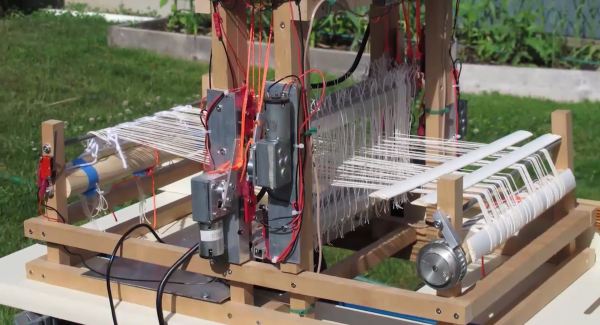
[Fred Hoefler] was challenged to finally do something with that Raspberry Pi he wouldn’t keep quiet about. So he built a machine assist loom for the hand weaver. Many older weavers simply can’t enjoy their art anymore due to the physical strain caused by the repetitive task. Since he had a Pi looking for a purpose, he also had his project.

His biggest requirement was cost. There are lots of assistive looms on the market, but the starting price for those is around ten thousand dollars. So he set the rule that nothing on the device would cost more than the mentioned single board computer. This resulted in a BOM cost for the conversion that came in well under two hundred dollars. Not bad!

The motive parts are simple cheap 12V geared motors off Amazon. He powered them using his own motor driver circuits. They get their commands from the Pi, running Python. To control the loom one can either type in commands into the shell or use the keyboard. There are also some manual switches on the loom itself.

In the end [Fred] met his design goal, and has further convinced his friends that the words Raspberry Pi are somehow involved with trouble.

Continue reading “One Man, A Raspberry Pi, And A Formerly Hand Powered Loom”

Struggling Robot Made With DIY Soft Limbs

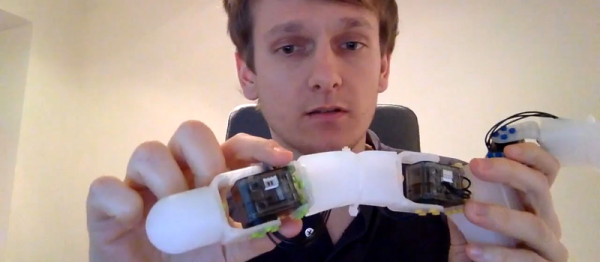
[Jonathan Grizou] is experimenting with robot designs, and recently stumbled upon a neat method for making soft robots. While his first prototype, a starfish like robot, doesn’t exactly “whelm” a person with it’s grace and agility, it proves the concept. Video after the break.

In this robot the frame is soft and the motor provides most of the rigidity for the structure. The soft parts of the frame have hardpoints embedded into them for mounting the motors or joining sections together. The sections are made with 3D printed molds. The molds hold the 3D printed hard points in place. Silicone is poured into the mold and left to cure overnight. The part is then demolded and is ready for use.

Continue reading “Struggling Robot Made With DIY Soft Limbs”

Creating Unbeatable Videogame AI

Super Smash Bros. Melee is a multiplayer fighting game released for the Nintendo GameCube in 2001. For the last decade and a half, it has become one of the premier fighting game eSports, and it is the reason Nintendo still makes a GameCube controller for the Wii U. Smash Melee has an intense following, and for years the idea of an AI that could beat top-tier players at Melee was inconceivable – the game was just far too complex, the strategies too demanding, and the tactics too hard.

[Dan] a.k.a. [AltF4] wasn’t satisfied that a computer couldn’t beat players at Melee, and a few years ago started work on the first Melee AI that could beat any human player. He just released Smashbot at this year’s DEF CON, and while the AI is limited, no human can beat this AI.

Continue reading “Creating Unbeatable Videogame AI”

OpenSurgery Explores The Possibility Of DIY Surgery Robots

As the many many warnings at the base of the Open Surgery website clearly state, doing your own surgery is a very bad idea. However, trying to build a surgery robot like Da Vinci to see if it can be done cheaply, is a great one.

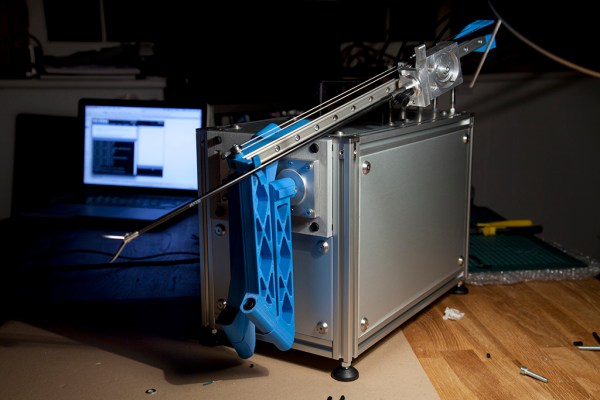
For purely academic reasons, [Frank Kolkman] decided to see if one could build a surgery robot for less than an Arab prince spends on their daily commuter vehicle. The answer is, more-or-less, yes. Now, would anyone want to trust their precious insides to a 3D printed robot with dubious precision?  Definitely not.

The end effectors were easily purchased from a chinese seller. Forty bucks will get you a sterile robotic surgery gripper, scissor, or scalpel in neat sterile packaging. The brain of the robot is basically a 3D printer. An Arduino and a RAMPS board are the most economical way to drive a couple steppers.

The initial version of the robot proves that for around five grand it’s entirely possible to build a surgery robot. Whether or not it’s legal, safe, usable, etc. Those are all questions for another research project.

Hedberg Is A Bionic Hand Made From A Single Keurig

Developing into a modern hacker and tinkerer requires a lot of things: electronics study, programming knowledge, and patience (among many other things). But, the most important quality a hacker can have is curiosity. The desire to see how things work is what drives most budding hackers towards the dismantling of family appliances and electronic gadgets.

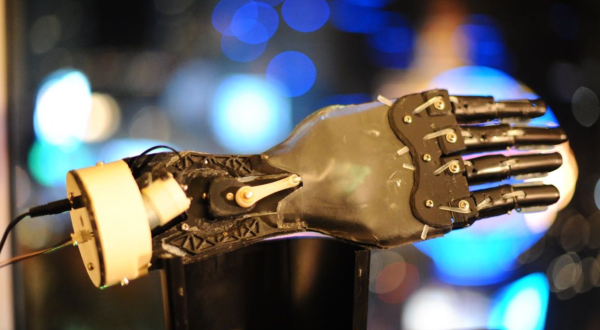
Many end up scavenging parts from the things around the house for their first projects. But, with money and more ambitious builds comes the need to purchase parts off the shelf. There is, however, something to be said for the ingenuity that comes with building something solely with scavenged parts, and that’s what [Evan Booth] decided to do, in a spectacular fashion.

Continue reading “Hedberg Is A Bionic Hand Made From A Single Keurig”

Tattoos By Robotic Arm With Pinpoint Accuracy

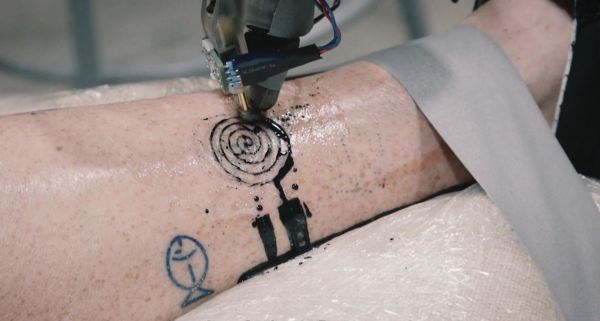
Tattoos are an ancient art, and as with most art, is usually the domain of human expertise. The delicate touch required takes years to master, but with the capacity for perfect accuracy and precision movements, enlisting a robotic arm and some clever software to tattoo a willing canvas is one step closer thanks to the efforts of [Pierre Emm] and [Johan da Silveira].

They began by using a 3D printer modified to ‘print’ with a tattoo needle. Catching the interest of the Applied Research Lab at Autodesk, the next logical step was to use an industrial robot arm get a human under the tattooing machine — dubbed Tatoué — after scanning the limb in question and loading it into Dynamo, their parametric design environment to map the design onto the virtual limb.

Continue reading “Tattoos By Robotic Arm With Pinpoint Accuracy”