
[youtube=http://www.youtube.com/watch?v=oYfybYkB2io]
All bow your heads in reverence to the Ponginator. This bad boy is a performance robot, mounted to the end of a 3 story tall crane. He makes all kinds of noises, flashes all kinds of lights, and shoots ping pong balls at 170 miles an hour. This thing looks like it would be so much fun to play with. listen to it as he’s talking and you’ll pick out all kinds of Sci Fi sound effects, from Portal sounds to Star Trek sounds. Check out the second video on the site to actually see the Ponginator shooting.
Robots Hacks2457 Articles
Robotic Baby Crib

This surprisingly pleasant looking crib is actually a robot, designed to keep babies quiet and happy all night long. Once inside and locked up, the baby is under the robot’s care. When the robot senses crying, it rocks gently back and forth. This should allow parents the time to catch some sleep. As pointed out in the article, the $5000 price tag is a bit steep. Especially considering the fact that you can get a much less technologically advanced equivalent for relatively cheap. How many of you hackers have babies? What hacks did you do to get your babies to sleep?
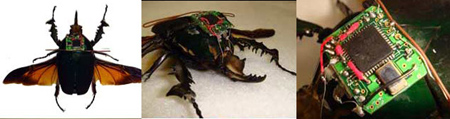
Radio Controlled Beetle
Scientists at the university of California have managed to implant a chip in a giant flower beetle that makes it respond to commands from the computer. They can tell it to fly, stop, turn left and turn right. The controls are done through its optic nerves and wing muscles. Though the article states that flight signals are sent to the optic lobes and steering is done through stimulation of the wing muscles, the video shows steering being accomplished through optic lobe stimulation.
Though we’re sure there’s some grand scientific goal behind this, we can’t help but think (hope) that we’ll be seeing giant robot controlled beetle battles with lasers and rockets.
OpenVulture, Software For Unmanned Vehicles

The first talk of ShmooCon was [Ethan O’Toole] and [Matt Davis] presenting their OpenVulture software for unmanned vehicles. In the initial stages, they had just planned on building software for Unmanned Aerial Vehicles, but realized that with the proper planning it could be used with any vehicle: airplanes, cars, boats, and subs (or more specifically, their Barbie PowerWheels). The software is in two parts. First is a library that lets you communicate with each of the vehicle’s modules. The second half is the actual navigation software.
They’ve spent a lot of time sourcing hardware modules. They are looking for items that work well, aren’t too expensive, and have a fairly plug and play implementation. For their main processor, they wanted something that wasn’t a microcontroller and could run a full Linux system. The ARM based NSLU2 NAS seems to be the current frontrunner. You can find the opensource software and descriptions of the supported modules on their site.
They’re building the first test UAVs now. One has a 12 foot wingspan for greater lift and stability. We’ve covered the Arduino based Ardupilot and other UAVs in the past.
Radio Controlled Sphere
[youtube=http://www.youtube.com/watch?v=8twa_zqT9Vg&feature=player_embedded]
[prabbit22m] has written an instructable on how to build a radio controlled sphere. The mechanism is fairly simple, with one drive motor, one servo and a gyro for stability. To turn, the servo shifts the center of gravity off to one side. You can see that the system works pretty well in the video above. If it didn’t have that gyro, it would be insane, believe us, we’ve done our own experimenting. If you like this, but want more features, check out this one that has a camera and takes pictures wherever it goes. We can’t forget Swarm either. The autonomous swarm of robot spheres. Of coarse [prabbit22m] might have the best idea of all. Dress it up as a regular ball to mess with people.
Laser Pup

[Joe] sent us this project called Laser Pup. After seeing many other projects with the ioBridge like beer pouring and dog treat dispensing, he wanted to make his own. His project allows him to play with his dog via a ceiling mounted laser pointer. We know, you were hoping for something more along the lines of Laser Cats, but this is still pretty cool. He built a web interface specifically for the iPhone to control the laser, room lights, and show a live feed of the puppy playing. You can see a video of it in action after the break.
Pong Playing Robot
[vimeo=1564591]
Sometimes, it can be very difficult to find a partner to play pong. Lets face it, pong just isn’t worth playing alone. Someone has come up with the perfect solution, a robot built specifically for playing pong. It watches the “ball” with a web cam and presses the appropriate buttons on the keyboard with its tentacle like arms. It is vaguely reminiscent of the switchboard operators from Men In Black, and definitely overkill for the job. You may notice there seems to be some performance issues with their game of pong. I doubt that the game itself is that taxing, but the same computer is controlling the robot as well.









