DIY Stress Meter

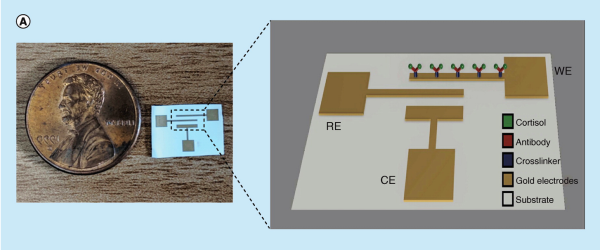
Stress monitoring has always been a tricky business. As it turns out, there is a somewhat reliable way of monitoring stress by measuring how much cortisol, the so-called “stress hormone,” the human body produces. With that in mind, bioengineering researchers at the University of Texas at Dallas decided to make CortiWatch, a wearable device for continuously monitoring cortisol excreted in sweat, as a sort of DIY stress meter.

They made their own potentiostat, a device for measure small amounts of current produced by electrochemical reactions, similar to the glucometer. We’ve talked about these types of measurements before. Simply put, the potentiostat contains a voltage reference generator which biases the sensing electrodes at a preset potential. The voltage bias causes local electrochemical reactions at the sensing electrodes (WE in the image above), stimulating electron flow which is then measured by a transimpedance amplifier or “current-to-voltage” converter. The signal is then analyzed by an onboard analog-to-digital converter. Simply put, the more cortisol in the system, the higher the transimpedance amplifier voltage.

To validate their system a bit more thoroughly than simple benchtop studies, the researchers did some “real-life” testing. A volunteer wore the CortiWatch for 9 hours. The researchers found a consistent decrease in cortisol levels throughout the day and were able to verify these measurements with another independent test. Seems reasonable, however, it’s not quite clear to us what cortisol levels they were expecting to measure during the testing period. We do admit that it takes quite a bit of calibration to get these systems working in real-life settings, so maybe this is a start. We’ll see where they go from here.

Maybe the CortiWatch can finally give us a proper lie detectorWe’ll let you be the judge.

Window In The Skies: Why Everyone Is Going To Mars This Month

Mars may not be the kind of place to raise your kids, but chances are that one day [Elton John]’s famous lyrics will be wrong about there being no one there to raise them. For now, however, we have probes, orbiters, and landers. Mars missions are going strong this year, with three nations about to launch their rockets towards the Red Planet: the United States sending their Perseverance rover, China’s Tianwen-1 mission, and the United Arab Emirates sending their Hope orbiter.

As all of this is planned to happen still within the month of July, it almost gives the impression of a new era of wild space races where everyone tries to be first. Sure, some egos will certainly be boosted here, but the reason for this increased run within such a short time frame has a simple explanation: Mars will be right around the corner later this year — relatively speaking — providing an ideal opportunity to travel there right now.

In fact, this year is as good as it gets for quite a while. The next time the circumstances will be (almost) as favorable as this year is going to be in 2033, so it’s understandable that space agencies are eager to not miss out on this chance. Not that Mars missions couldn’t be accomplished in the next 13 years — after all, several endeavors are already in the wings for 2022, including the delayed Rosalind Franklin rover launch. It’s just that the circumstances won’t be as ideal.

But what exactly does that mean, and why is that? What makes July 2020 so special? And what’s everyone doing up there anyway? Well, let’s find out!

Continue reading “Window In The Skies: Why Everyone Is Going To Mars This Month”

Solar Weather Station Listens For Lightning

Custom weather stations are a common enough project these days, especially based around the ESP8266. Wire a sensor up to the MCU, power it up with an old phone charger, and you’re half way there. But if you want something that’s going to operate remotely on the long term, you’ve got to put a little more thought into it.

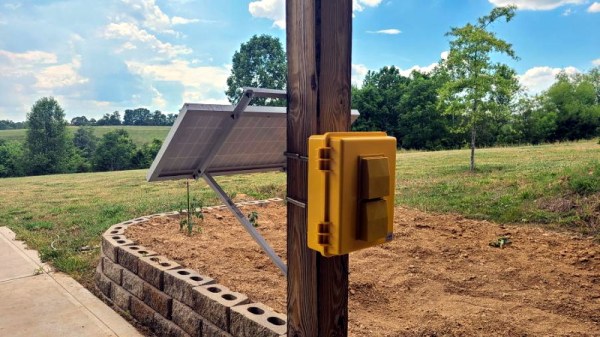
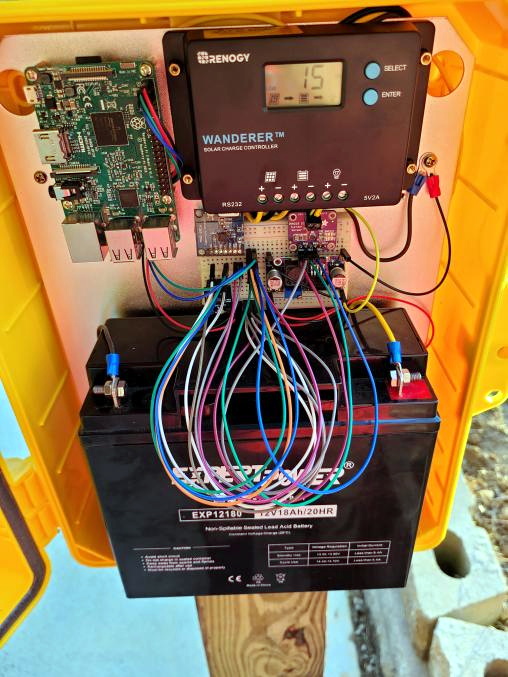
Which is exactly what [BuckarewBanzai] did for his solar powered Raspberry Pi weather station. With an industrial NEMA-rated enclosure, a beefy 35 watt photovoltaic panel, and enough lead-acid battery capacity to keep the show going for days, this build is certainly more robust than most. Some might call it overkill, but we think anyone who’s ever deployed hardware outdoors for more than a few days knows you can never be too careful when Mother Nature is involved.

To keep the 18 Ah battery topped off, [BuckarewBanzai] is using a 10 amp Wanderer charge controller. It sounds as though he burned through a few lesser models before settling on this one; something to consider for your own off-grid projects. An LM2596 regulator is then used to provide a stable 5 V for the Raspberry Pi.

In addition to the BME280 environmental sensor that picks up on temperature, humidity, and pressure, there’s also a AS3935 lightning sensor onboard which [BuckarewBanzai] says can pick up strikes up to 40 kilometers away. All of this environmental data is collected and stored in a local SQLite database, and gets pushed offsite every five minutes with a REST API so it can be visualized with Grafana.

Critics in the audience will no doubt pick up on the solderless breadboard located in the center of the weather station, but [BuckarewBanzai] says he’s already on the case. He’s working on a custom PCB that will accept the various modular components. Not only should this make the station more reliable, but he says it will cut down on the “spaghetti” wiring. Though for the record, this is hardly the worst offender we’ve seen in that department.

Video: Bil Herds Looks At Mitosis

I loved my science courses when I was in Junior High School; we leaned to make batteries, how molecules combine to form the world we see around us, and basically I got a picture of where we stood in the  scheme of things, though Quarks had yet to be discovered at the time.

In talking with my son I found out that there wasn’t much budget for Science learning materials in his school system like we had back in my day, he had done very little practical hands-on experiments that I remember so fondly. One of those experiments was to look and draw the stages of mitosis as seen under a Microscope. This was amazing to me back in the day, and cemented the wonder of seeing cell division into my memory to this day, much like when I saw the shadow of one of Jupiter’s moons with my own eyes!

Now I have to stop and tell you that I am not normal, or at least was not considered to be a typical young’un growing up near a river in rural Indiana in the 60’s. I had my own microscope; it quite simply was my pride and joy. I had gotten it while I was in the first or second grade as a present and I loved the thing. It was just horrible to use in its later years as lens displaced, the focus rack became looser if that was possible, and dirt accumulated on the internal lens; and yet I loved it and still have it to this day! As I write this, I realize that it’s the oldest thing that I own. (that and the book that came with it).

Today we have better tools and they’re pretty easy to come by. I want to encourage you to do some science with them. (Don’t just look at your solder joints!) Check out the video about seeing mitosis of onion cells through the microscope, then join me below for more on the topic!

Continue reading “Video: Bil Herds Looks At Mitosis”

The WIMP Is Dead, Long Live The Solar Axion!

For decades scientists have been building detectors deep underground to search for dark matter. Now one of these experiments, the XENON1T detector, has found an unexpected signal in their data. Although the signal does not stem from dark matter it may still revolutionize physics.

Since the 1980s the majority of scientists believe that the most likely explanation for the missing mass problem is some yet undiscovered Weakly Interacting Massive Particle (WIMP). They also figured that if you build a large and sensitive enough detector we should be able to catch these particles which are constantly streaming through Earth. So since the early 1990s, we have been putting detectors made from ultrapure materials in tunnels and mines where they are shielded from cosmic radiation and natural radioactivity.

Over the decades these detectors have increased their sensitivity by a factor of about 10 million due to ever more sophisticated techniques of shielding and discriminating against before mentioned backgrounds. So far they haven’t found dark matter, but that doesn’t mean the high-end sensing installations will go unused.

Continue reading “The WIMP Is Dead, Long Live The Solar Axion!”

Towards A 3D-Printed Neutrino Detector

Additive manufacturing techniques like fused deposition modeling, aka 3D printing, are often used for rapid prototyping. Another advantage is that it can create shapes that are too complex to be made with traditional manufacturing like CNC milling. Now, 3D printing has even found its way into particle physics as an international collaboration led by a group from CERN is developing a new plastic scintillator production technique that involves additive manufacturing.

A scintillator is a fluorescent material that can be used for particle detection through the flashes of light created by ionizing radiation. Plastic scintillators can be made by adding luminophores to a transparent polymer such as polystyrene and are usually produced by conventional techniques like injection molding.

Continue reading “Towards A 3D-Printed Neutrino Detector”

Recreating Paintings By Teaching An AI To Paint

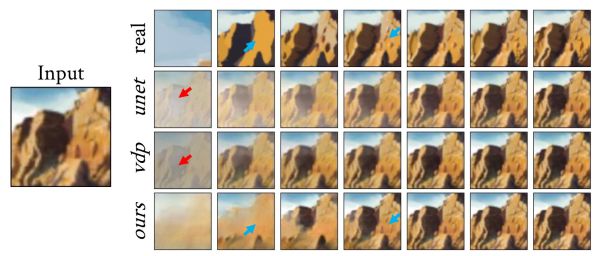
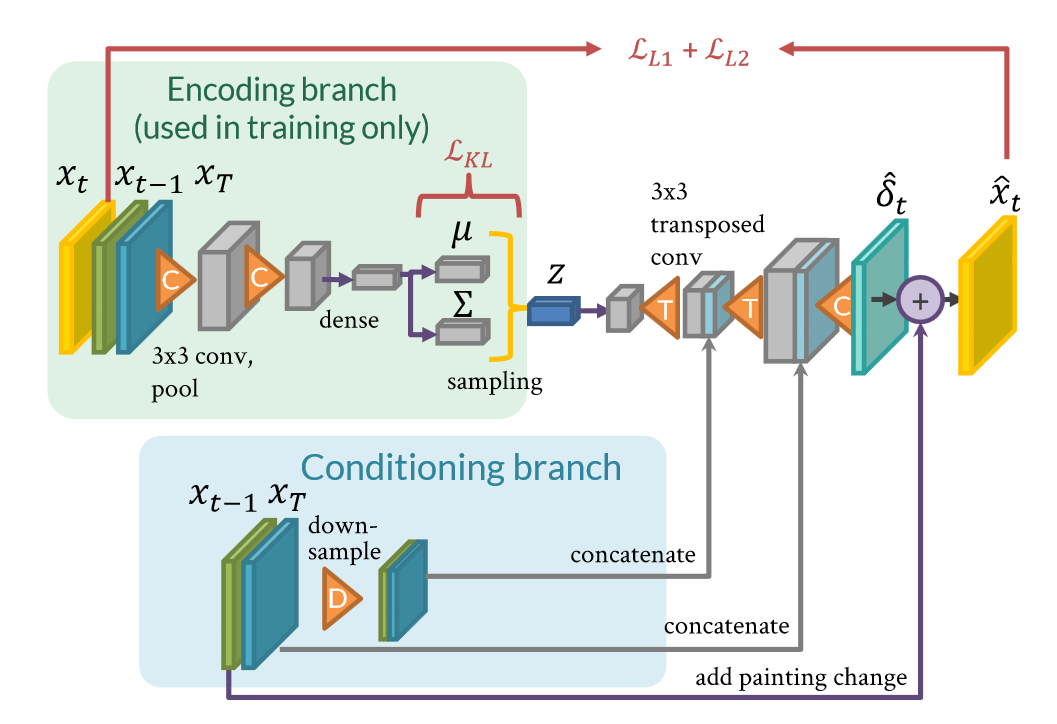
The Timecraft project by [Amy Zhao] and team members uses machine learning to figure out a way how an existing painting may have been originally been painted, stroke by stroke. In their paper titled ‘Painting Many Pasts: Synthesizing Time Lapse Videos of Paintings’, they describe how they trained a ML algorithm using existing time lapse videos of new paintings being created, allowing it to probabilistically generate the steps needed to recreate an already finished painting.

The probabilistic model is implemented using a convolutional neural network (CNN), with as output a time lapse video, spanning many minutes. In the paper they reference how they were inspired by artistic style transfer, where neural networks are used to generate works of art in a specific artist’s style, or to create mix-ups of different artists.

A lot of the complexity comes from the large variety of techniques and materials that are used in the creation of a painting, such as the exact brush used, the type of paint. Some existing approaches have focused on the the fine details here, including physics-based simulation of the paints and brush strokes. These come with significant caveats that Timecraft tried to avoid by going for a more high-level approach.

The time lapse videos that were generated during the experiment were evaluated through a survey performed via Amazon Mechanical Turk, with the 158 people who participated asked to compare the realism of the Timecraft videos versus that of the real time lapse videos. The results were that participants preferred the real videos, but would confuse the Timecraft videos for the real time lapse videos half the time.

Although perhaps not perfect yet, it does show how ML can be used to deduce how a work of art was constructed, and figure out the individual steps with some degree of accuracy.

Continue reading “Recreating Paintings By Teaching An AI To Paint”