Be Wary Of Radioactive Bracelets And Similar

Before you start cutting up that ‘negative ion’ health bracelet or personal massager, be aware that these are highly likely to contain thorium oxide or similar radioactive powder, as this research video by [Justin Atkin] (also embedded after the break) over at The Thought Emporium YouTube channel shows. Even ignoring the irony that thorium oxide is primarily an alpha (He+) emitter and thus not a ‘negative ion’ source (which would be beta decay, with e), thorium oxide isn’t something you want on your skin, or inside your lungs.

These bracelets and similar items appear to embed grains of thorium oxide into the usual silicon-polymer-based bracelet material, without any measures to prevent grains from falling out over time. More dangerous are the items such as the massage wand, which is essentially a metal tube that is filled with thorium oxide powder. This is not the kind of item you want to open on your kitchen table and have it spill everywhere.

Considering that these items are readily available for sale on Amazon, EBay and elsewhere, giving items like these a quick check with the ol’ Geiger counter before ripping them open or cutting them up for a project seems like a healthy idea. Nobody wants to cause a radiological incident in their workshop, after all.

Continue reading “Be Wary Of Radioactive Bracelets And Similar”
Gear Up Your Gear Knowledge With Gears

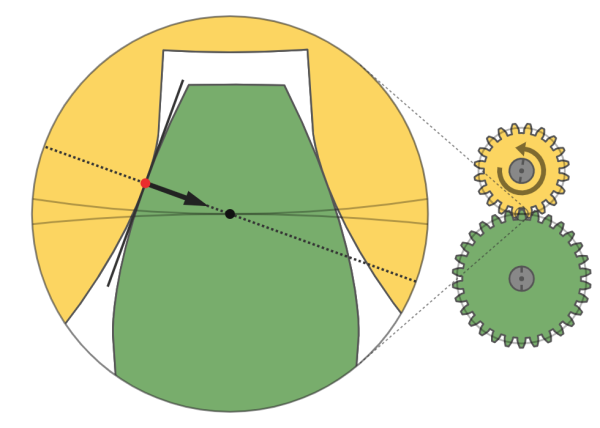
Gears are fairly straightforward way to couple rotational motion, and the physics topics required to understand them are encountered in an entry level physics classroom, not a university degree. But to really dig down to the root of how gears transfer motion may be somewhat more complex than it seems. [Bartosz Ciechanowski] put together an astonishingly good interactive teaching tool on gears, covering the fundamentals of motion up through multi-stage gear trains.

Illustrating the distance traveled at different points on the disc

The post starts at the beginning – not “how to calculate a gear ratio” – but how does rotational motion work at all. The illustrations help give the reader an intuitive sense for how the rate of rotation is measured and what that measurement actually represents in the real world. From there [Bartosz] builds up to describing how two discs touching edge to edge transfer motion and the relationship of their size on that process. After explaining torque he has the fundamentals in place to describe why gears have teeth, and why they work at all.

Well written explanatory copy aside, the real joy in this post is the interactivity. Each concept is illustrated, and each illustration is interactive. Images are accompanied by a slider which lets you adjust what’s shown, either changing the speed of a rotating gear or advancing the motion of two teeth interlocking. We found that being able to move through time this way really helped form an intuitive understanding of the concepts being discussed. This feels like the dream of interactive multimedia textbooks come to life.

DNA Now Stands For Data And Knowledge Accumulation

Technology frequently looks at nature to make improvements in efficiency, and we may be nearing a new breakthrough in copying how nature stores data. Maybe some day your thumb drive will be your actual thumb. The entire works of Shakespeare could be stored in an infinite number of monkeys. DNA could become a data storage mechanism! With all the sensationalism surrounding this frontier, it seems like a dose of reality is in order.

The Potential for Greatness

The human genome, with 3 billion base pairs can store up to 750MB of data. In reality every cell has two sets of chromosomes, so nearly every human cell has 1.5GB of data shoved inside. You could pack 165 billion cells into the volume of a microSD card, which equates to 165 exobytes, and that’s if you keep all the overhead of the rest of the cell and not just the DNA. That’s without any kind of optimizing for data storage, too.

This kind of data density is far beyond our current digital storage capabilities. Storing nearly infinite data onto extremely small cells could change everything. Beyond the volume, there’s also the promise of longevity and replication, maintaining a permanent record that can’t get lost and is easily transferred (like medical records), and even an element of subterfuge or data transportation, as well as the ability to design self-replicating machines whose purpose is to disseminate information broadly.

So, where is the state of the art in DNA data storage? There’s plenty of promise, but does it actually work?

Continue reading “DNA Now Stands For Data And Knowledge Accumulation”

Gravity-Defying Cosmetics Explained By Science!

There probably comes a point in every female technical journalist’s career at which she covers her first make-up story and wonders aloud whether this is what her life has come to. But this make-up story involves some physics, and follows a series of viral videos in the TikTok community in which specialist cosmetics vloggers were surprised to see lip gloss apparently levitating — defying gravity — from the ends of its applicators. This caught the attention of [Steve Mould], who followed up on his hunch that static electricity might be responsible. What follows in the video below the break are a variety of attempts to recreate and characterise the phenomenon.

The tried-and-trusted approach of rubbing feet on the carpet failing to cause any movement in the damp atmosphere of a British January, he’s off to try a Van de Graaff generator Even the hefty electrostatic charge from that failed to produce more than a tiny blip, but did at least give a suggestion that the effect might be electrostatic.

Finally he was able to replicate the beauty vloggers’ results using the FunFlyStick electrostatic toy, with satisfying threads of lip gloss heading off into the air. The FunFlyStick is an interesting device in its own right, being a Van de Graaff generator in toy form and capable of generating significant quantities of charge. The flying lip gloss is an interesting phenomenon, but speaks further about just how much electrostatic charge can accumulate on mundane objects in a dry climate. Those of in damper climes would do well to take note before we travel.

Continue reading “Gravity-Defying Cosmetics Explained By Science!”

Nuclear Fusion Power Without Regular Tokamaks Or Stellarators

When it comes to nuclear fusion, the most well-known reactor type today is no doubt the tokamak, due to its relatively straight-forward concept of plasma containment. That’s not to say that there aren’t other ways to accomplish nuclear fusion in a way that could conceivably be used in a commercial power plant in the near future.

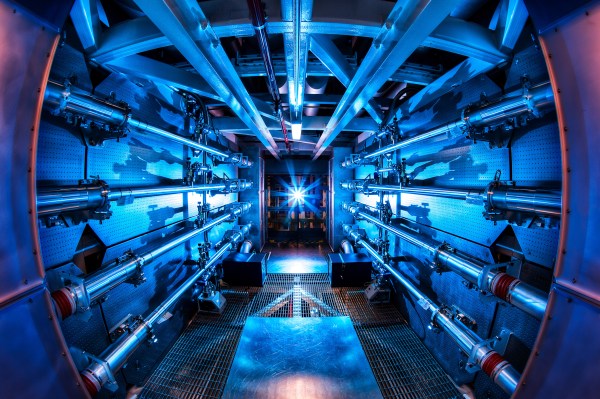
As we covered previously, another fairly well-known type of fusion reactor is the stellarator, which much like the tokamak, has been around since the 1950s. There are other reactor types from that era, like the Z-pinch, but they seem to have all fallen into obscurity. That is not to say that research on Z-pinch reactors has ceased, or that other reactor concepts — some involving massive lasers — haven’t been investigated or even built since then.

In this article we’ll take a look at a range of nuclear fusion reactor types that definitely deserve a bit more time in the limelight.

Continue reading “Nuclear Fusion Power Without Regular Tokamaks Or Stellarators”

Laser Etches Solar Absorbing Material

Having a laser cutter these days isn’t a big deal. But [Chunlei Guo], a professor at the University of Rochester, has a powerful femto-second pulse laser and used it to create what might be the perfect solar absorber. You can see a video about the work, below.

It stands to reason that white materials reflect most light and therefore absorb less energy than black materials — this is part of what makes a radiometer work. Tungsten, in particular, is a good metal for absorbing solar power, but this new laser treatment — which builds nanostructures on the surface of the metal — increases efficiency by 130% compared to untreated tungsten.

Continue reading “Laser Etches Solar Absorbing Material”

Tipping Points In The Climate System: The Worst Kind Of Positive Feedback

With global temperatures continuing to break records in recent years, it’s important to cast an eye towards the future. While efforts to reduce emissions remain in a political quagmire, time is running out to arrest the slide into catastrophe.

Further compounding the issue are a variety of positive feedback loops that promise to further compound the problem. In these cases, initial warming has flow-on effects that then serve to further increase global temperatures. Avoiding these feedback mechanisms is crucial if the Earth is to remain comfortably livable out to the end of the century.

A Multitude of Causes

The issue of climate change often appears as a simple one, with the goal being to reduce greenhouse gas emissions in order to prevent negative consequences for human civilization. Despite this, the effects of climate change are often diffuse and intermingled. The various climate systems of the Earth interact in incredibly complex ways, and there are many mechanisms at play in these feedback effects that could tip things over the edge.

Continue reading “Tipping Points In The Climate System: The Worst Kind Of Positive Feedback”