Fantastic Micrometeorites And Where To Find Them

Space is very much the final frontier for humanity, at least as far as our current understanding of the universe takes us. Only a handful of countries and corporations on Earth have the hardware to readily get there, and even fewer are capable of reaching orbit. For these reasons, working in this field can seem out of reach for many. Nevertheless, there’s plenty about the great expanse beyond our atmosphere that can be studied by the dedicated citizen scientist. With the right equipment and know-how, it’s even possible to capture and study micrometeorites yourself!

While you don’t see a meteor shower every day, micrometeorites are actually astoundingly common. They’re just hard to find!

For those new to the field, the terms used can be confusing. Meteoroids are small metallic or rocky objects found in outer space, up to around 1 meter in size. When these burn up upon entering the atmosphere, they are referred to as a meteor, or colloquially known as a shooting star. If part of the object survives long enough to hit the ground, this is referred to as a meteorite, and as you’d expect the smaller ones are called micrometeorites, being on the scale of 2mm or less.

Stardust Proves Hard To Find

Being tiny and having fallen from space, micrometeorites present certain challenges to those who wish to find and identify them. In spite of this, they can be found by using the right techniques and a heck of a lot of hard work.

Continue reading “Fantastic Micrometeorites And Where To Find Them”
Apollo’s PLSS And The Science Of Keeping Humans Alive In Space

Ever since humans came up with the bright idea to explore parts of the Earth which were significantly less hospitable to human life than the plains of Africa where humankind evolved, there’s been a constant pressure to better protect ourselves against the elements to keep our bodies comfortable. Those first tests of a new frontier required little more than a warm set of clothes. Over the course of millennia, challenging those frontiers became more and more difficult. In the modern age we set our sights on altitude and space, where a warm set of clothes won’t do much to protect you.

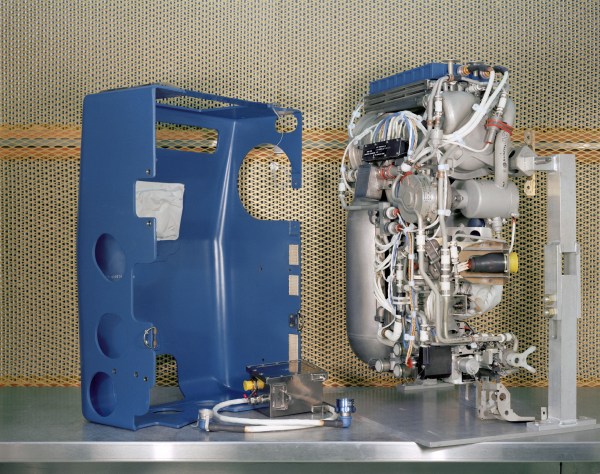
With the launch of Sputnik in 1957 and the heating up of the space race between the US and USSR, many firsts had to be accomplished with minimal time for testing and refinement. From developing 1945’s then state-of-the-art V-2 sounding rockets into something capable of launching people to the moon and beyond, to finding out what would be required to keep people alive in Earth orbit and on the Moon. Let’s take a look at what was required to make this technological marvel happen, and develop the Portable Life Support System — an essential component of those space suits that kept astronauts so comfortable they were able to crack jokes while standing on the surface of the Moon.

Continue reading “Apollo’s PLSS And The Science Of Keeping Humans Alive In Space”

The Thermochromic Display You Didn’t Know You Needed

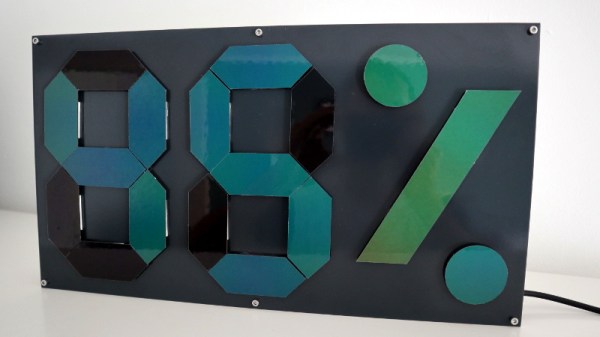
We love unique ways of displaying data here at Hackaday, and this ingenious thermochromic display created by [Moritz v. Sivers] more than fits the bill. Using sheets of color changing liquid crystals and careful temperature control of the plates they’re mounted on, he’s built a giant seven-segment display that can colorfully (albeit somewhat slowly) show the current temperature and humidity.

The sheets of temperature sensitive liquid crystals are a bit like flattened out Mood Rings; they starts out black, but as heat is applied, their color cycles through vibrant reds, greens, and blues. The sheets are perhaps best known as the sort of vaguely scientific toys you might see in a museum gift shop, but here [Moritz] has put their unique properties to practical use.

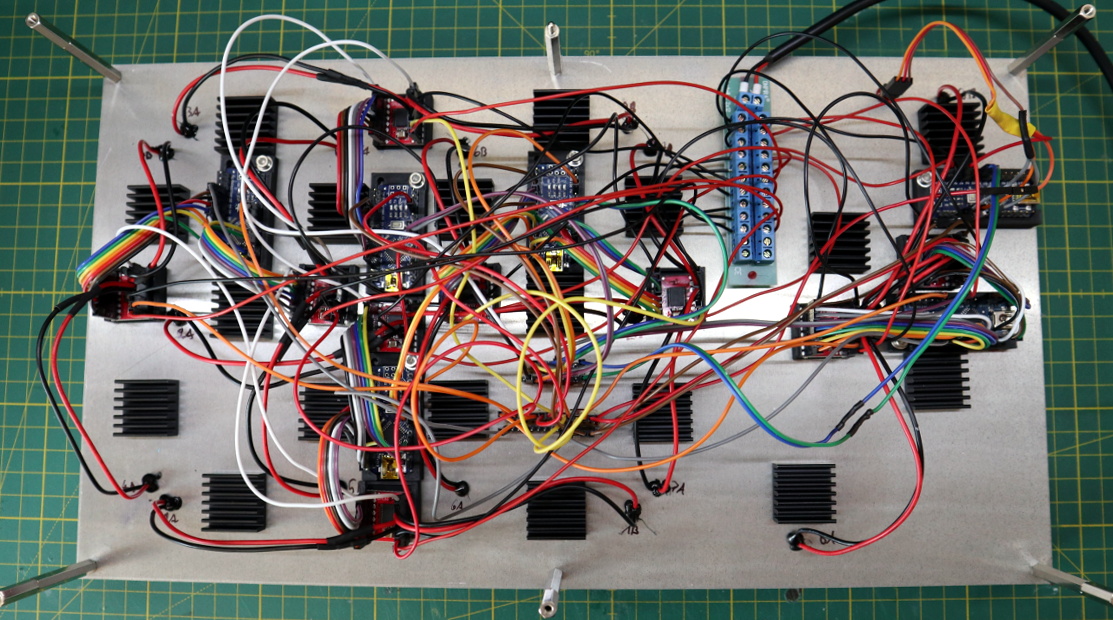
To achieve the effect, he first cut each segment out of copper. The crystal sheets were applied to the segments, thanks to their handy self-stick backing, and the excess was carefully trimmed away. Each segment was then mounted to a TES1-12704 Peltier module by way of thermally conductive epoxy. TB6612FNG motor controllers and a bevy of Arduino Nano’s are used to control the Peltier modules, raising and lowering their temperature as necessary to get the desired effect.

You can see the final result in the video after the break. It’s easily one of the most attractive variations on the classic seven-segment display we’ve ever seen. In fact, we’d go as far as to say it could pass for an art installation. The idea of a device that shows the current temperature by heating itself up certainly has a thoughtful aspect to it.

This actually isn’t the first display we’ve seen that utilized this concept, though it’s by far the largest. Back in 2014 we featured a small flexible display that used nichrome wires to “print” digits on a sheet of liquid crystals.

Continue reading “The Thermochromic Display You Didn’t Know You Needed”

Disappearing Writing With UV Laser Reveals Whitening Agents In Myriad Products

Many a budding maker has experimented with invisible inks, with a wide variety of solutions having a viable set of properties for this purpose. However, [Ben Krasnow] stumbled upon a different method entirely when tinkering with a UV laser.

The effect is subtle, but remains visible for several minutes.

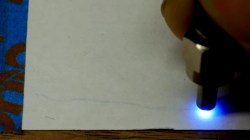
The laser in question was a MNL100 UV laser, configured to produce nanosecond-scale 20 kW pulses at up to 24 Hz, operating at wavelength of 337 nm, deep in the ultraviolet. After piping the laser light through an optical fiber and aiming it at some regular white paper, dark marks were observed, which disappear without a trace over the course of a few minutes.

Upon investigation, the dark marks seemed to be the result of fluorescent whitening agents in the paper. It appears they are overloaded or otherwise changed chemically by the laser, and slowly return back to normal over time. Further experiments showed that hydrogen peroxide was able to remove the marks instantly, and an argon atmosphere slowed the rate at which the marks faded.

It’s an interesting look at an odd chemical effect, with the benefit of a well-equipped optics lab to analyse what’s going on. Following the phenomenon down the rabbit hole leads to some tips on how to extract fluorescent additives from common laundry detergent. Be it paper, plastic, or textile, if it looks really bright white to your eye it probably contains stilbene organic compounds as optical brighteners, a hidden trait you never actually thought about before. Video after the break.

Continue reading “Disappearing Writing With UV Laser Reveals Whitening Agents In Myriad Products”

An All-Iron Battery Isn’t Light, But It’s Cheap

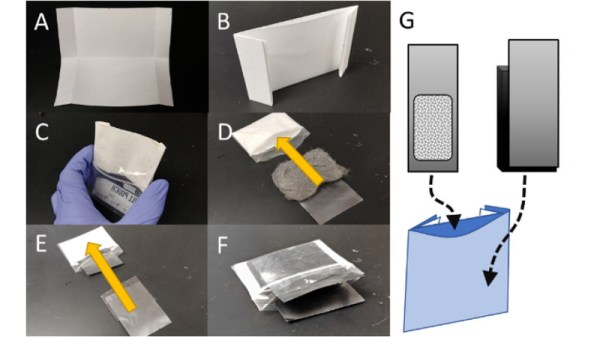
Rechargeable batteries are a technology that has been with us for well over a century, and which is undergoing a huge quantity of research into improved energy density for both mobile and alternative energy projects. But the commonly used chemistries all come with their own hazards, be they chemical contamination, fire risk, or even cost due to finite resources. A HardwareX paper from a team at the University of Idaho attempts to address some of those concerns, with an open-source rechargeable battery featuring electrode chemistry involving iron on both of its sides. This has the promise of a much cheaper construction without the poisonous heavy metal of a lead-acid cell or the expense and fire hazard of a lithium one.

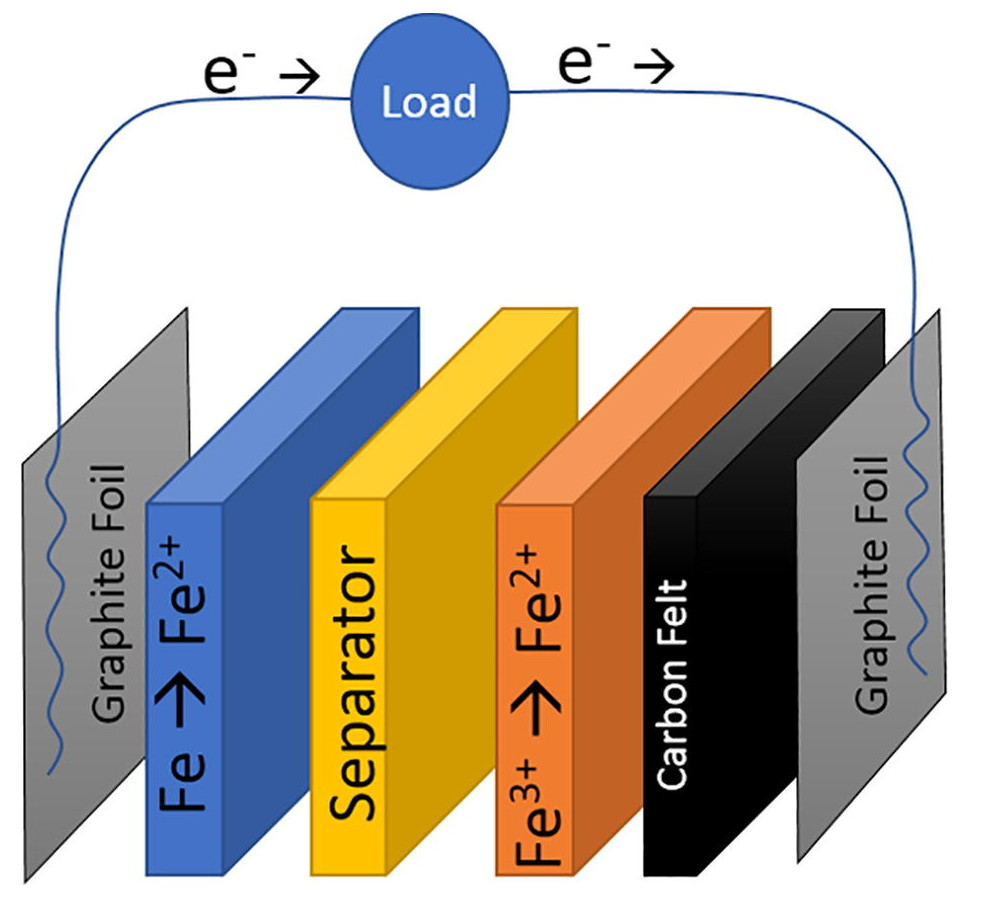
A diagram of the all-iron cell.

The chemistry of this cell is split into two by an ion-exchange membrane, iron (II) chloride is the electrolyte on the anode side where iron is oxidised to iron 2+ ions, and Iron (III) chloride on the cathode where iron is reduced to iron hydroxide. The result is a cell with a low potential of only abut 0.6V, but at a claimed material cost of only $0.10 per kWh Wh of stored energy. The cells will never compete on storage capacity or weight, but this cost makes them attractive for fixed installations.

It’s encouraging to see open-source projects coming through from HardwareX, we noted its launch back in 2016.

Thanks [Julien] for the tip.

Memristor Computing On A Chip

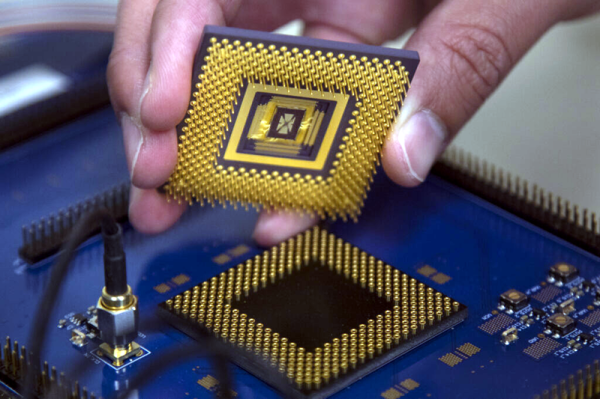
Memristors have been — so far — mostly a solution looking for a problem. However, researchers at the University of Michigan are claiming the first memristor-based programmable computer that has the potential to make AI applications more efficient and faster.

Because memristors have a memory, they can accumulate data in a way that is common for — among other things — neural networks. The chip has both an array of nearly 6,000 memristors, a crossbar array, along with analog to digital and digital to analog converters. In fact, there are 486 DACs and 162 ADCs along with an OpenRISC processor.

Continue reading “Memristor Computing On A Chip”

A PKE Meter That Actually Detects Radiation

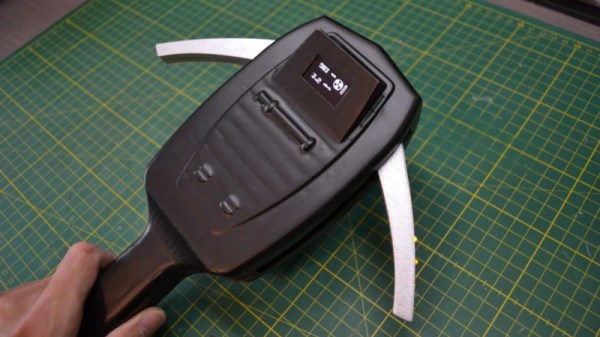
Fans of Ghostbusters will remember the PKE meter, a winged handheld device capable of detecting supernatural activity. Precious little technical data on the device remains, leaving us unable to replicate its functionality. However, the flashing, spreading wings serve as a strong visual indicator of danger, and [mosivers] decided this would be perfect for a Geiger counter build.

An SBM20 Geiger tube serves as the detection device, hooked up to an Arduino Nano. An OLED display is used to display the numerical data to the user. The enclosure and folding wings are 3D printed, and fitted with 80s-style yellow LEDs as per the original movie prop.

The device is quite intuitive in its use – if the wings flare out and the lights are flashing faster, you’re detecting an increased level of radiation. In a very real sense, it makes using a Geiger counter much more straightforward for the inexperienced or the hearing impaired. Naturally, there’s also a buzzer generating the foreboding clicks as you’d expect, too.

Geiger counters are a popular project, though we hope they don’t become common household items in the near future. Here’s a Fallout-inspired build for fans of the game. Video after the break.

Continue reading “A PKE Meter That Actually Detects Radiation”