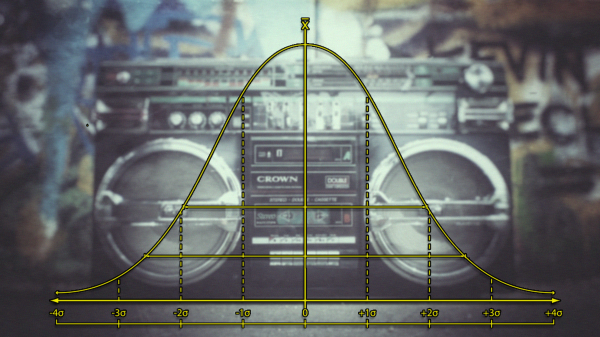
By The Numbers: Which Rapper’s Rhymes Are The Freshest?

Beats and rhymes are life in the world of hip-hop. A rapper’s ability to seamlessly merge the two is the mark of a master wordsmith. Ranking a rapper’s contributions to hip-hop will forever remain subjective, however [Matt] sought to apply a more quantitative approach to the matter. He created an interactive data set containing all the lyrics from over 150 rappers in order to determine which rapper’s vocabulary was the largest. Now everyone can know definitively which rapper’s rhymes truly are “the freshest”.

The study encompasses hip-hop artists from the last thirty years, pitting recent hit-makers like Lil Uzi Vert against veteran artists like KRS-One. To ensure everything is on even playing field [Matt] limited the study to the first 35,000 lyrics of each artist including any material on a mixtape, EP, or full album release. Rappers’ vocabulary was then plotted according to the total number of unique words found in their lyrics (i.e.: “shorty” and the alternative spelling “shawty” were each considered to be unique words). Oddly enough, there were some notable exclusions from the list as artists like Chance the Rapper, Queen Latifah, and The Notorious B.I.G’s discography did not exceed the 35,000 lyrics mark.

When digging into the data, there was a downward trend in the vocabulary used amongst popular artists of the last decade. [Matt] attributed this trend to the fact that many of these artists have modeled their music to reflect the pop/rock music structure that makes use of simple, repetitive choruses. While others may attribute this downward trend to a general lack of talent when it comes to lyricism, however, it should be noted that the economics of music streaming platforms have had an effect on the average song length. Though whatever era of hip-hop you subscribe to, it is always interesting to see where your favorite emcees rank.

 

Transparent And Flexible Circuits

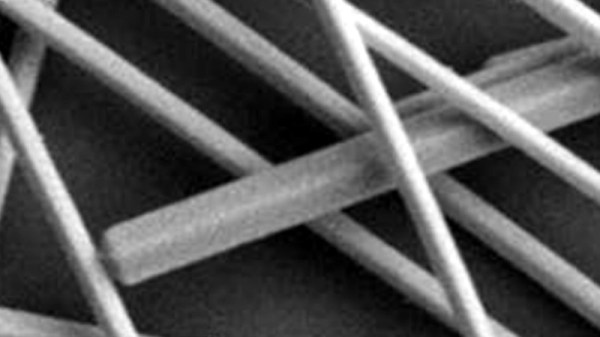
German researchers have a line on 3D printed circuitry, but with a twist. Using silver nanowires and a polymer, they’ve created flexible and transparent circuits. Nanowires in this context are only 20 nanometers long and only a few nanometers thick. The research hopes to print things like LEDs and solar cells.

Of course, nothing is perfect. The material has a sheet resistance as low as 13Ω/sq and the optical transmission was as high as 90%. That sounds good until you remember the sheet resistance of copper foil on a PCB is about 0.0005Ω.

Continue reading “Transparent And Flexible Circuits”

Deflecting Earthquakes The Way Ancient Romans Did It

A recent French study indicates that the ancient Romans may have figured out how to deal with earthquakes by simply deflecting the energy of the waves using structures that resemble metamaterials. These are materials which can manipulate waves (electromagnetic or otherwise) in ways which are normally deemed impossible, such as guiding light around an object using a special pattern.

In a 2012 study, the same researchers found that a pattern of 5 meter deep bore holes in the ground was effective at deflecting a significant part of artificially generated acoustic waves. One of the researchers, [Stéphane Brûlé], noticed on an aerial photograph of a Gallo-Roman theater near the town of Autun in central France that its pattern of pillars bore an uncanny resemblance to this earlier experiment: a series of concentric (semi) circles with the distance between the pillars (or holes) decreasing nearer the center.

Further research using archaeological data of this theater site confirmed that it did appear to match up the expected pattern if one would have aimed to design a structure that could successfully deflect the acoustic energy from an earthquake. This raises the interesting question of whether this was a deliberate design choice, or just coincidence.

Additional research on the Colosseum in Rome and various other amphitheaters did however turn up the same pattern, which makes it seem like a deliberate choice by the Roman builders over a long period of time. With this pattern apparently capable of protecting a structure from the destructive effects of the acoustic waves generated by an earthquake, the remaining question is whether they discovered this pattern over time by observing damage to buildings and decided to implement it in new buildings.

Although we’ll likely never get an answer to that question, this discovery can however lead to improvements to individual buildings today, as well as entire cities, that may protect them against earthquakes and save countless lives that way.

The Amazing New World Of Gallium Nitride

From the heart of Silicon Valley comes a new buzzword. Gallium nitride is the future of power technology. Tech blogs are touting gallium nitride as the silicon of the future, and you are savvy enough to get in on the ground floor. Knowing how important gallium nitride is makes you a smarter, better consumer. You are at the forefront of your peer group because you know of an up and coming technology, and this one goes by the name of gallium nitride.

OK, gallium nitride is more than just a buzzword. It is, indeed, important materials science. Gallium nitride is a semiconductor that allows for smaller electronics, more powerful electric cars, better solar cells, and is the foundation of all LED lighting solutions today. Time will tell, but it may well mark a revolution in semiconductors. Here’s what you need to know about it now.

Continue reading “The Amazing New World Of Gallium Nitride”

Hacking The Ionosphere, For Science

Imagine what it must have been like for the first human to witness an aurora. It took a while for our species to migrate from its equatorial birthplace to latitudes where auroras are common, so it was a fairly recent event geologically speaking. Still, that first time seeing the shimmers and ribbons playing across a sky yet to be marred by light pollution must have been terrifying and thrilling, and like other displays of nature’s power, it probably fueled stories of gods and demons. The myths and legends born from ignorance of what an aurora actually represents seem quaint to most of us, but it was as good a model as our ancestors needed to explain the world around them.

Our understanding of auroras needs to be a lot deeper, though, because we now know that they are not only a beautiful atmospheric phenomenon but also a critical component in the colossal electromagnetic system formed by our planet and our star. Understanding how it works is key to everything from long-distance communication to keeping satellites in orbit to long-term weather predictions.

But how exactly does one study an aurora? Something that’s so out of reach and so evanescent seems like it would be hard to study. While it’s not exactly easy science to do, it is possible to directly study auroras, and it involves some interesting technology that actually changes them, somehow making the nocturnal light show even more beautiful.

Continue reading “Hacking The Ionosphere, For Science”

Dark Absorbing Diodes Are No DAD Joke

We will confess that the authors of the Applied Physics Letters article “Experimental Demonstration of Energy Harvesting from the Sky using the Negative Illumination Effect of a Semiconductor Photodiode” never used the acronym DAD or the phrase “dark absorbing diode.” But we thought it was too good to pass up. The research work uses a type of diode to generate small amounts of power from darkness. Admittedly, the amount of power is small, but it is still an important result and could result in — another coined phrase — negative solar cells providing energy by taking advantage of the temperature differential between the cell and the night sky.

In theory — and with no atmosphere — the technique could only result in about 4 watts per square meter. Not only is this low compared to a solar panel’s 100 to 200 watts per square meter, but it is also far from the prototype’s 64 nanowatts per square meter. Clearly, this technology has a ways to go to become practical.

Continue reading “Dark Absorbing Diodes Are No DAD Joke”

Swiss Cheese Metamaterial Is An Analog Computer

If you have had trouble with ordinary calculus, you may not be pleased to hear about “photonic calculus” — a recent idea from [Nader Engheta] of the University of Pennsylvania. The idea is that materials with certain properties could manipulate an electromagnetic wave in a way to solve a specific mathematical equation. [Engheta] proposed this idea back in 2014 and recently announced that he and his team have a demonstration device that proves the concept. The analog computer is about twice the size of an airplane’s tray table and made of CNC-shaped polystyrene. It solves Fredholm integral equations of the second kind.

The analog computer uses microwaves for the input and the polystyrene acts as a dielectric full of air holes. The team likens its structure to that of Swiss cheese. The shape is generated through an inverse design process which builds the shapes from known solutions to the equations. That means a particular set of shapes will do one specific equation. The equation could, for example, model the sound volume in a concert hall. You can encode certain parameters in the input wave and the output would specify the volume at different locations. However, a change to the actual equation would require a new set of plastic pieces.

The computation is very fast. Using microwaves, the answer comes out in a few hundred nanoseconds — a speed a conventional computer could not readily match. The team hopes to scale the system to use light which will speed the computation into the picosecond range. Creating a new optical analog computer could be similar to how we burn a CD or DVD today.

Analog computers predate digital ones by a lot. We really want to build one like [Bill Schweber’s]. Then again, we wouldn’t mind finding a Donner 3500 at a hamfest, either.