Our bodies are not like LEGO blocks or computers because we cannot swap out our parts in the living room while watching television. Organ transplants and cosmetic surgery are currently our options for upgrades, repairs, and augments, but post-transplant therapy can be a lifelong commitment because of rejection. Elective surgery costs more than a NIB Millenium Falcon LEGO set. Laboratories have been improving the processes and associated treatments for decades but experimental labs and even home laboratories are getting in on the action as some creative minds take the stage. These folks aren’t performing surgeries, but they are expanding what is possible to for people to do and learn without a medical license.
One promising gateway to human building blocks is the decellularization and recellularization of organic material. Commercial scaffolds exist but they are expensive, so the average tinkerer isn’t going to be buying a few to play with over a holiday weekend.
Let’s explore what all this means. When something is decellularized, it means that the cells are removed, but the structure holding the cells in place remains. Recellularizing is the process where new cells are grown in that area. Decellularizing is like stripping a Hilton hotel down to the girders. The remaining structures are the ECM or the Extra Cellular Matrix, usually referred to as scaffolding. The structure has a shape but no functionality, like a stripped hotel. The scaffolding can be repopulated with new cells in the same way that our gutted hotel can be rebuilt as a factory, office building, or a hospital.
Émilie du Châtelet lived a wild, wild life. She was a brilliant polymath who made important contributions to the Enlightenment, including adding a mathematical statement of conservation of energy into her French translation of Newton’s Principia, debunking the phlogiston theory of fire, and suggesting that what we would call infrared light carried heat.
She had good company; she was Voltaire’s lover and companion for fifteen years, and she built a private research institution out of a château with him before falling in love with a younger poet. She was tutored in math by Maupertuis and corresponded with Bernoulli and Euler. She was an avid gambler and handy with a sword. She died early, at 41 years, but those years that she did live were pretty amazing. Continue reading “Émilie Du Châtelet: An Energetic Life”→
It’s easy to dismiss decades old electronics as effectively e-waste. With the rapid advancements and plummeting prices of modern technology, most old hardware is little more than a historical curiosity at this point. For example, why would anyone purchase something as esoteric as 1980-era video production equipment in 2018? A cheap burner phone could take better images, and if you’re looking to get video in your projects you’d be better off getting a webcam or a Raspberry Pi camera module.
But occasionally the old ways of doing things offer possibilities that modern methods don’t. This fascinating white paper from [David Prutchi] describes in intricate detail how a 1982 JVC KY-1900 professional video camera purchased for $50 on eBay was turned into a polarimetric imager. The end result isn’t perfect, but considering such a device would normally carry a ~$20,000 price tag, it’s good enough that anyone looking to explore the concept of polarized video should probably get ready to open eBay in a new tab.
Likely many readers are not familiar with polarimetric imagers, it’s not exactly the kind of thing they carry at Best Buy. Put simply, it’s a device that allows the user to visualize the polarization of light in a given scene. [David] is interested in the technology as, among other things, it can be used to detect man-made materials against a natural backdrop; offering a potential method for detecting mines and other hidden explosives. He presented a fascinating talk on the subject at the 2015 Hackaday SuperConference, and DOLpi, his attempt at building a low-cost polarimetric imager with the Raspberry Pi, got him a fifth place win in that year’s Hackaday Prize.
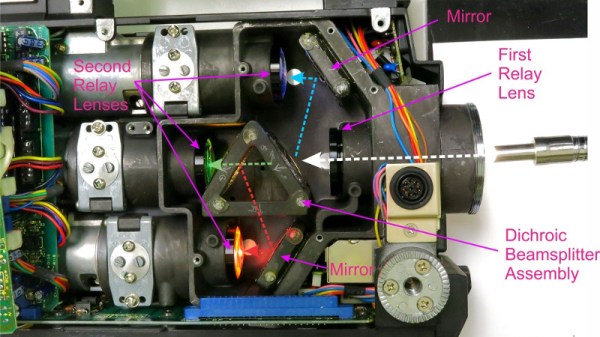
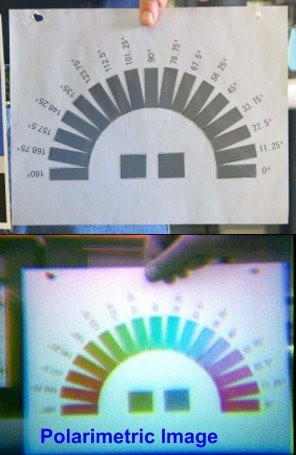
While he got good results with his Raspberry Pi solution, it took several seconds to generate a single frame of the image. To be practical, it needed to be much faster. [David] found his solution in an unlikely place, the design of 1980’s portable video cameras. These cameras made use of a dichroic beamsplitter to separate incoming light into red, blue, and green images; and in turn, each color image was fed into a dedicated sensor by way of mirrors. By replacing the beamsplitter assembly with a new 3D printed version that integrates polarization filters, each sensor now receives an image that corresponds to 0, 45, and 90 degrees polarization.
With the modification complete, the camera now generates real-time video that shows the angle of polarization as false color. [David] notes that the color reproduction and resolution is quite poor due to the nature of 30+ year old video technology, but that overall it’s a fair trade-off for running at 30 frames per second.
If you are an astronomer with an optical reflecting telescope, the quality of your mirror is one of your most significant concerns. Large observatories will therefore often have on-site vapour deposition plants to revitalise their reflectors by depositing a fresh layer of aluminium upon them. You might think that such a device would be the preserve only of such well-funded sites, but perhaps [Michael Koch]’s work will prove you wrong. He’s created his own vapour deposition system (Google Translate link of the German original) from scratch, and while it might be smaller than the institutional equivalents it is no less effective in its task.
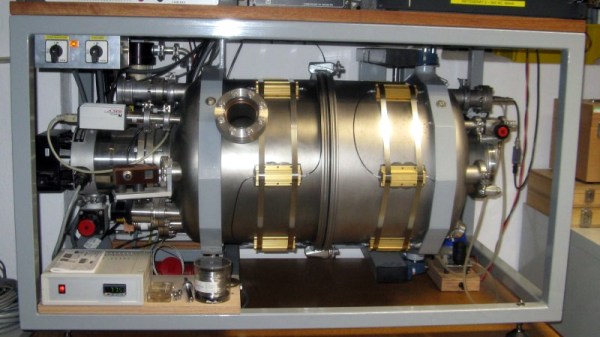
At the heart of it is a stainless steel vacuum vessel with a two stage vacuum pump system to evacuate it. The mirror to be silvered is suspended in the vessel, and a piece of aluminium is suspended over a coil of tungsten wire that his electrically heated to melt it. The molten aluminium is described as “wetting” the tungsten wire in the same manner as we’ll be used to solder working on copper, but in the vacuum it vaporizes and deposits itself upon the mirror. Such a simple description glosses over the impressive work that went into it.
This is a long-running project that isn’t entirely new, but very much worth a look if only for its introduction to this fascinating field. If you are new to vacuum work, how about looking at a Superconference presentation introducing vacuum technology?
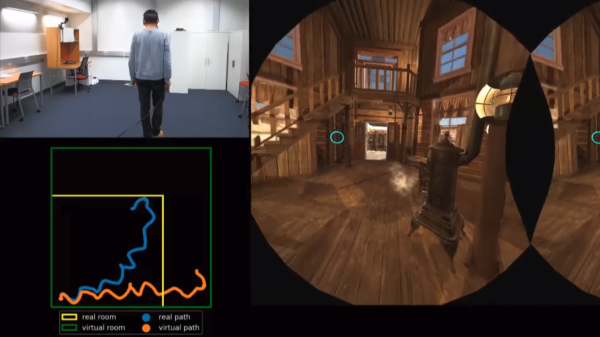
[Anjul Patney] and [Qi Sun] demonstrated a fascinating new technique at NVIDIA’s GPU Technology Conference (GTC) for tricking a human into thinking a VR space is larger than it actually is. The way it works is this: when a person walks around in VR, they invariably make turns. During these turns, it’s possible to fool the person into thinking they have pivoted more or less than they have actually physically turned. With a way to manipulate perception of turns comes a way for software to gently manipulate a person’s perception of how large a virtual space is. Unlike other methods that rely on visual distortions, this method is undetectable by the viewer.
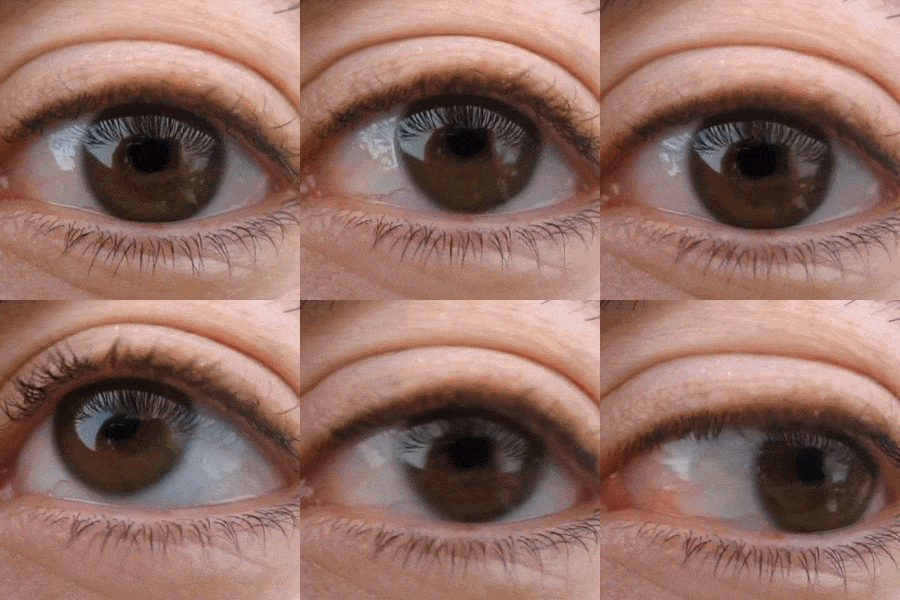
Saccadic movements
The software essentially exploits a quirk of how our eyes work. When a human’s eyes move around to look at different things, the eyeballs don’t physically glide smoothly from point to point. The eyes make frequent but unpredictable darting movements called saccades. There are a number of deeply interesting things about saccades, but the important one here is the fact that our eyes essentially go offline during saccadic movement. Our vision is perceived as a smooth and unbroken stream, but that’s a result of the brain stitching visual information into a cohesive whole, and filling in blanks without us being aware of it.
Part one of [Anjul] and [Qi]’s method is to manipulate perception of a virtual area relative to actual physical area by making a person’s pivots not a 1:1 match. In VR, it may appear one has turned more or less than one has in the real world, and in this way the software can guide the physical motion while making it appear in VR as though nothing is amiss. But by itself, this isn’t enough. To make the mismatches imperceptible, the system watches the eye for saccades and times its adjustments to occur only while they are underway. The brain ignores what happens during saccadic movement, stitches together the rest, and there you have it: a method to gently steer a human being in a way that a virtual space is larger than the physical area available.
Embedded below is a video demonstration and overview, which mentions other methods of manipulating perception of space in VR and how it avoids the pitfalls of other methods.
The semiconductor devices were put to the test under different atmospheres in this chamber.
One of the humbling things about writing for Hackaday comes when we encounter our readership and learn the breadth of our community and the huge variety of skills and professions you represent. Among your number are a significant representation among scientists, and as a result we often receive fascinating previews of and insights into their work. Sometimes they deserve a little bit more attention than one of our normal short daily pieces, and such a moment has come our way this week.
We’ve been fortunate enough to have an early look at a paper which makes detailed observations of a hitherto barely characterised property of semiconductor junctions that might have some interest for Hackaday readers in their work. In their paper, [Mellie], [Bacon] et al at Fulchester University in northeast England take a look at incandescent luminescence, a fleeting and curious effect exhibited by all semiconductor junctions in which they emit short-duration high-intensity infra-red and visible light with an extremely fast rise time when presented with high levels of current. This is a property which has been rarely exploited in commercial devices due to the large current densities required to reproduce it.
Incandescent Luminescence Explained
If you’ve never heard of incandescent luminescence before then you’re in good company, for neither had we until it was explained to us. It appears that there are a set of higher energy state conductivity bands in a semiconductor junction that can only be reached once the current passing through it breaches a threshold governed by the available quantum plasma dipole moment of the semiconductor material in question. At this point the junction assumes a plasma condition resulting in the abrupt emission of infra-red and visible radiation, the incandescent luminescence phase has been triggered.
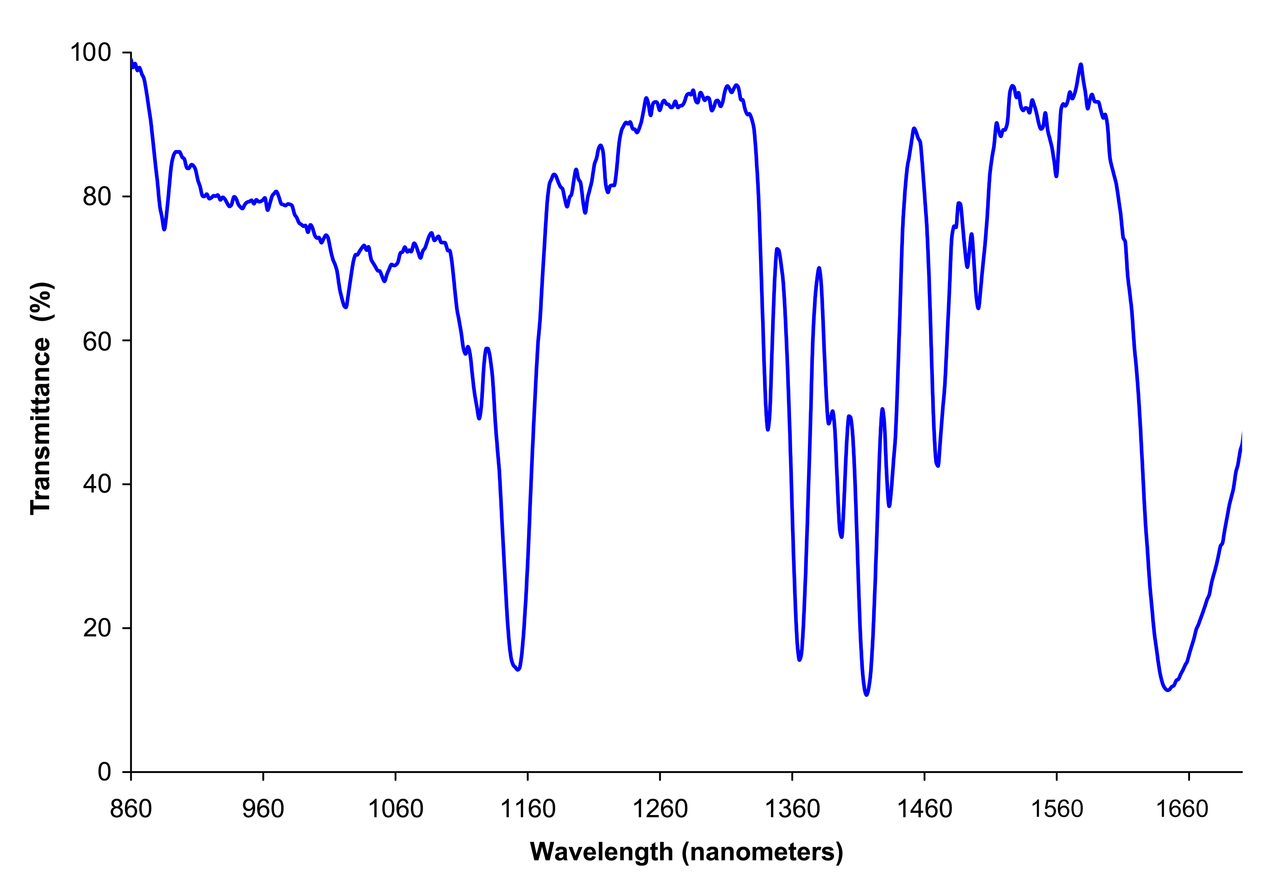
A near-infra-red spectrum of incandescent luminescence in a silicon semiconductor junction.
Though it has been known to science since first being observed in the early 20th century by the earliest experimenters in the field of semiconductor junctions, the transitory nature of the phenomenon has traditionally been a barrier to its proper examination. The British team took a selection of commercial semiconductor devices very similar to the types that might be used by Hackaday readers, placed them in a chamber, and used an array of photoelectric sensors coupled with ionising detectors using americium-241 alpha radiation sources to measure their emissions.
The resulting data was then harvested for processing through a stack of custom high-speed ADC cards. Current densities from as low as a few milliamps to hundreds of amps were tested across forward-biased PN diode junctions using a computer-controlled DC power supply, resulting in a variety of spectra and showing the resulting thermionic photon emission at higher currents to have a preponderance in the infra-red region.
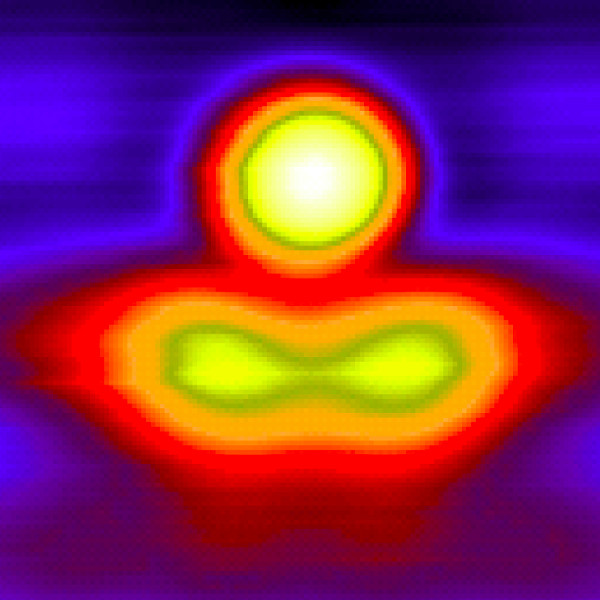
Incandescent luminescence in action, through an infra-red pyrometer.
A series of experiments were conducted to investigate a related effect first described by those early scientists in the field: that the atmosphere in which the semiconductor junction sits has a significant effect on the way it exhibits incandescent luminescence. Bathing it in gaseous CO₂ or nitrogen was found to reduce the phenomenon by as much as 95%, while immersing it in liquid nitrogen resulted in it becoming completely unobservable. Oxygen-rich atmospheres by comparison served to enhance the luminescence observed, to the point that in one of pure oxygen it reached an efficiency level of 100%.
The high conversion efficiencies and rapid onset of incandescent luminescence once it has been triggered compares favourably to those of existing devices such as LEDs or wire-wound resistors used where either infra-red or visible light is required. The researchers expect the effect to be exploited in such product families as photographic flash generators, electronic igniters, and other short-duration high-intensity applications. Given their obvious advantages, we’d expect their effects on those particular markets to be nothing short of incendiary.
Thanks Ellie D. Martin-Eberhardt for some invaluable inspiration and technical help with covering this story.
Kagome is a pattern used to weave baskets from bamboo strips. The pattern is a symmetrical pattern of interlaced triangles that share corners. Scientists from MIT, Harvard, and Lawrence Berkeley National Laboratory have produced a kagome metal and found that it has exotic quantum properties.
Their paper, published in Nature (paywall), reports that the crystal made from layers of iron and tin atoms, causes electrons to flow in strange ways. The electrons bend into tight circular paths and flow along the edges without losing energy.