Lightning Generator From Electric Lighter

Generating high voltages isn’t too hard. A decent transformer will easily get you into the 100s of kilovolts, provided you’re a power company and have access to millions of dollars and a substation to put it. If you want to go above that then things start getting difficult, and most tend to look in other places for high voltages such as voltage multipliers.

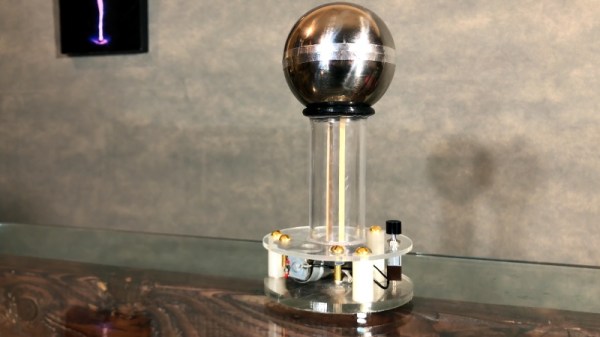
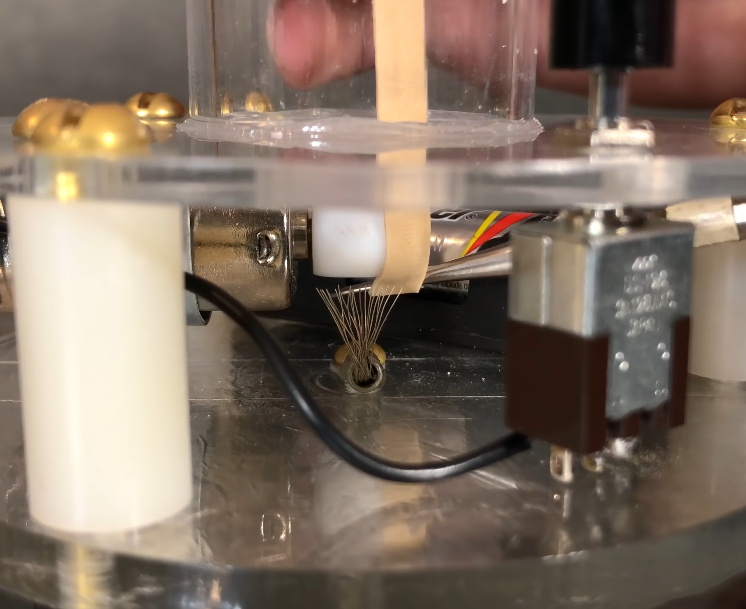
These devices use nothing but capacitors and diodes, as [Jay] from [Plasma Channel] shows us how to build a small desktop version of a voltage multiplier that can produce almost 70 kV. That’s enough to throw a substantial spark, powered by nothing but a rechargable battery found in an electric lighter. They can also be cheaper than transformers to a point, since they require less insulation and less copper and iron. The voltage multiplier works in stages, with each stage boosting the voltage to a critical level above the stage before it similar to a Marx generator.

Similar designs are used by laboratories to simulate lightning strikes, and can generate millions of volts. They’re a cost-effective way of generating huge voltage pulses and studying everything from the effects of lightning on various equipment to generating X-rays in fusion power tests. We’ve even seen them in use in lasers.

Continue reading “Lightning Generator From Electric Lighter”

360 Live VR Teleportation Uses Drones, Neural Networks, And Perseverance

This past semester I added research to my already full schedule of math and engineering classes, as any masochistic student eagerly would. Packed schedule aside, how do you pass up the chance to work on implementing 360° virtual teleportation to anywhere in the world, in real-time. Yes, it is indeed the same concept as the cult worshipped Star Trek transporter, minus the ability to physically be at the location. Perhaps we can add a, “beam me up, Scotty” command when shutting down.

The research lab I was working with is the Laboratory for Immersive CommunicatiON (LION). It’s funded by NSF, Microsoft, and Adobe and has been on the pursuit of VR teleportation for some time now.  There’s a lot of cool technologies at work here, like drones which are used as location collection devices. A network of drones will survey landscape anywhere in the world and build the collection assets needed for recreating it in VR. Okay, so a swarm of drones might seem a little intimidating at first, but when has emerging technology not?

Continue reading “360 Live VR Teleportation Uses Drones, Neural Networks, And Perseverance”

Pimp My Scope

Most of us have heard some form of the adage, “You can buy cheaper, but you’ll never pay less.” It means that cheaper products ultimately do not stand up to the needs of their superior counterparts. Hackers love to prove this aphorism wrong by applying inexpensive upgrades to inexpensive tools to fill up a feature-rich tool bag. Take [The Thought Emporium] who has upgraded an entry-level microscope into one capable of polarized and dark-field microscopy. You can also see the video after the break.

Functionally, polarized images can reveal hidden features of things like striations in crystals or stress lines in hot glue threads. Dark-field microscopy is like replacing the normally glaring white background with a black background, and we here at Hackaday approve of that décor choice. Polarizing filters sheets are not expensive and installation can be quick, depending on your scope. Adding a dark-field filter could cost as much as a dime.

Like most mods, the greatest investment will be your time. That investment will pay back immediately by familiarizing you with your tools and their workings. In the long-run, you will have a tool with greater power.

Simple mods like the light source can be valuable, but upgrades are not limited to optical scopes, an electron microscope was brought back to life with Arduino

Continue reading “Pimp My Scope”

Decellularization: Apples To Earlobes

Our bodies are not like LEGO blocks or computers because we cannot swap out our parts in the living room while watching television. Organ transplants and cosmetic surgery are currently our options for upgrades, repairs, and augments, but post-transplant therapy can be a lifelong commitment because of rejection. Elective surgery costs more than a NIB Millenium Falcon LEGO set. Laboratories have been improving the processes and associated treatments for decades but experimental labs and even home laboratories are getting in on the action as some creative minds take the stage. These folks aren’t performing surgeries, but they are expanding what is possible to for people to do and learn without a medical license.

One promising gateway to human building blocks is the decellularization and recellularization of organic material. Commercial scaffolds exist but they are expensive, so the average tinkerer isn’t going to be buying a few to play with over a holiday weekend.

Let’s explore what all this means. When something is decellularized, it means that the cells are removed, but the structure holding the cells in place remains. Recellularizing is the process where new cells are grown in that area. Decellularizing is like stripping a Hilton hotel down to the girders. The remaining structures are the ECM or the Extra Cellular Matrix, usually referred to as scaffolding. The structure has a shape but no functionality, like a stripped hotel. The scaffolding can be repopulated with new cells in the same way that our gutted hotel can be rebuilt as a factory, office building, or a hospital.

Continue reading “Decellularization: Apples To Earlobes”

Émilie Du Châtelet: An Energetic Life

Émilie du Châtelet lived a wild, wild life. She was a brilliant polymath who made important contributions to the Enlightenment, including adding a mathematical statement of conservation of energy into her French translation of Newton’s Principia, debunking the phlogiston theory of fire, and suggesting that what we would call infrared light carried heat.

She had good company; she was Voltaire’s lover and companion for fifteen years, and she built a private research institution out of a château with him before falling in love with a younger poet. She was tutored in math by Maupertuis and corresponded with Bernoulli and Euler. She was an avid gambler and handy with a sword. She died early, at 41 years, but those years that she did live were pretty amazing. Continue reading “Émilie Du Châtelet: An Energetic Life”

Real-Time Polarimetric Imager From 1980s Tech

It’s easy to dismiss decades old electronics as effectively e-waste. With the rapid advancements and plummeting prices of modern technology, most old hardware is little more than a historical curiosity at this point. For example, why would anyone purchase something as esoteric as 1980-era video production equipment in 2018? A cheap burner phone could take better images, and if you’re looking to get video in your projects you’d be better off getting a webcam or a Raspberry Pi camera module.

But occasionally the old ways of doing things offer possibilities that modern methods don’t. This fascinating white paper from [David Prutchi] describes in intricate detail how a 1982 JVC KY-1900 professional video camera purchased for $50 on eBay was turned into a polarimetric imager. The end result isn’t perfect, but considering such a device would normally carry a ~$20,000 price tag, it’s good enough that anyone looking to explore the concept of polarized video should probably get ready to open eBay in a new tab.

Likely many readers are not familiar with polarimetric imagers, it’s not exactly the kind of thing they carry at Best Buy. Put simply, it’s a device that allows the user to visualize the polarization of light in a given scene. [David] is interested in the technology as, among other things, it can be used to detect man-made materials against a natural backdrop; offering a potential method for detecting mines and other hidden explosives. He presented a fascinating talk on the subject at the 2015 Hackaday SuperConference, and DOLpi, his attempt at building a low-cost polarimetric imager with the Raspberry Pi, got him a fifth place win in that year’s Hackaday Prize.

While he got good results with his Raspberry Pi solution, it took several seconds to generate a single frame of the image. To be practical, it needed to be much faster. [David] found his solution in an unlikely place, the design of 1980’s portable video cameras. These cameras made use of a dichroic beamsplitter to separate incoming light into red, blue, and green images; and in turn, each color image was fed into a dedicated sensor by way of mirrors. By replacing the beamsplitter assembly with a new 3D printed version that integrates polarization filters, each sensor now receives an image that corresponds to 0, 45, and 90 degrees polarization.

With the modification complete, the camera now generates real-time video that shows the angle of polarization as false color. [David] notes that the color reproduction and resolution is quite poor due to the nature of 30+ year old video technology, but that overall it’s a fair trade-off for running at 30 frames per second.

In another recent project, [David] found a way to hack optics onto a consumer-level thermal imaging camera. It’s becoming abundantly clear that he’s not a big fan of leaving hardware in an unmodified state.

This Vapour Deposition Chamber Isn’t Vapourware

If you are an astronomer with an optical reflecting telescope, the quality of your mirror is one of your most significant concerns. Large observatories will therefore often have on-site vapour deposition plants to revitalise their reflectors by depositing a fresh layer of aluminium upon them. You might think that such a device would be the preserve only of such well-funded sites, but perhaps [Michael Koch]’s work will prove you wrong. He’s created his own vapour deposition system (Google Translate link of the German original) from scratch, and while it might be smaller than the institutional equivalents it is no less effective in its task.

At the heart of it is a stainless steel vacuum vessel with a two stage vacuum pump system to evacuate it. The mirror to be silvered is suspended in the vessel, and a piece of aluminium is suspended over a coil of tungsten wire that his electrically heated to melt it. The molten aluminium is described as “wetting” the tungsten wire in the same manner as we’ll be used to solder working on copper, but in the vacuum it vaporizes and deposits itself upon the mirror. Such a simple description glosses over the impressive work that went into it.

This is a long-running project that isn’t entirely new, but very much worth a look if only for its introduction to this fascinating field. If you are new to vacuum work, how about looking at a Superconference presentation introducing vacuum technology?

Thanks [Paul Bauer] for the tip.