Two guys — Stern and Gerlach — did an experiment in 1922. They wanted to measure magnetism caused by electron orbits. At the time, they didn’t know about particles having angular momentum due to spin. So — as explained by [The Science Asylum] in the video below — they clearly showed quantum spin, they just didn’t know it and Physics didn’t catch on for many years.
The experiment was fairly simple. They heated a piece of silver foil to cause atoms to stream out through a tiny pinhole. The choice of silver was because it was a simple material that had a single electron in its outer shell. An external magnet then pulls silver atoms into a different position before it hits some film and that position depends on its magnetic field.
In our high school chemistry classes we all learn about chirality, the property of organic molecules in which two chemically identical molecules can have different structures that are mirror images of each other. This can lead to their exhibiting different properties, and one aspect of chirality is causing significant concerns in the field of synthetic biology. The prospect of so-called mirror organisms is leading to calls from a group of prominent scientists for research in the field to be curtailed due to the risks they would present.
Chirality is baked into all life; our DNA is formed of right-handed molecules while our proteins are left handed. The “mirror” organisms would reverse either or both of these, and could in theory be used to improve biochemical production processes. The concern is that these organisms would evade both the immune systems of all natural life forms, and any human defences such as antibiotics, thus posing an existential risk to life. It’s estimated that the capacity to produce such a life form lies more than a decade away, and the scientists wish to forestall that by starting the conversation early. They are calling for a halt to research likely to result in these organisms, and a commitment from funding bodies not to support such research.
Warnings of the dangers from scientific advances are as old as science itself, and it’s safe to say that many such prophecies have come from dubious sources and proved not to have a basis in fact. But this one, given the body of opinion behind it, is perhaps one that should be heeded.
Header: Original: Unknown Vector: — πϵρήλιο, Public domain.
We haven’t seen [Les Wright] in a while, and with the release of his new video, we know why — he’s been busy growing crystals.
Now, that might seem confusing to anyone who has done the classic “Crystal Garden” trick with table salt and laundry bluing, or tried to get a bit of rock candy out of a supersaturated sugar solution. Sure, growing crystals takes time, but it’s not exactly hard work. But [Les] isn’t in the market for any old crystals. Rather, he needs super-sized, optically clear crystals of potassium dihydrogen phosphate, or KDP, which are useful as frequency doublers for lasers. [Les] has detailed his need for KDP crystals before and even grown some nice ones, but he wanted to step up his game and grow some real whoppers.
And boy, did he ever. Fair warning; the video below is long and has a lot of detail on crystal-growing theory, but it’s well worth it for anyone taking the plunge. [Les] ended up building an automated crystal lab, housing it in an old server enclosure for temperature and dust control. The crystals are grown on a custom-built armature that slowly rotates in a supersaturated solution of KDP which is carefully transitioned through a specific temperature profile under Arduino control. As a bonus, he programmed the rig to take photographs of the growing crystals at intervals; the resulting time-lapse sequences are as gorgeous as the crystals, one of which grew to 40 grams in only a week.
We’re keen to see how [Les] puts these crystals to work, and to learn exactly what a “Pockels Cell” is and why you’d want one. In the meantime, if you’re interested in how the crystals that make the whole world work are made, check out our deep dive into silicon.
Since the construction of the first commercial light water nuclear power plants (LWR) the design of their fuel rods hasn’t changed significantly. Mechanically robust and corrosion-resistant zirconium alloy (zircalloy) tubes are filled with ceramic fuel pellets, which get assembled into fuel assemblies for loading into the reactor.
A 12′ SiGa fuel assembly, demonstrating the ability to scale to full-sized fuel rods. (Credit: DoE)
Now it seems that silicon carbide (SiC) may soon replace the traditional zirconium alloy with General Atomics’ SiGa fuel cladding, which has been tested over the past 120 days in the Advanced Test Reactor at Idaho National Laboratory (INL). This completes the first of a series of tests before SiGa is approved for commercial use.
One of the main advantages of SiC over zircalloy is better resistance to high temperatures — during testing with temperatures well above those experienced with normal operating conditions, the zircalloy rods would burst while the SiC ones remained intact (as in the embedded video). Although normally SiC is quite brittle and unsuitable for such structures, SiGa uses a SiC fiber composite, which allows it to be used in this structural fashion.
Although this development is primarily part of the Department of Energy’s Accident Tolerant Fuel Program and its focus on melt-down proof fuel, the switch to SiC could also solve a major issue with zirconium, being its use as a catalyst with hydrogen formation when exposed to steam. Although with e.g. Fukushima Daiichi’s triple meltdown the zircalloy fuel rods were partially destroyed, it was the formation of hydrogen gas inside the reactor vessels and the hydrogen explosions during venting which worsened what should have been a simple meltdown into something significantly worse.
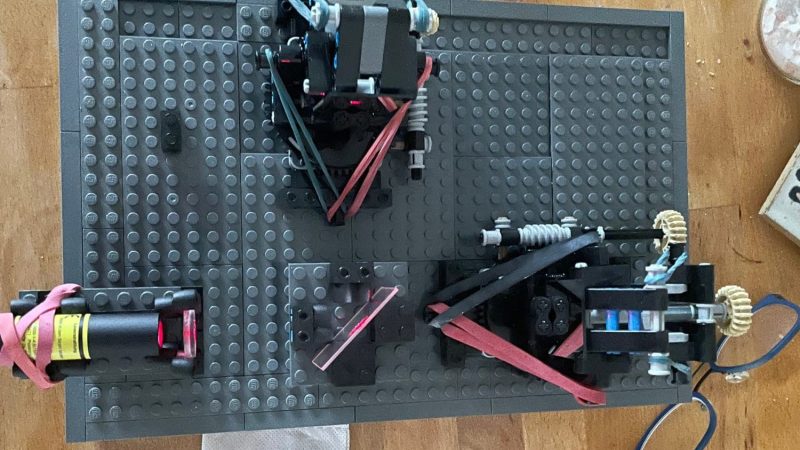
The difference between holography and photography can be summarized perhaps most succinctly as the difference between recording the effect photons have on a surface, versus recording the wavefront which is responsible for allowing photographs to be created in the first place. Since the whole idea of ‘visible light’ pertains to a small fragment of the electromagnetic (EM) spectrum, and thus what we are perceiving with our eyes is simply the result of this EM radiation interacting with objects in the scene and interfering with each other, it logically follows that if we can freeze this EM pattern (i.e. the wavefront) in time, we can then repeat this particular pattern ad infinitum.
Close-up of the wavefront pattern recorded on the holographic film (Credit: 3Blue1Brown, YouTube)
In a recent video by [3Blue1Brown], this process of recording the wavefront with holography is examined in detail, accompanied by the usual delightful visualizations that accompany the videos on [3Blue1Brown]’s channel. The type of hologram that is created in the video is the simplest type, called a transmission hologram, as it requires a laser light to illuminate the holographic film from behind to recreate the scene. This contrasts with a white light reflection hologram, which can be observed with regular daylight illumination from the front, and which is the type that people are probably most familiar with.
The main challenge is, perhaps unsurprisingly, how to record the wavefront. This is where the laser used with recording comes into play, as it forms the reference wave with which the waves originating from the scene interact, which allows for the holographic film to record the latter. The full recording setup also has to compensate for polarization issues, and the exposure time is measured in minutes, so it is very sensitive to any changes. This is very much like early photography, where monochromatic film took minutes to expose. The physics here are significant more complex, of course, which the video tries to gently guide the viewer through.
Also demonstrated in the video is how each part of the exposed holographic film contains enough of the wavefront that cutting out a section of it still shows the entire scene, which when you think of how wavefronts work is quite intuitive. Although we’re still not quite in the ‘portable color holocamera’ phase of holography today, it’s quite possible that holography and hologram-based displays will become the standard in the future.
The 20th century saw humankind’s first careful steps outside of the biosphere in which our species has evolved. Whereas before humans had experienced the bitter cold of high altitudes, the crushing pressures in Earth’s oceans, as well as the various soundscapes and vistas offered in Earth’s biosphere, beyond Earth’s atmosphere we encountered something completely new. Departing Earth’s gravitational embrace, the first humans who ventured into space could see the glowing biosphere superimposed against the seemingly black void of space, in which stars, planets and more would only appear when blending out the intense light from the Earth and its life-giving Sun.
Years later, the first humans to set foot on the Moon experienced again something unlike anything anyone has experienced since. Walking around on the lunar regolith in almost complete vacuum and with very low gravity compared to Earth, it was both strangely familiar and hauntingly alien. Although humans haven’t set foot on Mars yet, we have done the next best thing, with a range of robotic explorers with cameras and microphones to record the experience for us here back on Earth.
Unlike the Moon, Mars has a thin but very real atmosphere which permits the travel of soundwaves, so what does the planet sound like? Despite what fictional stories like Weir’s The Martian like to claim, reality is in fact stranger than fiction, with for example a 2024 research article by Martin Gillier et al. as published in JGR Planets finding highly variable acoustics during Mars’ seasons. How much of what we consider to be ‘normal’ is just Earth’s normal?
Although largely relegated to retrocomputing enthusiasts and embedded systems or microcontrollers now, there was a time when there were no other computers available other than those with 8-bit processors. The late 70s and early 80s would have seen computers with processors like the Motorola 6800 or Intel 8080 as the top-of-the-line equipment and, while underpowered by modern standards, these machines can do quite a bit of useful work even today. Mathematician [Jean Michel Sellier] wanted to demonstrate this so he set up a Commodore 64 to study some concepts like simulating a quantum computer.
The computer programs he’s written to do this work are in BASIC, a common high-level language of the era designed for ease of use. To simulate the quantum computer he sets up a matrix-vector multiplication but simplifies it using conditional logic. Everything is shown using the LIST command so those with access to older hardware like this can follow along. From there this quantum computer even goes as far as demonstrating a quantum full adder.