2024 Hackaday Europe Call For Participation Extended

Good news, procrastineers! A few folks asked us for a little more time to get their proposals together for our upcoming 2024 Hackaday Europe event in Berlin, and we’re listening. So now you’ve got an extra week – get your proposals for talks or workshops in before February 29th.
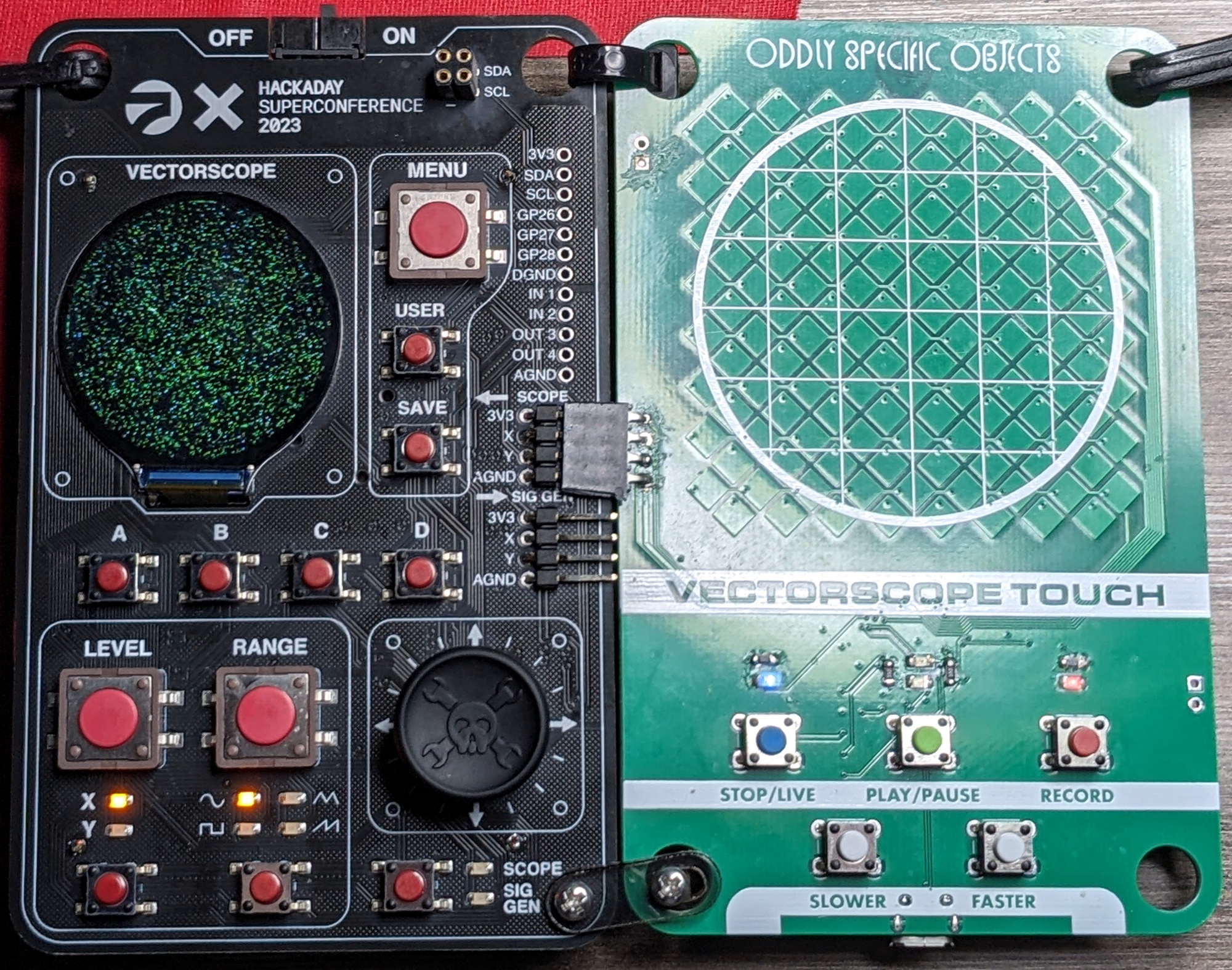
[Joey Castillo]’s awesome custom touchpad
Hackaday Europe is a two-day event taking place April 13th and 14th in Berlin, Germany. Saturday the 13th is the big day, with a full day of badge hacking, talks, music, and everything else. We’ve got the place booked until 2 AM, so get your sleep the night before. Sunday is a half-day of brunch, lightning talks, and showing off the badge hacks from the day before. And if you’re in town on Friday the 12th, we’ll be going out in the evening for drinks and dinner, location TBA but hopefully closer than where we ended up last year!

The badge is going to be a re-spin of the Supercon badge for all of you who couldn’t fly out to the US last November. There are no secrets anymore, so get your pre-hacks started now. We’ve seen some sweet all-analog hacks, some complete revisions of the entire firmware loadout, and, of course, all sorts of awesome hardware bodged onto it. Heck, we even saw Asteroids and DOOM. But we haven’t seen any native Jerobeam Fenderson-style oscilloscope music. You’ve got your homework.

What to Bring?

A few other people have asked if they could bring in (art) projects to show and share. Of course! Depending on the scale, though, you may need to contact us beforehand. If it’s larger than a tower PC, get in touch with us, and we’ll work it out. Smaller hacks, projects in progress, and anything you want to bring along to show and inspire others with, are, of course, welcome without any strings attached.

What else might you need? A computer of your choice and a micro USB cable for programming the badge. There will be soldering stations, random parts, and someone will probably be able to lend you nearly any other piece of gear, so you can pack light if you want to. But you don’t have to.

If you’d like to attend but you don’t have tickets yet – get them soon! Space is limited, and we tend to sell out. Or better yet, submit a talk and sneak in the side door. We’d love to hear what you’ve got going on, and we can’t wait to see you all.


Car Driving Simulators For Students, Or: When Simulators Make Sense

There are many benefits to learning to fly an airplane, drive a racing car, or operate some complex piece of machinery. Ideally, you’d do so in a perfectly safe environment, even when the instructor decides to flip on a number of disaster options and you find your method of transportation careening towards the ground, or the refinery column you’re monitoring indicating that it’s mere seconds away from going critical and wiping out itself and half the refinery with it.

Still, we send inexperienced drivers in cars onto the roads each day as they either work towards getting their driving license, or have passed their driving exam and are working towards gaining experience. It is this inexperience with dangerous situations and tendency to underestimate them which is among the primary factors why new teenage drivers are much more likely to end up in crashes, with the 16-19 age group having a fatal crash nearly three times as high as drivers aged 20 and up.

After an initial surge in car driving simulators being used for students during the 1950s and 1960s, it now appears that we might see them return in a modern format.

Continue reading “Car Driving Simulators For Students, Or: When Simulators Make Sense” →

Linux Fu: Forward To The Past!

Ok, so the title isn’t as catchy as “Back to the Future,” but my guess is a lot of people who are advanced Linux users have — at least — a slight interest in retrocomputing. You’d like an Altair, but not for $10,000. You can build replicas of varying fidelities, of course. You can also just emulate the machine or a similar CP/M machine in software. There are many 8080 or Z80 emulators out there, ranging from SIMH to MAME. Most of these will run on Linux or — at the least — WINE. However, depending on your goals, you should consider RunCPM. Why? It runs on many platforms, including, of course, Linux and other desktop systems. But it also will work with the Arduino, Teensy, ESP32, or STM32 processors. There is also experimental support for SAM4S and Cyclone II FPGAs.

It’s pretty interesting to have one system that will work across PCs and embedded hardware. What’s more is that, at least on Linux, the file system is directly translated (sort of), so you don’t have to use tricks or special software to transfer files to and from CP/M. It is almost like giving Linux the ability to run CP/M software. You still have to have virtual disks, but they are nothing more than directories with normal files in them.

Goals

Of course, if your goal is to simulate a system and you want to have 180 kB floppies or whatever, then the direct file system isn’t a benefit. But if you want to use CP/M software for education, nostalgia, or cross-development, this is the way to go, in my opinion.

It isn’t just the file system, either. If you need a quick utility inside your bogus CP/M environment, you can write it in Lua, at least on desktop systems. On the Arduino, you can access digital and analog I/O. Theoretically, you could deploy an embedded Altair for some real purpose fairly cheaply. Continue reading “Linux Fu: Forward To The Past!” →

Illustrated Kristina with an IBM Model M keyboard floating between her hands.

Keebin’ With Kristina: The One With The 200% Typewriter

Image by [jefmer] via Hackaday.IO
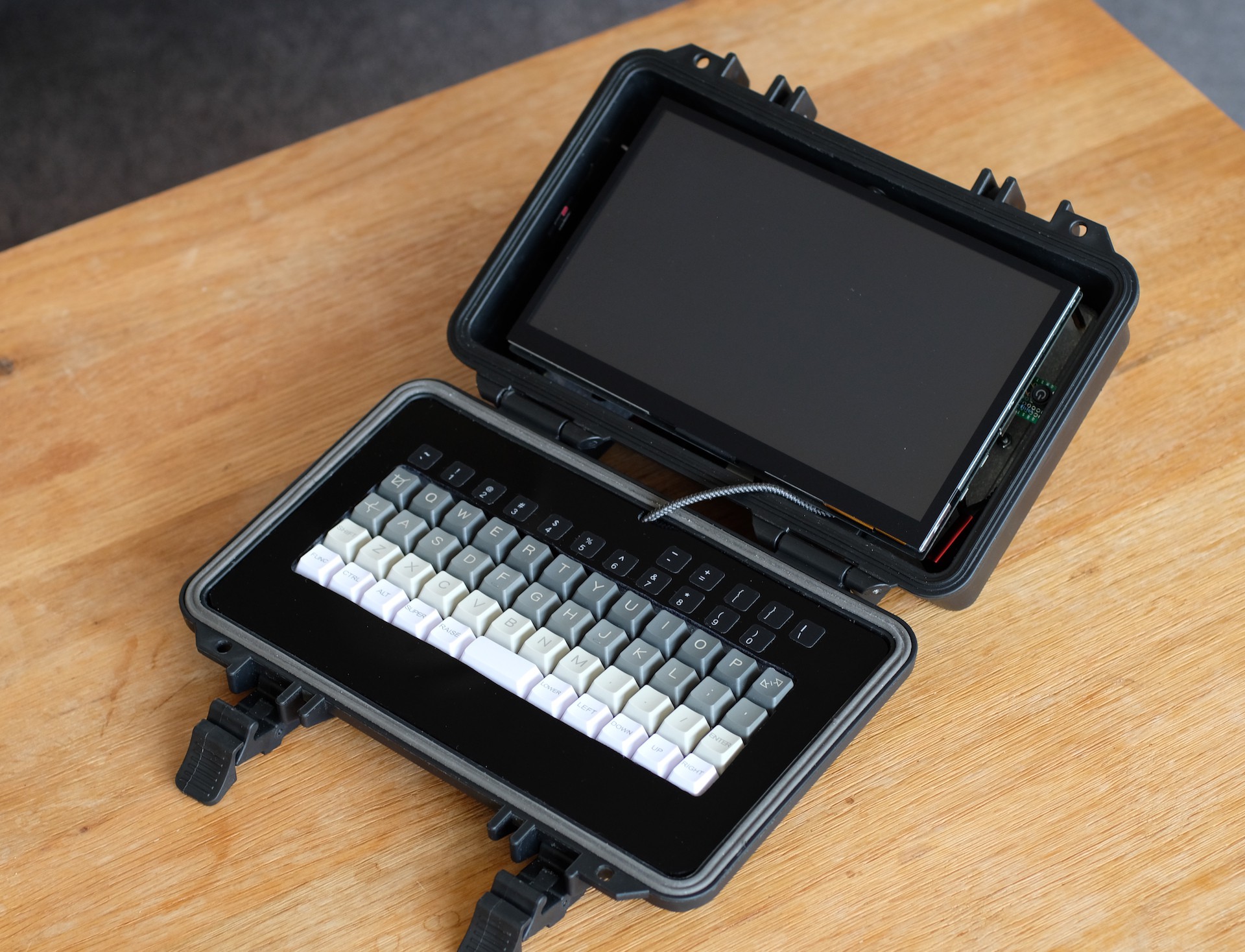
You know, the really sad truth about cyberdecks and cyberdeck-adjacent builds is that many of them just end up on the shelf, collecting dust while waiting for the dystopian future. Well, not this one. No, [jefmer] says their Portable Pi sees daily use, and even comes along on the go.

Since [jefmer] is “temperamentally unsuited to 3D printing”, the Pi 4B and its accessories are nestled in a rugged, splash-proof case under some acrylic sheets. One of those accessories, the keyboard, is a KPrepublic BM40 with Gateron Yellows. In order to get used to the number and symbols layer, [jefmer] laid down some great-looking labels above the keyboard.

Although the build started with an SD card for storage, [jefmer] has since upgraded to a 120 GB SSD. This required a beefy battery pack, but the difference is that it gets around four hours of power versus five hours when using an SD card.

Continue reading “Keebin’ With Kristina: The One With The 200% Typewriter” →

Hackaday Links Column Banner

Hackaday Links: February 18, 2024

So it turns out that walking around with $4,000 worth of hardware on your head isn’t quite the peak technology experience that some people thought it would be. We’re talking about the recently released Apple Vision Pro headset, which early adopters are lining up in droves to return. Complaints run the gamut from totally foreseeable episodes of motion sickness to neck pain from supporting the heavy headset. Any eyeglass wearer can certainly attest to even lightweight frames and lenses becoming a burden by the end of the day. We can’t imagine what it would be like to wear a headset like that all day. Ergonomic woes aside, some people are feeling buyer’s remorse thanks to a lack of apps that do anything to justify the hefty price tag. The evidence for a wave of returns is mostly gleaned from social media posts, so it has to be taken with a grain of salt. We wouldn’t expect Apple to be too forthcoming with official return figures, though, so the ultimate proof of uptake will probably be how often you spot one in the wild. Apart from a few cities and only for the next few weeks, we suspect sightings will be few and far between.

Continue reading “Hackaday Links: February 18, 2024” →

Wireless All The Things!

Neither Tom Nardi nor I are exactly young anymore, and we can both remember a time when joysticks were actually connected with wires to the computer or console, for instance. Back then, even though wireless options were on the market, you’d still want the wired version if it was a reaction-speed game, because wireless links just used to be too slow.

Somehow, in the intervening years, and although we never even really noticed the transition as such, everything has become wireless. And that includes our own hacker projects. Sure, the ESP8266 and other WiFi-capable chips made a big difference, but I still have a soft spot in my heart for the nRF24 chipset, which made at least point-to-point wireless affordable and easy. Others will feel the same about ZigBee, but the point stands: nothing has wires anymore, except to charge back up.

The reason? As this experiment comparing the latency of many different wireless connections bears out, wireless data links have just gotten that good, to the point that the latency in the radio is on par with what you’d get over USB. And the relevant software ecosystems have made it easier to go wireless as well. Except for the extra power requirement, and for cases where you need to move a lot of data, there’s almost no reason that any of your devices need wires anymore.

Are you with us? Will you throw down your chains and go wireless?

Slime Mold-Powered Smart Watches See Humans Fall In Love With The Goo

Humans are very good at anthropomorphising things. That is, giving them human characteristics, like ourselves. We do it with animals—see just about any cartoon—and we even do it with our own planet—see Mother Nature. But we often extend that courtesy even further, giving names to our cars and putting faces on our computers as well.

A recent study has borne this out in amusing fashion. Researchers at the University of Chicago found that human attitudes towards a device can change if they are required to take actions to look after it. Enter the slime mold smartwatch, and a gooey, heartwarming story of love and care between human and machine, mediated by mold.

Continue reading “Slime Mold-Powered Smart Watches See Humans Fall In Love With The Goo” →