Classic Chat: Arko Takes Us Inside NASA’s Legendary JPL

Started by graduate students from the California Institute of Technology in the late 1930s, the Jet Propulsion Laboratory (JPL) was instrumental in the development of early rocket technology in the United States. After being tasked by the Army to analyze the German V2 in 1943, the JPL team expanded from focusing purely on propulsion systems to study and improve upon the myriad of technologies required for spaceflight. Officially part of NASA since December of 1958, JPL’s cutting edge research continues to be integral to the human and robotic exploration of space.

For longtime friend of Hackaday Ara “Arko” Kourchians, getting a job JPL as a Robotics Electrical Engineer was a dream come true. Which probably explains why he applied more than a dozen times before finally getting the call to join the team. He stopped by the Hack Chat back in August of 2019 to talk about what it’s like to be part of such an iconic organization, reminisce about some of his favorite projects, and reflect on the lessons he’s learned along the way.

Continue reading “Classic Chat: Arko Takes Us Inside NASA’s Legendary JPL”

Remoticon 2021 // Joey Castillo Teaches Old LCDs New Tricks

Segmented liquid crystal displays are considered quite an old and archaic display technology these days. They’re perhaps most familiar to us from their use in calculators and watches, where they still find regular application. [Joey Castillo] decided that he could get more out of these displays with a little tinkering, and rocked up to Remoticon 2021 to share his findings.

[Joey’s] talk is a great way to learn the skills needed to reverse engineer a typical segment LCD.
[Joey] got his start hacking on these displays via his Sensor Watch project –  a board swap for the venerable Casio F-91W wristwatch, with the project now available on CrowdSupply. It kits out the 33-year-old watch design with a modern, low-power ARM Cortex M0+ microcontroller running at 32 MHz that completely revolutionizes what the watch can do. Most importantly, however, it repurposes the watches original segmented monochrome LCD.

Segment LCDs are usually small monochrome devices made out of glass, that have the benefit of using very little power in their operation. They come with a fixed layout, which cannot be changed – so they’re often designed specifically for a given purpose. A calculator will have segments laid out to display numbers, often in the usual 7-segment fashion, while a watch may add dedicated segments for displaying things like “AM,” “PM,” or “ALARM.” Continue reading “Remoticon 2021 // Joey Castillo Teaches Old LCDs New Tricks”

Ask Hackaday: What’s Your Worst Soldering Job?

Soldering! It’s the primary method for attaching one component to another in the world of electronics. Whether you’re free-forming a circuit, attaching connectors to cables, or populating a PCB, you’ll eventually find yourself doing some soldering, whether by hand, reflow, or maybe even a fancy wave soldering machine.

It’s a fundamental skill that nevertheless remains one of the biggest hurdles for newcomers to overcome when diving into the electronics hobby. Difficult jobs with tiny components or with large heat sinks can up the challenge for even well-practiced hands. Thus, today we ask the question: What’s your worst soldering job?
Continue reading “Ask Hackaday: What’s Your Worst Soldering Job?”

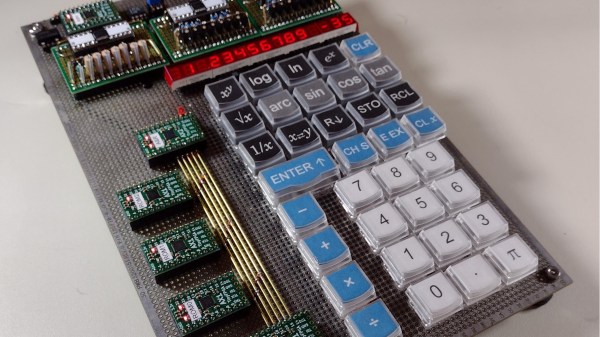
Inputs Of Interest: Canadian MCM/70 Was Kinda Like The First Cyberdeck

Not to start a debate in the comments or anything, but what would you say was the first microcomputer, or personal computer? We suppose the answer depends on your definition. Some would argue that the PC was born at Xerox PARC with a curious portrait-mode display and a three-button mouse, while others would say it all began in a garage in either Los Altos, California or Albuquerque, New Mexico.

If you take the term ‘computer’ to mean that which can crunch big numbers fairly quickly, then the Canadian-made MCM/70 is arguably the first personal computer in that it is portable, has an alphanumeric keyboard, a display, and supports cassette storage, which could be used to extend the 8K of memory. It was an all-in-one computing solution, and it could have an optional telephone modem built in. This was a forward-thinking machine for 1974.

Continue reading “Inputs Of Interest: Canadian MCM/70 Was Kinda Like The First Cyberdeck”

Astra’s Frugal Design Leads To Latest Unusual Failure

We’ve all heard it said, and it bears repeating: getting to space is hard. But it actually gets even harder the smaller your booster is. That’s because the structure, engines, avionics, and useful payload of a rocket only make up a tiny portion of its liftoff mass, while the rest is dedicated to the propellant it must expend to reach orbital velocity. That’s why a Falcon 9 tipping the scales at 549,054 kilograms (1,207,920 pounds) can only loft a payload of 22,800 kg (50,265 lb) — roughly 4% of its takeoff weight.

As you might imagine, there’s a lower limit where there simply isn’t enough mass in the equation for the hardware necessary to build a fully functional rocket. But where is that limit? That’s precisely what aerospace newcomer Astra is trying to find out. Their Rocket 3 is among the smallest orbital boosters to ever fly, closer in size and mass to the German V2 of World War II than the towering vehicles being built by SpaceX or Blue Origin. Even the Rocket Lab Electron, itself an exceptionally svelte rocket, is considerably larger.

The reason they’re trying to build such a small rocket is of course very simple: smaller means cheaper. Assuming you’ve got a payload light and compact enough to fit on their launcher, Astra says they can put it into orbit for roughly $2.5 million USD; less than half the cost of a dedicated flight aboard Rocket Lab’s Electron, and competitive with SpaceX’s “rideshare” program. Such a low ticket price would have been unfathomable a decade ago, and promises to shake up an already highly competitive commercial launch market. But naturally, Astra has to get the thing flying reliably before we can celebrate this new spaceflight milestone.

Their latest mission ended in a total loss of the vehicle and payload when the upper stage tumbled out of control roughly three minutes after an otherwise perfect liftoff from Cape Canaveral Space Force Station in Florida. Such issues aren’t uncommon for a new orbital booster, and few rockets in history have entered regular service without a lost payload or two on the books. But this failure, broadcast live over the Internet, was something quite unusual: because of the unconventional design of Astra’s diminutive rocket, the upper stage appeared to get stuck inside the booster after the payload fairing failed to open fully.

Continue reading “Astra’s Frugal Design Leads To Latest Unusual Failure”

AI Maybe Revives Dead Languages

While Star Trek’s transporter is hard to imagine — perfect matter movement across vast distances with no equipment on one end — it may not be the most far-fetched piece of tech on the Enterprise. While there are several contenders, I strongly suspect the universal translator is the most unlikely MacGuffin. After all, how would you decipher a totally unknown language in real-time? Of course, no one wants to watch 30 episodes of TV about how we finally figured out what Klingons call clouds, so pretty much every science fiction movie has some hand-waving explanation for speaking the viewer’s language. Farscape had microbes, some aliens have telepathy that works with alien brains of any kind, and still others study English from afar for decades off camera. Babelfish anyone?

I was thinking about this because of an article I read by [Alizeh Kohari] about [Jiaming Luo’s] work using AI to decode dead languages. While this might seem to be similar to Spock’s translator, it really isn’t. Human languages change over time and distance. You only have to watch the BBC or read something written by Thomas Jefferson to see that. But there is still a lot in common, at least within certain domains.

Continue reading “AI Maybe Revives Dead Languages”

Big Chemistry: From Gasoline To Wintergreen

Most of us probably have some vivid memories of high school or college chemistry lab, where the principles of the science were demonstrated, and where we all got at least a little practice in experimental methods. Measuring, diluting, precipitating, titrating, all generally conducted under safe conditions using stuff that wasn’t likely to blow up or burn.

But dropwise additions and reaction volumes measured in milliliters are not the stuff upon which to build a global economy that feeds, clothes, and provides for eight billion people. For chemistry to go beyond the lab, it needs to be scaled up, often to a point that’s hard to conceptualize. Big chemistry and big engineering go hand in hand, delivering processes that transform the simplest, most abundant substances into the things that, for better or worse, make life possible.

To get a better idea of how big chemistry does that, we’re going to take a look at one simple molecule that we’ve probably all used at one time or another: the common artificial flavoring wintergreen. It’s an innocuous ingredient in a wide range of foods and medicines, but the infrastructure required to make it and all its precursors is a snapshot of just how important big chemistry really is.

Continue reading “Big Chemistry: From Gasoline To Wintergreen”