A Trillion Trees – How Hard Can It Be?

Data from 2016 pegs it as the hottest year since recording began way back in 1880. Carbon dioxide levels continue to sit at historical highs, and last year the UN Intergovernmental Panel on Climate Change warned that humanity has just 12 years to limit warming to 1.5 C.

Reducing emissions is the gold standard, but it’s not the only way to go about solving the problem. There has been much research into the field of carbon sequestration — the practice of capturing atmospheric carbon and locking it away. Often times, this consists of grand plans of pumping old oil wells and aquifers full of captured CO2, but there’s another method of carbon capture that’s as old as nature itself.

As is taught in most primary school science courses, the trees around us are responsible for capturing carbon dioxide, in the process releasing breathable oxygen. The carbon becomes part of the biomass of the tree, no longer out in the atmosphere trapping heat on our precious Earth. It follows that planting more trees could help manage carbon levels and stave off global temperature rises. But just how many trees are we talking? The figure recently floated was 1,000,000,000,000 trees, which boggles the mind and has us wondering what it would take to succeed in such an ambitious program.


Continue reading “A Trillion Trees – How Hard Can It Be?”

Abraham Wald’s Problem Solving Lesson Is To Seek What’s Not There

You may not know the name Abraham Wald, but he has a very valuable lesson you can apply to problem solving, engineering, and many other parts of life. Wald worked for the Statistical Research Group (SRG) during World War II. This was part of a top secret organization in the United States that applied elite mathematical talent to help the allies win the war. Near Columbia University, mathematicians and computers — the human kind — worked on problems ranging from how to keep an enemy plane under fire longer to optimal bombing patterns.

One of Wald’s ways to approach problem was to look beyond the data in front of him. He was looking for things that weren’t there, using their absence as an additional data point. It is easy to critique things that are present but incorrect. It is harder to see things that are missing. But the end results of this technique were profound and present an object lesson we can still draw from today.

Continue reading “Abraham Wald’s Problem Solving Lesson Is To Seek What’s Not There”

Automate The Freight: When The Freight Is People

Before I got a license and a car, getting to and from high school was an ordeal. The hour-long bus ride was awful, as one would expect when sixty adolescents are crammed together with minimal supervision. Avoiding the realities going on around me was a constant chore, aided by frequent mental excursions. One such wandering led me to the conclusion that we high schoolers were nothing but cargo on a delivery truck designed for people. That was a cheery fact to face at the beginning of a school day.

What’s true for a bus full of students is equally true for every city bus, trolley, subway, or long-haul motorcoach you see. People can be freight just as much as pallets of groceries in a semi or a bunch of smiling boxes and envelopes in a brown panel truck. And the same economic factors that we’ve been insisting will make it far more likely that autonomous vehicles will penetrate the freight delivery market before we see self-driving passenger vehicles are at work with people moving. This time on Automate the Freight: what happens when the freight is people?

Continue reading “Automate The Freight: When The Freight Is People”

Machinist Tools: Edge Finding

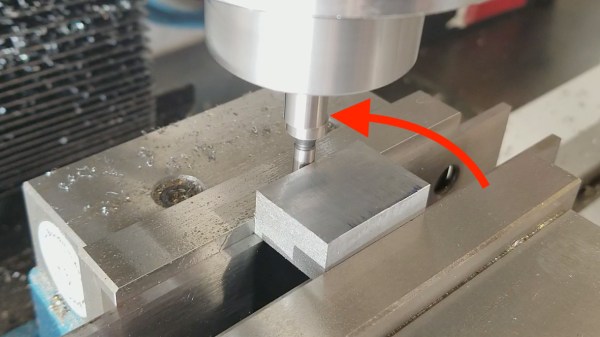
Machinists like to live on the edge, but they always want to know precisely where it is. If you’ve watched any machining videos (*cough*) then you’ve seen heavy use of digital readouts on machines. A “DRO” (as the cool kids call them) is a little computer that knows where the slides are, and thus where your cutter is on the piece. However, there’s a catch. DROs don’t know the absolute position of the spindle, they know theĀ relative position of it. The bottom line is that a DRO is just a fancier version of the graduated scales on the hand wheels. The key difference is that the DRO doesn’t suffer from backlash, because it is measuring the slides directly (via glass scales similar to your digital caliper) rather than inferring position from rotations of the leadscrews. With traditional hand wheels, you have to compensate for backlash every time you change direction, and a DRO saves you from that (among other convenience features).

The point is that, whether old school or new, you still only get a relative coordinate system on your part. You need to establish an origin somehow. A useful way to do this is to set an origin at one corner of the part, based on its physical edges. How do you tell the DRO (or hand wheels) where the edges are? Enter the edge finder.

Continue reading “Machinist Tools: Edge Finding”

RTL-SDR: Seven Years Later

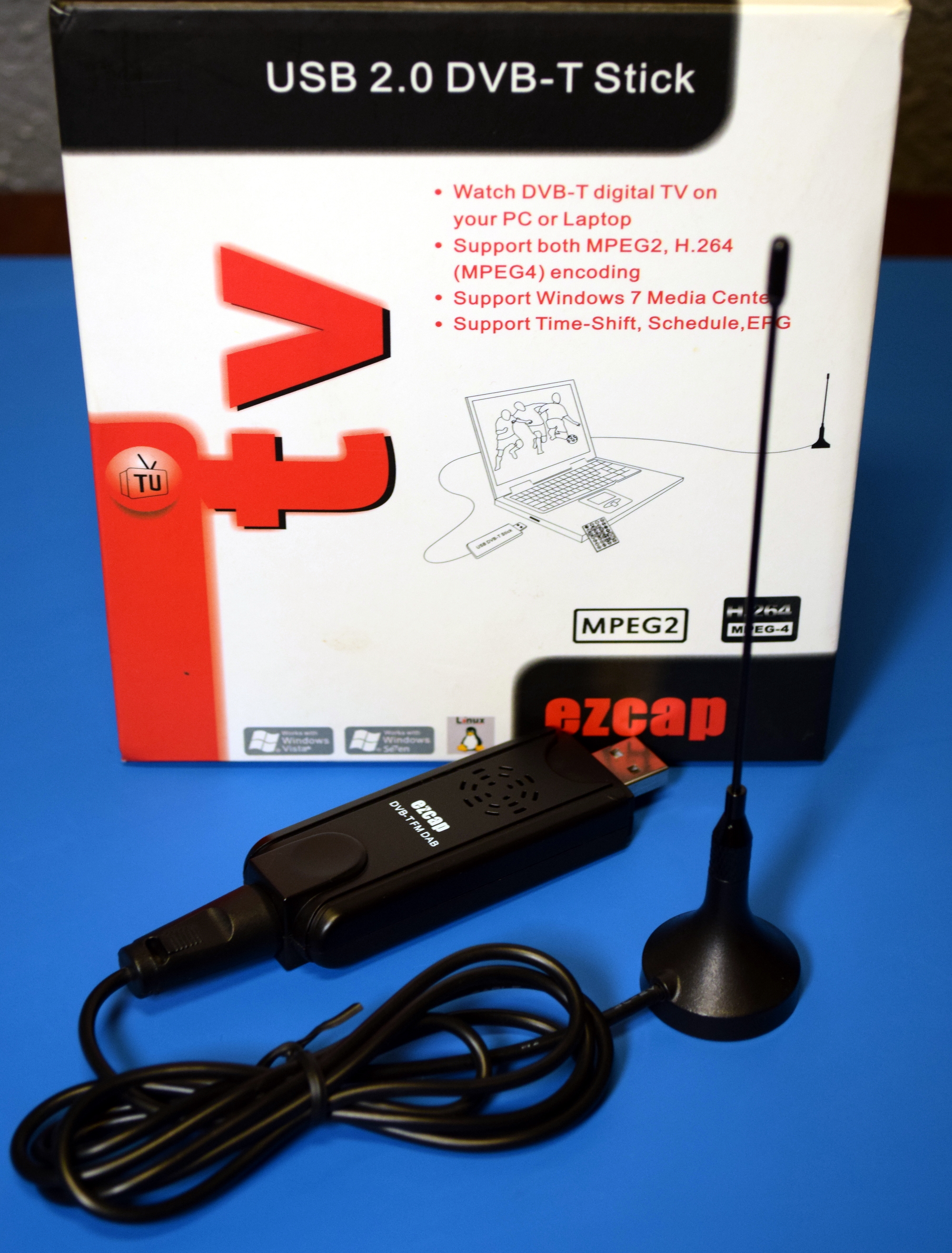
Before swearing my fealty to the Jolly Wrencher, I wrote for several other sites, creating more or less the same sort of content I do now. In fact, the topical overlap was enough that occasionally those articles would get picked up here on Hackaday. One of those articles, which graced the pages of this site a little more than seven years ago, was Getting Started with RTL-SDR. The original linked article has long since disappeared, and the site it was hosted on is now apparently dedicated to Nintendo games, but you can probably get the gist of what it was about from the title alone.

An “Old School” RTL-SDR Receiver

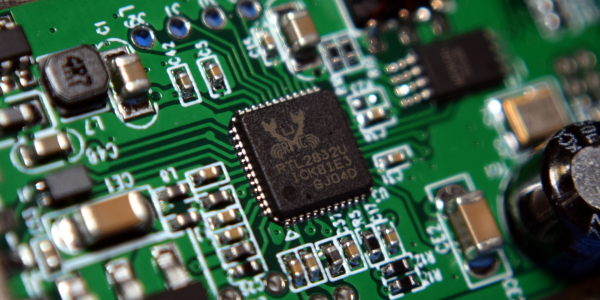
When I wrote that article in 2012, the RTL-SDR project and its community were still in their infancy. It took some real digging to find out which TV tuners based on the Realtek RTL2832U were supported, what adapters you needed to connect more capable antennas, and how to compile all the software necessary to get them listening outside of their advertised frequency range. It wasn’t exactly the most user-friendly experience, and when it was all said and done, you were left largely to your own devices. If you didn’t know how to create your own receivers in GNU Radio, there wasn’t a whole lot you could do other than eavesdrop on hams or tune into local FM broadcasts.

Nearly a decade later, things have changed dramatically. The RTL-SDR hardware and software has itself improved enormously, but perhaps more importantly, the success of the project has kicked off something of a revolution in the software defined radio (SDR) world. Prior to 2012, SDRs were certainly not unobtainable, but they were considerably more expensive. Back then, the most comparable device on the market would have been the FUNcube dongle, a nearly $200 USD receiver that was actually designed for receiving data from CubeSats. Anything cheaper than that was likely to be a kit, and often operated within a narrower range of frequencies.

Today, we would argue that an RTL-SDR receiver is a must-have tool. For the cost of a cheap set of screwdrivers, you can gain access to a world that not so long ago would have been all but hidden to the amateur hacker. Let’s take a closer look at a few obvious ways that everyone’s favorite low-cost SDR has helped free the RF hacking genie from its bottle in the last few years.

Continue reading “RTL-SDR: Seven Years Later”

Teardown: Catel CTP300 Restaurant Pager

I have a problem. If I go to a swap meet , or even a particularly well stocked yard sale, I feel compelled to buy something. Especially if that something happens to be an oddball piece of electronics. While on the whole I’m a man of few vices, I simply can’t walk away from a good deal; doubly so if it has a bunch of buttons, LEDs, and antennas on it.

Table for one, by the window.

Which is exactly how I came into the possession of a Catel CPT300 restaurant paging system for just $20 a few months ago. I do not, as you may have guessed, operate a restaurant. In fact, as many of my meals take the form of military rations eaten in front of my computer, I’m about as far away from a restaurateur as is humanly possible. But I was so enamored with the rows of little plastic pagers neatly lined up in their combination charging dock and base station that I had to have it.

The man selling it swore the system worked perfectly. Even more so after he plugged it in and it didn’t do anything. But appearances can be deceiving, and his assurance that all the pagers needed was a good charge before they’d burst back to life seemed reasonable enough to me. Of course, it hardly mattered. The regular Hackaday reader at this point knows the fate of the CPT300 was to be the same whether or not it worked.

Incidentally, those cute little pagers would not burst back to life with a good charge. They may well have burst into something, but we’ll get to that in a moment. For now, let’s take a look at a gadget that most of us have used at one time or another, but few have had the opportunity to dissect.

Continue reading “Teardown: Catel CTP300 Restaurant Pager”

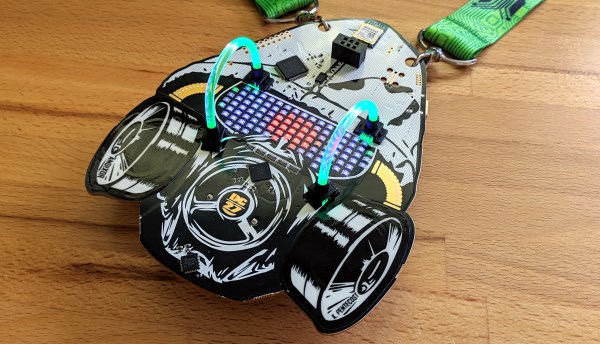
Hands-On: AND!XOR DEF CON 27 Badge Ditches Bender, Adopts Light Pipes

The newest offering from the AND!XOR team is out and it delivered exactly what hardware badges were missing: light pipes. No joke, the DEF CON 27 edition AND!XOR badge will be most recognizable because of two arcs of light pipe material blinging RGB goodness in three dimensions. But if you can peel your eyes away from that oddity there’s a lot to love about the new design.

Continue reading “Hands-On: AND!XOR DEF CON 27 Badge Ditches Bender, Adopts Light Pipes”