World’s Worst Bitcoin Mining Rig

Even if we don’t quite understand what’s happening in a Bitcoin mine, we all pretty much know what’s needed to set one up. Racks of GPUs and specialized software will eventually find a few of these vanishingly rare virtual treasures, but if you have enough time, even a Xerox Alto from 1973 can be turned into a Bitcoin mine. As for how much time it’ll take [Ken Shirriff]’s rig to find a Bitcoin, let’s just say that his Alto would need to survive the heat death of the universe. About 5000 times. And it would take the electricity generated by a small country to do it.

Even though it’s not exactly a profit center, it gives [Ken] a chance to show off his lovingly restored Alto. The Xerox machine is the granddaddy of all modern PCs, having introduced almost every aspect of the GUI world we live in. But with a processor built from discrete TTL chips and an instruction set that doesn’t even have logical OR or XOR functions, the machine isn’t exactly optimized for SHA-256 hashing. The fact that [Ken] was able to implement a mining algorithm at all is impressive, and his explanation of how Bitcoin mining is done is quite clear and a great primer for cryptocurrency newbies.

[Ken] seems to enjoy sending old computer hardware to the Bitcoin mines — he made an old IBM mainframe perform the trick a while back. But if you don’t have a room-size computer around, perhaps reading up on alternate uses for the block chain would be a good idea.

[via Dangerous Prototypes]

Bearing-in-Bearing Fidget Spinner Taken To The Max

People who know about bearings go through a phase of bemusement with regards to fidget spinners. We say something like, “man, I got a whole box of bearings in the basement.” Then we go through a “OK, I’ll make one” phase and print one out of PLA.

[fishpepper] took that sentiment a step further. After being forced to print spinners for his kids, he got jealous and decided to make his own—but his spinner would be a version for engineers. [fishpepper]’s ginormous spinner consists of five bearings superglued inside each other, with the grease cleaned out of the insides to make them spin faster. The inner two sets are doubled up bearings, 6 mm x 17 mm x 6 mm and 17 mm x 30 mm x 7 mm. The middle bearing measures 30 mm x 55 mm x 13 mm, and the fourth bearing 55 mm x 90 mm x 18 mm.

If you want to stop here, it’s a good size, around two inches across. However, [fishpepper] took it a step further, adding a fifth bearing, a 90 mm x 140 mm x 24 mm monster weighing in at 1 kg by itself. The total weight comes to 1.588 kg with the 3D-printed hub included. If you want to make one yourself, check out [fishpepper’s] bearing-in-bearing spinner tutorial which guides you through the various steps.

Hackaday likes fidget spinners so much you’d think we were in 6th grade: we’ve published posts on the three-magnet spinner hack, a fidget-spinning robot, and teaching STEAM with fidget spinners.

Continue reading “Bearing-in-Bearing Fidget Spinner Taken To The Max”

Automate The Freight: The Robotic Garbage Man

When I started the Automate the Freight series, my argument was that long before the vaunted day when we’ll be able to kick back and read the news or play a video game while our fully autonomous car whisks us to work, economic forces will dictate that automation will have already penetrated the supply chain. There’s much more money to be saved by carriers like FedEx and UPS cutting humans out of the loop while delivering parcels to homes and businesses than there is for car companies to make by peddling the comfort and convenience of driverless commuting.

But the other end of the supply chain is ripe for automation, too. For every smile-adorned Amazon package delivered, a whole bunch of waste needs to be toted away. Bag after bag of garbage needs to go somewhere else, and at least in the USA, municipalities are usually on the hook for the often nasty job, sometimes maintaining fleets of purpose-built trucks and employing squads of workers to make weekly pickups, or perhaps farming the work out to local contractors.

Either way you slice it, the costs for trash removal fall on the taxpayers, and as cities and towns look for ways to stretch those levies even further, there’s little doubt that automation of the waste stream will start to become more and more attractive. But what will it take to fully automate the waste removal process? And how long before the “garbage man” becomes the “garbage ‘bot”?

Continue reading “Automate The Freight: The Robotic Garbage Man”

Places To Visit: Electric Mountain

The experience of being a teenager leaves a host of memories, of social awkwardness in the difficult process of not quite being a child any more, of tedious school days, and of team sports seemingly enjoyed only by the few. Wherever in the world you grew up will have lent a particular flavour to your recollections of that period of your life, whether your memories are good or bad.

One surprising common theme in British teenage memories, at least those of a few decades ago, are power stations. In the 1970s and 1980s, the Central Electricity Generating Board had a PR effort that involved bringing parties of teenage school geography students in for a tour of their local electricity plant, so if you talk to a British person of a certain age you’ll probably find they’ve been up close and personal with a coal-fired power station.

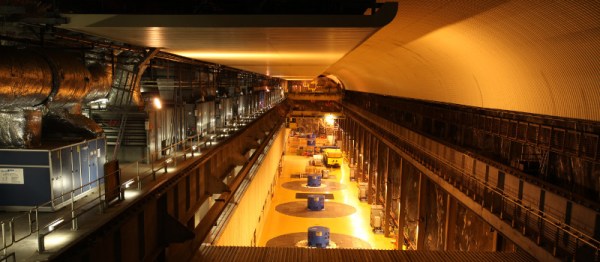
The true power station marvel of the age would have been too far away to tour for most kids at the time, though our geography teachers expounded on it at length. Dinorwig pumped-storage power station in Wales was opened in the early 1980s, and is a hydroelectric plant that uses excess grid generating capacity in the middle of the night to pump water into a lake at the top of a mountain, from which it can later be released at very short notice to respond to demand surges in a matter of seconds. The oft-quoted example is that when an episode of Coronation Street draws to a close there are several million British kettles turned on simultaneously, at which point Dinorwig comes online to rapidly make up the resulting shortfall.

Continue reading “Places To Visit: Electric Mountain”

Bicycle Racing In Space Could Be A Thing

It’s 2100 AD, and hackers and normals live together in mile-long habitats in the Earth-Moon system. The habitat is spun up so that the gravity inside is that of Earth, and for exercise, the normals cycle around on bike paths. But the hackers do their cycling outside, in the vacuum of space.

How so? With ion thrusters, rocketing out xenon gas as the propellant. And the source of power? Ultimately that’s the hackers’ legs, pedaling away at a drive system that turns two large Wimshurst machines.

Those Wimshurst machines then produce the high voltage needed for the thruster’s ionization as well as the charge flow. They’re also what gives the space bike it’s distinctly bicycle-like appearance. And based on the calculations below, this may someday work!

Continue reading “Bicycle Racing In Space Could Be A Thing”

Horns Across America: The AT&T Long Lines Network

A bewildering amount of engineering was thrown at the various challenges presented to the United States by the end of World War II and the beginning of the Cold War. From the Interstate Highway System to the population shift from cities to suburbs, infrastructure of all types was being constructed at a rapid pace, fueled by reasonable assessments of extant and future threats seasoned with a dash of paranoia, and funded by bulging federal coffers due to post-war prosperity and booming populations. No project seemed too big, and each pushed the bleeding edge of technology at the time.

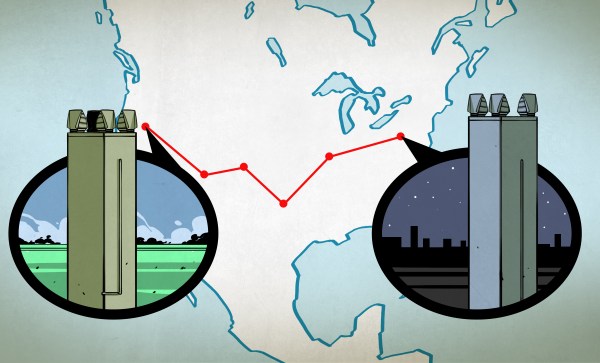
Some of these critical infrastructure projects have gone the way of the dodo, supplanted by newer technologies that rendered them obsolete. Relics of these projects still dot the American landscape today, and are easy to find if you know where to look. One that always fascinated me was the network of microwave radio relay stations that once stitched the country together. From mountaintop to mountaintop, they stand silent and largely unattended, but they once buzzed with the business of a nation. Here’s how they came to be, and how they eventually made themselves relics.

Continue reading “Horns Across America: The AT&T Long Lines Network”

Hackaday Superconference: Tickets And Proposals

We’re thrilled to announce Supercon tickets are now available. The 2017 Hackaday Superconference is November 11th and 12th in Pasadena, California.

This is the ultimate hardware conference. Hackers, designers, and engineers from all over the world converge — from the greenest beginners to those who have made history with their designs. This is the Hackaday community, and the Supercon is your chance to experience all things involved in hardware creation for one great weekend. There will be unparalleled talks and workshops, but the experience of Supercon transcends the organized event. We call it a conference but it’s truly a hacker village.

Call for Proposals

Want to present a talk (or a workshop) at this year’s Supercon? Great, please submit your proposal using this form.

The number one question we get about CFP is “I’m excited about X, should I submit a proposal?” The answer is yes. Don’t self-eliminate — if you have an idea for a talk we want to hear from you. Supercon is a flat conference, your proposal will be judged on the idea and how you plan to present it, not on how many other amazing speaking slots you’ve secured.

To help get your mind moving about topics, we suggest that you consider this list of themes your talk might fit into: Engineering Heroics, Prototyping, Research, Product Development, Full-Stack Fabrication, and of course Wildcard.

Tickets! Get Your Tickets Here!

Are you a true believer? We’ve just opened up the Call for Proposal today, so we can’t tell you who’s speaking or what workshops will take place. However, we suspect there are many of you ready to take the plunge right now. Those first 96 true believers get an incredibly low ticket price of $128. This covers admission for both days of the con, admission to the Hackaday Prize party on Saturday night and food on both days.

This is the third year we’ve hosted the Hackaday Superconference. You can check out all of the talk videos from last year, there’s a slew of articles on the event, and of course it was really fun seeing the geeky and unique shirts on exhibit throughout.

Get your ticket and book your travel. We look forward to hanging out with a huge chunk of the Hackaday community at Supercon!