A Functioning 3D Printer For 10€

There was a time when crowdfunding websites were full of 3D printers at impossibly low prices. You knew that it would turn out to be either blatant vaporware or its delivery date would slip into the 2020s, but still there seemed always to be an eager queue ready to sign up. Even though there were promised models for under $200, $150, and then $100, there had to be a lower limit to the prices they were prepared to claim for their products. A $10 printer on Kickstarter for example would have been just a step too far.

There is a project that’s come close to that mark though, even though the magic figure is 10 euros rather than 10 dollars, so just short of 12 dollars at today’s exchange rate. [Michele Lizzit] has built a functioning 3D printer for himself, and claims that magic 10€ build price. How on earth has he done it? The answer lies in extensive use of scrap components, in this case from broken inkjet printers and an image scanner. These provide all the mechanical parts for the printer, leaving him only having to spend his 10€ on some hot end parts and the printer’s electronics. In an unusual move, the frame of the machine appears to come from a set of cardboard biscuit boxes, a master stroke of junk box construction.

The claimed resolution is 33µm, and using the position encoders from the inkjet printers he is able to make it a closed loop device. We salute his ingenuity in building such an impressive printer from so little, and were we ever locked by the bad guys in a room full of IT junk and lacked a handy escape device, we’d wish to be incarcerated with [Michele] any day over [Angus MacGyver] or [Sgt. Bosco BA Baracus].

You can see the printer in action in the video below the break.
Continue reading “A Functioning 3D Printer For 10€” →

Raspberry Pi automated greenhouse

Raspberry Pi Is The Brains Behind Automated Greenhouse

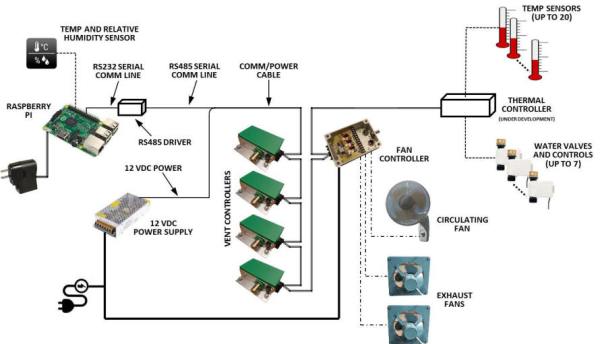
[Asa Wilson] and his wife picked up a 10’x12′ greenhouse from Harbor Freight that for their location required some serious changes, understandable since they’re in Colorado on the western slope of Pike’s Peak where the winds are strong and the normal growing season is short. After assembling it on a concrete footing and adding some steel bracing, they got to work on adding an environment management system based around a Raspberry Pi. Read on for a look at the modifications they made.

Continue reading “Raspberry Pi Is The Brains Behind Automated Greenhouse” →

Custom Cut Pinwheel Makes A Useful HVAC Duct Flow Meter

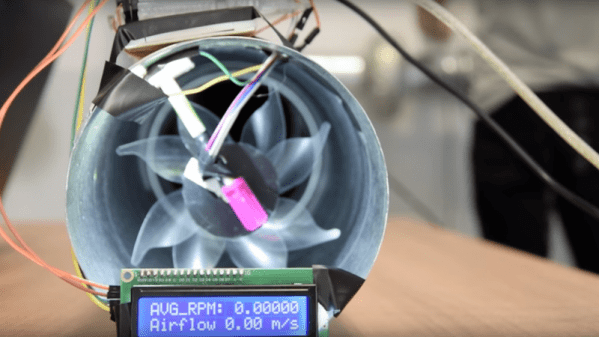
Everyone is familiar with pinwheels, and few of us haven’t crafted one from a square of paper, a stick, and a pin. Pinwheels are pretty optimized from a design standpoint, and are so cheap and easy to build that putting a pinwheel to work as an HVAC duct flow meter seems like a great idea.

Great in theory, perhaps, but as [ItMightBeWorse] found out, a homemade pinwheel is far from an ideal anemometer. His experiments in air duct flow measurements, which previously delved into ultrasonic flow measurement, led him to try mechanical means. That calls for some kind of turbine producing a signal proportional to air flow, but a first attempt at using a computer fan with brushless DC motor failed when a gentle airflow couldn’t overcome the drag introduced by the rotor magnets. But a simple pinwheel, custom cut from patterns scaled down from a toy, proved to be just the thing. A reflective optosensor counts revolutions as the turbine spins in an HVAC duct, and with a little calibration the rig produces good results. The limitations are obvious: duct turbulence, flimsy construction, and poor bearings. But for a quick and dirty measurement, it’s not bad.

Looking for an outdoor anemometer rather than an HVAC flow meter? We’ve got one made from an old electric motor, or a crazy-accurate ultrasonic unit.

Continue reading “Custom Cut Pinwheel Makes A Useful HVAC Duct Flow Meter” →

Ask Hackaday: Saving The World With Wacky Waving Inflatable Arm Flailing Tube Men

This is a solution to global warming. This solution will also produce electricity, produce rain in desertified areas, and transform the Sahara into arable land capable of capturing CO2. How is this possible? It’s simple: all we need to do is build a five-kilometer tall, twenty-meter wide chimney. Hot air, warmed by the Earth’s surface, will enter the base of the chimney and flow through turbines, generating electricity. From there, air will rise through the chimney, gradually cooling and transferring energy from the atmosphere at Earth’s surface to five kilometers altitude. This is the idea behind the Super Chimney, It’s an engineering concept comparable to building a dam across the Strait of Gibraltar, a system of gigantic mirrors in Earth’s orbit, or anything built under an Atoms for Peace project. In short, this is fringe engineering.

This is also, ‘saving the world with wacky waving inflatable arm flailing tube men.’

The idea of building tens of thousands of fabric chimneys, placing them all around the globe, and cooling the Earth while sequestering carbon dioxide is fantastic. Ideas are simple, implementation is something else entirely. There are also obvious problems with the physics presented in the Super Chimney presentation, but these problems don’t actually make a Super Chimney impossible. We need more eyes on this, so we’re opening this one up as an Ask Hackaday. What do you think of this audacious scheme, and is it even possible?

Continue reading “Ask Hackaday: Saving The World With Wacky Waving Inflatable Arm Flailing Tube Men” →

The Last Interesting Chrysler Had A Gas Turbine Engine

The piston engine has been the king of the transportation industry for well over a century now. It has been manufactured so much that it has become a sort of general-purpose machine that can be used to do quite a bit more than merely move people and cargo from one point to another. Running generators, hydraulic systems, pumps, and heavy machinery are but a few examples of that.

Scale production of this technology also had the effect of driving prices for these engines down, and now virtually everyone in the developed world has cheap and easy access to them. In the transportation world, at least, it looks like its reign might finally be coming to a slow, drawn-out conclusion as electric cars capture more and more market share.

Electric motors aren’t the first technology to try to topple the piston engine from its apex position on top of our modern transportation industry, though. In the 1960s another technology, the gas turbine engine, tried to replace it — and failed.

Continue reading “The Last Interesting Chrysler Had A Gas Turbine Engine” →

Laser Etching PCBs

A while ago, [Marco] mounted a powerful laser diode to a CNC machine in an attempt to etch copper clad board and create a few PCBs. The results weren’t that great, but the technique was promising. In a new experiment, [Marco] purchased a very cheap laser engraver kit from China, and now this technique looks like it might be a winner.

[Marco] sourced his laser engraver from Banggood, and it’s pretty much exactly what you would expect for a CNC machine that costs under $200. The frame is aluminum extrusion, the motors are off-the-shelf steppers, the electronics are just Pololu-like drivers, and the software is somewhere between abysmal and terrible. Nevertheless, this machine can cut wood, leather, fabric, and can remove spray paint with a big blue laser diode.

To create his PCBs, [Marco] is first cleaning a piece of copper clad board, coating it with spray paint, then blasting it with a laser. The preferred software for this is LaserWeb, and the results are pretty good for a cheap machine.

There are a few extra steps to creating the PCB once the board has been coated with paint and blasted with a laser. This process still requires etching in either ferric chloride or some other mess of acid, but the results are good. So good, in fact, that [Marco] is experimenting with copper foil and Kapton to create flexible circuit boards. You can check out the video of these experiments below.

Continue reading “Laser Etching PCBs” →

Living Logic: Biological Circuits For The Electrically Minded

Did you know you can build fundamental circuits using biological methods? These aren’t your average circuits, but they work just like common electrical components. We talk alot about normal silicon and copper circuits ‘roud here, but it’s time to get our hands wet and see what we can do with the power of life!

In 1703, Gottfried Wilhelm Leibniz published his Explication de l’Arithmétique Binaire (translated). Inspired by the I Ching, an ancient Chinese classic, Leibniz established that the principles of arithmetic and logic could be combined and represented by just 1s and 0s. Two hundred years later in 1907, Lee De Forest’s “Audion” is used as an AND gate. Forty years later in 1947, Brattain and H. R. Moore demonstrate their “PNP point-contact germanium transistor” in Bell Labs (often given as the birth date of the transistor). Six years later in 1953, the world’s first transistor computer was created by the University of Manchester. Today, 13,086,801,423,016,741,282,5001 transistors have built a world of progressing connectivity, automation and analysis.

While we will never know how Fu Hsi, Leibniz, Forest or Moore felt as they lay the foundation of the digital world we know today, we’re not completely out of luck: we’re in the midst’s of our own growing revolution, but this one’s centered around biotechnology. In 1961, Jacob and Monod discovered the lac system: a biological analog to the PNP transistor presented in Bell Labs fourteen years earlier. In 2000, Gardner, Cantor, and Collins created a genetic toggle switch controlled by heat and a synthetic fluid bio-analog2. Today, AND, OR, NOR, NAND, and XOR gates (among others) have been successfully demonstrated in academic labs around the world.

But wait a moment. Revolution you say? Electrical transistors went from invention to computers in 6 years, and biological transistors went from invention to toggle button in 40? I’m going to get to the challenges facing biological circuits in time, but suffice it to say that working with living things that want to be fed and (seem to) like to die comes with its own set of challenges that aren’t relevant when working with inanimate and uncaring transistors. But, in the spirit of hacking, let’s dive right in. Continue reading “Living Logic: Biological Circuits For The Electrically Minded” →