Electromagnetic Pulse: Pure Hollywood?

Imagine you’re in charge of a major heist. Right as your crew is about to rob the main vault, you need all of the electronics in the building to fail at exactly the right moment with no other collateral damage (except, maybe, to your raggedy panel van). Obviously you will turn to one of the entertainment industry’s tired tropes, the electromagnetic pulse! The only problem is that if you were to use a real one rather than a Hollywood prop either there would be practically no effect, a large crater where the vault used to be, or most of humanity would be in deep trouble. After all, the real world isn’t quite as convenient as the movies make it seem.

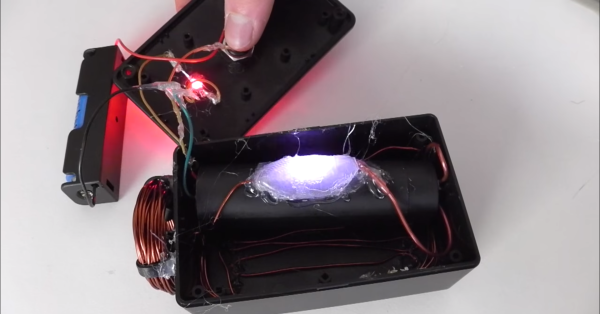
emp-electromagnetic-pulse-jra-1cg_wq4mp4-shot0001Our curiosity into this phenomenon was piqued when we featured an “EMP generator” from [FPS Weapons]. The device doesn’t create an enrapturing movie-esque EMP pulse suitable for taking down a casino or two, but it does spew a healthy amount of broadband electromagnetic interference (EMI) in every direction. It probably also doesn’t send the EMI very far; as we’ve seen in many other projects, it’s hard to transfer energy through the air. It got us wondering, though: what is the difference between being annoying and creating a weapon? And, is there any practical use for a device like this?


Continue reading “Electromagnetic Pulse: Pure Hollywood?”

Microwave Ovens Turn You Into Spiderman

Want to climb a wall like Spiderman? No problem – just whip up a climbing rig with microwave oven transformers. And find a steel building. And rewrite the canon so that Peter Parker is bitten by an electromagnetic spider instead of a radioactive one.

Back in the reality-based world, you’d probably be taking you life in your hands if you use [Make It Extreme]’s rig to get more than a dozen feet above the ground. The basics are pretty sound, but the devil is in the details. Four MOTs are cut and stripped of their secondary coils and attached to fixtures for the feet and hands. A backpack full of gel cell batteries powers the rig, and simple normally closed switches in the handholds control both the foot and hand magnets on a side.  A click of a switch releases the magnets on one side, allowing the climber to reach up.

And therein lies our safety beef: what happens when you make a mistake and push both buttons at the same time? Seems like this build is screaming for some control circuitry that prevents this most obvious failure mode. We’re not ones to throw an Arduino at every problem, but in this case it may make sense, especially when it could monitor your time left before cratering the charge remaining in the battery pack.

Still, like most dangerous stunts, this looks really cool. If you’ve got any ideas for improvements in the controls, leave them in the comments below. And if you’re interested in transforming yourself into a superhero, learn from a guy who’s actually doing it – our own [James Hobson]. Check out some of his builds, like the Captain America shield or his car-lifting exoskeleton.

Continue reading “Microwave Ovens Turn You Into Spiderman”

Too Good To Throw Away: Dealing With An Out-Of-Control Junk Hoard

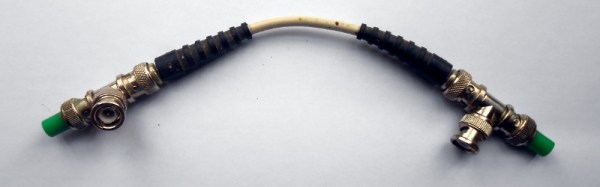
There it was, after twenty minutes of turning the place over, looking through assorted storage boxes. A Thinwire Ethernet network. About the smallest possible Thinwire Ethernet network as it happens, a crimped BNC lead about 100mm long and capped at each end by a T-piece and a 50 ohm terminator. I’d been looking for a BNC T-piece on which to hook up another terminator to a piece of test equipment, and I’d found two of them.

As I hooked up the test I wanted to run I found myself considering the absurdity of the situation. I last worked somewhere with a Thinwire network in the mid 1990s, and fortunately I am likely to never see another one in my life. If you’ve never encountered Thinwire, be thankful. A single piece of co-ax connecting all computers on the network, on which the tiniest fault causes all to fail.

So why had I held on to all the parts to make one, albeit the smallest possible variant? Some kind of memento, to remind me of the Good Old Days of running round an office with a cable tester perhaps? Or was I just returning to my past as a hoarder, like a Tolkienic dragon perched atop a mountain of electronic junk, and not the good kind of junk?

Continue reading “Too Good To Throw Away: Dealing With An Out-Of-Control Junk Hoard”

Blinking An LED – Extreme Edition

This hacker’s video on blinking LEDs never got the recognition it deserves. At the time of writing clocking in at just 61 views, but it is indeed a work of art. Just trust me, scroll to the bottom of the article and watch it, you wont be disappointed.

Not convinced? OK, let me tell you about it and the world it has opened up in the Japanese maker scene. We’ve all blinked an LED. Maybe it was just to test a microcontroller, like the simplest Arduino example.

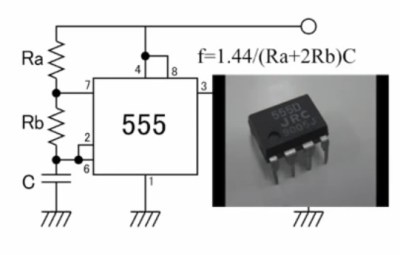
blink555

Or we’ve been a tad more old school and used the classic 555 to do it. Or maybe like me, you went through a phase of hacking together Phase Shift and other oscillators because well… it’s fun!

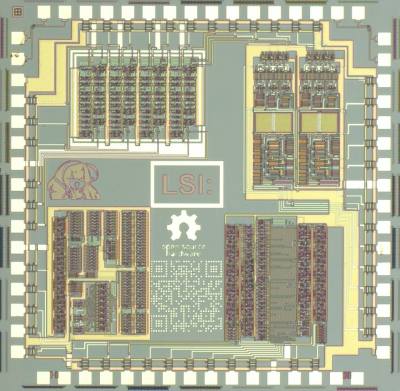
But [Junichi AKITA] has more extreme tastes, deciding that a custom IC layout is the way to go. [Junichi] designed a ring oscillator composed of flip-flops, then hand laid out each MOSFET placing each layer exactly where it should be fabricated.

The resulting design was then fabricated by an academic shuttle service in Japan (a bit like the well known MOSIS service). The result is a tiny circuit in the top right corner of the IC. Which of course [Junichi] then had to wirebond (check the video for a cool 1980s style Westbond machine which are still hugely popular in Japan).

[Junichi] bonded the die directly to a PCB (COB). I assume, purely for irony, a 555, and ATtiny based oscillator were also laid out on the board.

makelsi_icI guess you might have a couple of lingering questions. First you’ll likely bemoan your lack of your own fabrication facility (I’m still eyeing those used 1 micron fab lines that crop up on eBay from time to time). And secondly you might be asking yourself… why?


Both these questions are somewhat answers by the MakeLSI project. This growing project in Japan seems to have opened up semiconductor fabrication to all kinds of projects.

While my Japanese isn’t good enough to fully understand what’s happening it’s clear there are many awesome projects going on. Including joys such as IC layouts designed in vector graphics packages (Inkscape) and die images packed with interesting layouts, anime characters and QR codes.

For more awesome images and information (unfortunately all in Japanese) you can check them out on Facebook or on their homepage.

Continue reading “Blinking An LED – Extreme Edition”

Become Very Unpopular Very Fast With This DIY EMP Generator

Taking a break from his book, “How to Gain Enemies and Encourage Hostility,” [FPS Weapons] shows us how to build our own handheld EMP generator which can be used to generate immediate dislike from anyone working on something electronic at the hackerspace.

The device is pretty simple. A DC source, in this case an 18650 lithium battery cell, sends power to an “Ultra High Voltage 1000kV Ignition Coil” (as the eBay listing calls it), when a button is pressed. A spark gap is used to dump a large amount of magic pixies into the coil all at once, which generates a strong enough magnetic pulse to induce an unexpected voltage inside of a piece of digital electronics. This usually manages to fire a reset pin or something equivalent, disrupting the device’s normal operation.

While you’re not likely to actually damage anything in a dramatic way with this little EMP, it can still interrupt an important memory write or radio signal and damage it that way. It’s a great way to get the absolute shock of your life if you’re not careful. Either from the HVDC converter or the FCC fines. Video after the break.

Continue reading “Become Very Unpopular Very Fast With This DIY EMP Generator”

Ask Hackaday: DIY Handwriting Recognition

Computer handwriting recognition is very cool by itself, and it’s something that we’d like to incorporate into a project. So we went digging for hacker solutions, and along the way came up with an interesting bit of history and some great algorithms. We feel like we’ve got a good start on that front, but we’re stuck on the hardware tablet sensor itself. So in this Ask Hackaday, we’re going to make the case for why you could be using a tablet-like device for capturing user input or doing handwriting recognition, and then we’re going to ask if you know of any good DIY tablet designs to make it work.

Continue reading “Ask Hackaday: DIY Handwriting Recognition”

NextThingCo Introduces C.H.I.P. Pro, GR8 System On Module

NextThingCo, makers of the very popular C.H.I.P. single board Linux computer, have released the latest iteration of their hardware. It’s the C.H.I.P. Pro, an SBC designed to be the embedded brains of your next great project, product, or Internet of Things thing.

The C.H.I.P. Pro features an Allwinner R8 ARMv7 Cortex-A8 running at 1 GHz, a MALI-400 GPU, and either 256 MB or 512 MB of NAND Flash. The Pro also features 802.11 b/g/n WiFi, Bluetooth 4.2, and is fully certified by the FCC. This board will be available in December at supposedly any quantity for $16.

The design of the C.H.I.P. Pro is a mix between a module designed to be installed in a product and a single board computer designed for a breadboard. It features castellated edges like hundreds of other modules, but the design means that assembly won’t be as simple as throwing down some paste and reflowing everything. The C.H.I.P. Pro features parts on two sides, making reflow questionable and either 0.1″ headers or a cutout on a PCB necessary. As a single board computer, this thing is small, powerful, and a worthy competitor to the Raspberry Pi Zero. A C.H.I.P. Pro development kit, consisting of two C.H.I.P. Pro units, a ‘debug’ board, and headers for breadboarding, is available for $49, with an estimated ship date in December.

A $16 Linux module with WiFi, Bluetooth, and no NDA is neat, but perhaps a more interesting announcement is that NextThingCo will also be selling the module that powers the C.H.I.P. Pro.

The GR8 module includes an Allwinner R8 ARMv7 Cortex-A8 running at 1 GHz, a MALI-400 GPU, and 256 MB of DDR3 SDRAM. Peripherals include TWI, two UARTS, SPI (SD cards support is hacked onto this), two PWM outputs, a single 6-bit ADC, I2S audio, S/PDIF, one USB 2.0 Host and one USB 2.0 OTG, and a parallel camera interface. This isn’t really a chip meant for video out, but it does support TV out and a parallel LCD interface. A limited datasheet for the GR8 is available on the NextThingCo GitHub.

Putting an entire Linux system on a single BGA module must draw comparisons to the recent release of the Octavo Systems OSD355X family, best known to the Hackaday audiences as the Beaglebone on a chip. Mechanically, the Octavo chip will be a bit easier to solder. Even though it has almost twice as many balls as the GR8, 400 on the Octavo and 252 on the GR8, the Octavo has a much wider pitch between the balls, making escape routing much easier.

Comparing peripherals between the OSD355X and GR8, it’s a bit of a wash, with the OSD coming out slightly ahead with Ethernet, more RAM and fancy TI PRUs. Concerning pricing, the GR8 wins hands down at $6 per chip in any quantity. That’s significantly less than the OSD355X.

The original C.H.I.P. has been exceptionally well received by the community NextThingCo is marketing to, despite the community’s distaste for Allwinner CPUs, cringeworthy PR, and questions concerning the true price of the C.H.I.P.. The C.H.I.P. Pro will surely see more than a few uses, but the GR8 is the real story here. A jellybean part that contains an entire Linux system has been the fevered dream of a madman for years now. The GR8 makes putting the power of open software into any project much easier, and we can’t wait to see the applications it allows.