The Quantum Eraser

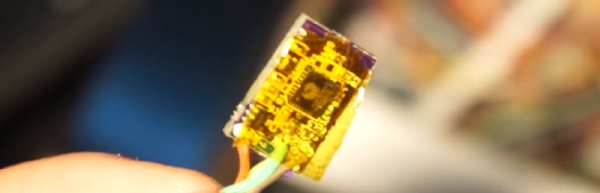
Richard Feynmann noted more than once that complementarity is the central mystery that lies at the heart of quantum theory. Complementarity rules the world of the very small… the quantum world, and surmises that particles and waves are indistinguishable from one other. That they are one and the same. That it is nonsensical to think of something, or even try to visualize that something as an individual “particle” or a “wave.” That the particle/wave/whatever-you-want-to-call-it is in this sort of superposition, where it is neither particle nor wave. It is only the act of trying to measure what it is that disengages the cloaking device and the particle or wave nature is revealed. Look for a particle, and you’ll find a particle. Look for a wave instead, and instead you’ll find a wave.

Complementarity arises from the limits placed on measuring things in the quantum world with classical measuring devices. It turns out that when you try to measure things that are really really really small, some issues come up… some fundamental issues.  For instance, you can’t really know exactly where a sub-atomic particle is located in space. You can only know where it is within a certain probability, and this probability is distributed through space in the form of a wave. Understanding uncertainty in measurement is key to avoiding the disbelief that hits you when thinking about complementarity.

This article is a continuation of the one linked above. I shall pick up where I left off, in that everyone agrees that measurement on the quantum scale presents some big problems. However, not everyone agrees what these problems mean. Some, such as Albert Einstein, say that just because something cannot be measured doesn’t mean it’s not there. Others, including most mainstream physicists, say the opposite — that if something cannot be measured, it for all practical purposes is not there. We shall continue on our journey by using modern technology to peer into the murky world of complementarity. But first, a quick review.

Continue reading “The Quantum Eraser”

Hackaday Prize Entry: Adblock For TV

Contact, the 1985 book by Carl Sagan, was significantly better than the movie. Five people went through the wormhole, three machines were made (in Russia, Wyoming, and a third on Hokkaido), Erbium did something, and the novelization provided much better worldbuilding. One of the more interesting characters in the book was H.R. Haddon, the megalomaniacal business man, made his first million designing a chip that would block advertisements on TV. The book strongly suggests this commercial-blocking chip was a purely analog device, a concept that would have been an amazing abuse of NTSC produced by a damn fine engineer.

Now, even though cord cutting is commonplace and streaming is taking over, there’s still commercials on Hulu. In a few months, I’ll have to pay $5 a month to watch Star Trek with commercials. There is obviously a market for ‘adblock for TV’, and that’s what [PixJuan] is doing for his Hackaday Prize entry.

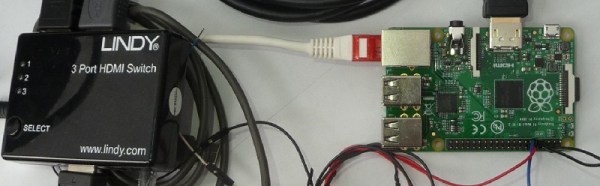
[Juan]’s device is a basically an HDMI switch with a remote that’s pressed every time the ads start to show on a broadcast. This switch will change the input of the HDMI switch from a cable box to a Raspberry Pi and play a short video clip or something else that isn’t selling you crap. When the Raspi is done, the switch goes back over to the original input.

With a bit of computation in this adblock-for-TV device, there are a few more options for ad detection. The Raspberry Pi could build a database of when ads play and for how long, depending on the channel. This is a great project that has a lot of potential to use some interesting techniques like computer vision and machine learning for the goal of removing commercials before they start.

Run A RepRap On An ESP8266

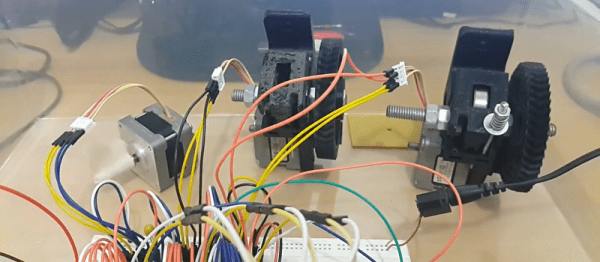
What can’t the little $5 WiFi module do? Now that [lhartmann] has got an ESP8266 controlling the motors of a 3D printer, that’s one more item to check off the list.

What’s coolest about this project is the way that [lhartmann] does it. The tiny ESP8266 has nowhere near the required number of GPIO pins, the primary SPI is connected to the onboard flash memory, and the secondary SPI is poorly documented and almost nobody uses it. So, [lhartmann] chose to use the I2S outputs.

I2S is most often an audio protocol, so this might at first seem like a strange choice. Although I2S sounds like I2C, it’s really essentially an SPI protocol with a fourth wire that alternates to designate the right or left channel. It’s actually just perfect for sending 16×2 bits of data at high data rates.

[lhartmann] takes these 32 bits and feeds them into four shift registers, producing 32 outputs from just the four I2S data lines. That’s more than enough signals to run the stepper motors. And since it updates at 192 kHz sample rate, it’s plenty fast enough to drive them.

The other side benefit of this technique is that it can work on single-board computers with just a little bit of software. Programming very complicated stepper movements then becomes just a matter of generating the right “audio” file and playing it out. [lhartmann] demonstrated this earlier with an Orange Pi. That’s pretty cool, too.

The code for turning the ESP8266 and a short handful of 74HC595s into a 3D printer controller are up on GitHub, so go check it out.

Thanks [CNLohr] for the tip!

What Is There To Know About Resistors?

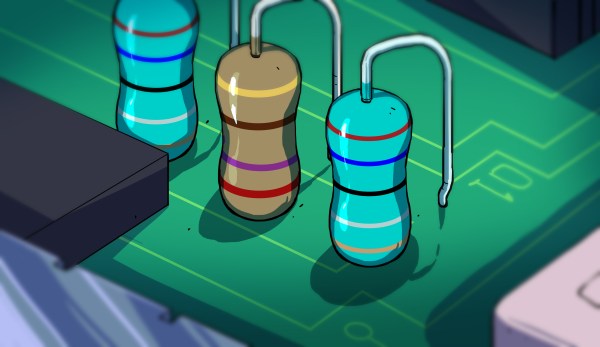
Resistor: A passive chunk of material that resists the flow of electrical current. A terminal is connected to each end you’re done. What could be simpler?

It turns out it’s not so simple at all. Temperature, capacitance, inductance and other factors all play a part in making the resistor a rather complex component after all. Even its uses in circuits are many, but here we’ll just focus on the different types of fixed-value resistors, how they’re made, and what makes them desirable for different applications.

Let’s start with a simple one, and one of the oldest.

Continue reading “What Is There To Know About Resistors?”

New Part Day: The ESP32 Has Been Released

A few years ago, a strange little chip showed up on Seeed Studio one day. It was the ESP8266, originally sold as a serial to WiFi adapter. Since then, the microcontroller in this wee WiFi module was discovered, and the ESP8266 has been the breakout module for hundreds of Internet of Thing modules, and other wireless baubles.

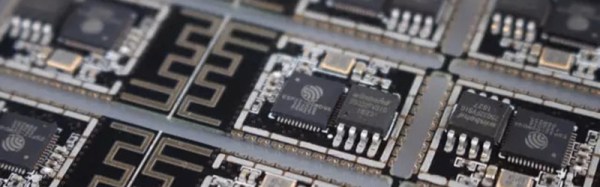
The company behind the ESP8266, Espressif, wasn’t sitting on their laurels for the last few years. They’ve been working on a followup to the ESP8266. It’s the ESP32, and it’s faster, has more peripherals, better WiFi, and Bluetooth LE. Since Christmas, we’ve been ogling this chip. Now, it’s finally out. You can buy an ESP32 right now. Consider the ESP32 released.

Almost exactly two years ago, the forerunner of the ESP32 was released, allowing anyone to blink a LED from the Internet for five dollars. There was a catch with the release of the ESP8266, and that was documentation. Documentation in English did not exist, and it took Espressif a while to realize the hit they had on their hands. Even now, with a proper English datasheet from Espressif, we don’t know if the ESP8266 has 5V tolerant pins. Documentation was an issue for the ESP8266, but it didn’t really matter because someone on the Internet figured it out.

History doesn’t repeat itself, but it is the franchise with the most reboots. There’s some documentation for the ESP32, but it’s far from complete. There’s a CAN bus peripheral in the ESP32, but no one knows what pins it’s attached to. There are some secrets hidden away, but no one is at liberty to discuss them. No one outside Espressif has any idea if the specs are real. This will, of course, change in the next month or so, but only due to the tireless work of electronics enthusiasts the world over.

Right now, there are several listings on the usual online outlets including Espressif’s Taobao shop and Seeed Studio offering either bare ESP32 chips or modules based on this WiFi Bluetooth wonder. These modules include the ESP-Wroom-32 (PDF) that is seemingly based on the ESP31 test modules released late last year and the ESP3212, a module based on the popular ESP8266-12. There are also bare chips floating about.

As far as any new information regarding the ESP32 is concerned, don’t expect much. It’s released, though, and in a month or so the work of documenting this supposed wonderchip will begin.

Although they’re not available to everyone quite yet, we have two ESP-32 modules in hand, and [Elliot] is currently slogging through installing the toolchain and getting everything working. Watch this space, because we’re going to have an Introduction to the ESP-32 post up shortly.

Retrotechtacular: Home Video Recording

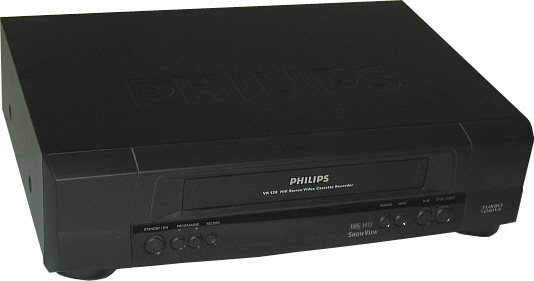
The news has been full of reports that the last company manufacturing consumer VCRs will cease making them this year. I think most of us are surprised that the event is only happening now. After all, these days, video recording is likely to be on a hard drive, a USB stick, or on a server somewhere. Even recording to DVDs seems a bit quaint these days.

VCR-03Back before there were web sites, people had to get information from magazines like Popular Electronics, Radio Electronics, and a few others. In the late 1960s and early 1970s, it was common to see these magazines predict that this would be the year of the home video recording system. For example, in 1971, [Lou Garner] wrote: “…they [Sony] hope will put home videotape playing in the same living room as conventional high-fidelity sound systems.” You should know that the video cassette he was talking about was 8 inches wide by 5 inches deep (a big larger than a VHS tape) and contained 3/4 inch magnetic tape (VHS used 1/2 inch tape). The 32-pound player had a retail price of about $350 (about $2,000 in today’s dollars; remember gas was $0.36 a gallon and eggs were $0.53 a dozen). It would be several years before VHS and Betamax would duke it out for home supremacy.

Continue reading “Retrotechtacular: Home Video Recording”

Software USB On The ESP8266

A while back, [cnlohr] needed a USB keyboard and mouse. His box ‘o junk didn’t hold this particular treasure, and instead of hopping on Amazon like a normal geek or venturing into the outside realm on a mid-level ‘store’ quest like a normal person, [cnlohr] decided to turn an ESP8266 into a USB keyboard and mouse. How hard could it be? The ESP doesn’t support USB, but bitbanging hasn’t stopped him before. The end result is a USB stack running on the ESP8266 WiFI module.

[cnlohr] has been working for about a month on this USB implementation for the ESP, beginning with a logic analyzer, Wireshark, Xtensa assembly, and a lot of iteration. The end result of this hardware hacking is a board based on the ESP8285 – an 8286 with integrated Flash – that fits snugly inside a USB socket.

This tiny board emulates low-speed USB (1.5 Mbps), and isn’t really fast enough for storage, serial, or any of the fancier things USB does, but it is good enough for a keyboard and mouse. Right now, [cnlohr]’s ESP USB device is hosting a webpage, and by loading this webpage on his phone, he has a virtual keyboard and mouse on a handheld touchscreen.

If you’re keeping track, [cnlohr] has now brought Ethernet and USB to a tiny microcontroller that can be bought for a few bucks through the usual online outlets. If you’d like to build your own ESP USB stick, all the files are over on the Gits.

Thanks [lageos] for the tip.

Continue reading “Software USB On The ESP8266”