Distributed Censorship Or Extortion? The IoT Vs Brian Krebs

Now it’s official. The particular website that was hit by a record-breaking distributed denial of service (DDOS) attack that we covered a few days ago was that of white-hat security journalist [Brian Krebs]: Krebs on Security.

During the DDOS attack, his site got 600 Gigabits per second of traffic. It didn’t involve amplification or reflection attacks, but rather a distributed network of zombie domestic appliances: routers, IP webcams, and digital video recorders (DVRs). All they did was create HTTP requests for his site, but there were well in excess of 100,000 of these bots.

In the end, [Krebs’] ISP, Akamai, had to drop him. He was getting pro bono service from them to start with, and while they’ve defended him against DDOS attacks in the past, it was costing them too much to continue in this case. An Akamai exec estimates it would have cost them millions to continue defending, and [Brian] doesn’t blame them. But when Akamai dropped the shields, his hosting provider would get slammed. [Krebs] told Akamai to redirect his domain to localhost and then he went dark.

Continue reading “Distributed Censorship Or Extortion? The IoT Vs Brian Krebs”

Homebrew Powerwall Sitting At 20kWh

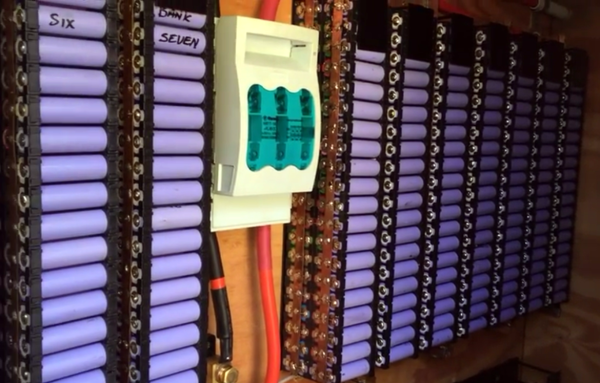
Every now and then a hacker gets started on a project and forgets to stop. That’s the impression we get from [HBPowerwall]’s channel anyway. He’s working on adding a huge number of 18650 Lithium cells to his home’s power grid and posting about his adventures along the way. This week he gave us a look at the balancing process he uses to get all of these cells to work well together. Last month he gave a great overview of the installed system.

His channel starts off innocently enough. It’s all riding small motor bikes around and having a regular good time.  Then he experiments a bit with the light stuff, like a few solar panels on the roof.  However, it seems like one day he was watching a news brief about the Powerwall (Tesla’s whole-home battery storage system) and was like, “hey, I can do that.”

After some initial work with the new substance it wasn’t long before he was begging, borrowing, and haggling for every used 18650 lithium battery cell the local universe in Brisbane, Australia could sell him. There are a ton of videos documenting his madness, but he’s all the way up to a partly off-grid house with a 20kWh battery bank, for which he has expansion plans.

There’s a lot of marketing flim flam and general technical pitfalls in the process of generating your own non-grid electricity. But for hackers in sunny areas who want to dump those rays into local storage this is an interesting blueprint to start with.

Continue reading “Homebrew Powerwall Sitting At 20kWh”

New SuperCon Badge Is 40% Lighter And A Work Of Art

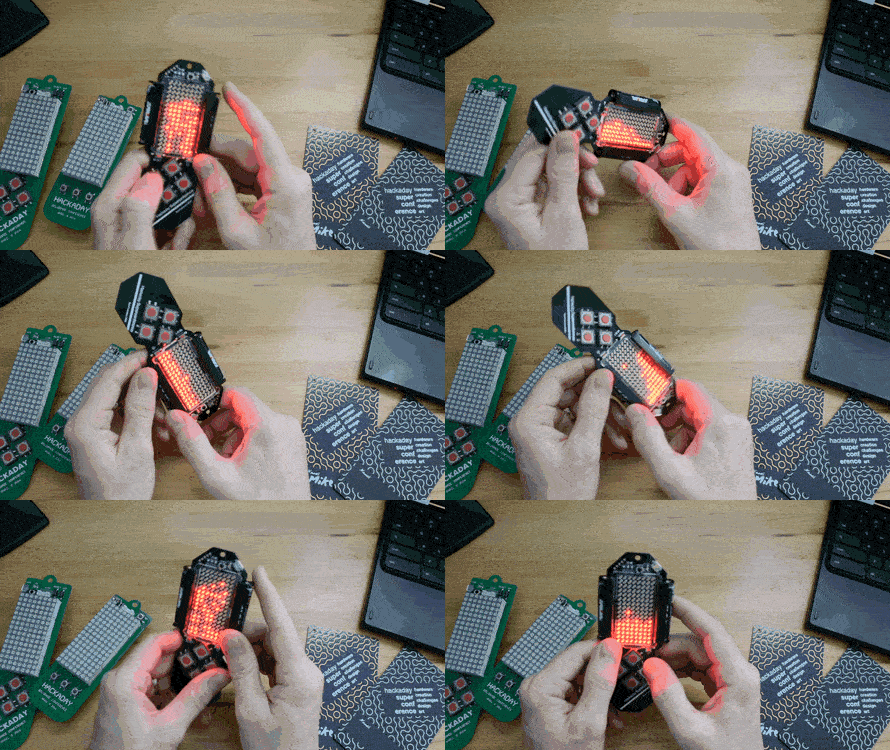
The 2016 Hackaday SuperConference is just around the corner and today we get a good look at the hardware badge. It was designed by [Voja Antonic] — a legend of hardware creation who will be at the conference. I like to think of him as the Woz of the Eastern Bloc, having designed the Galaksija computer. This badge is a beautiful example of embedded design. We’ll dive into all of the details after the break.

Get your ticket now for 48-hours of talks, workshops, the Hackaday Prize party, badge hacking,  and so much more.

Continue reading “New SuperCon Badge Is 40% Lighter And A Work Of Art”

Songbird, A Mostly 3D Printed Pistol That Appears To Actually Work

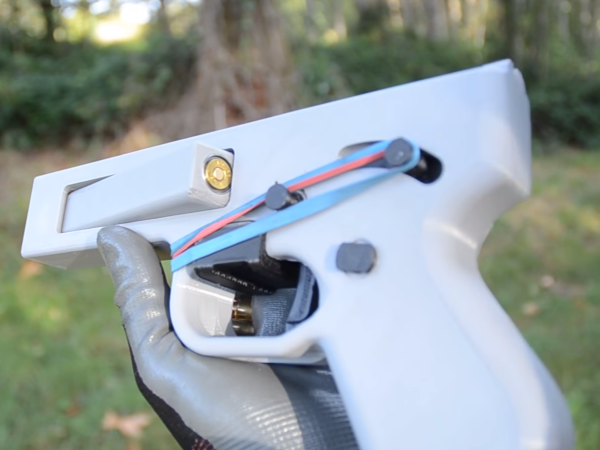
[Guy in a garage] has made a 3D printed gun that not only appears to fire in the direction pointed, it can also do it multiple times. Which, by the standard of 3D printed guns, is an astounding feat. He started with .22 rifle cartridges but has since upgraded and tested the gun with .357 rounds. The link above is a playlist which starts of with an in-depth explanation of the .22 version and moves through design iterations

This gun prints on a standard FDM printer. Other 3D printable guns such as the infamous Liberator or the 3D printed metal gun need more exotic or precise 3D printing to work effectively. The secret to this gun’s ability is the barrel, which can be printed in nylon for .22 cartridges, or in ABS plus a barrel liner for .22 and .357 caliber.

A barrel liner is one way to repair a gun that has aged and is no longer shooting properly. Simply put, it is a long hardened metal tube with rifling on the inside. Some guns come out of the factory with one, and a gunsmith simply has to remove the old one and replace it. Other guns need to be bored out before a liner can be installed.

The metal liner surrounded by plastic offers enough mechanical strength for repeat firings without anyone losing a hand or an eye; though we’re not sure if we recommend firing any 3D printed gun as it’s still risky business. It’s basically like old stories of wrapping a cracked cannon in twine. The metal tries to expand out under the force of firing, but the twine, which would seem like a terrible material for cannon making, is good in tension and when wrapped tightly offers more than enough strength to hold it all together.

This is also how he got the .357 version to work. The barrel slots into the gun frame and locates itself with a rounded end. However, with the higher energy from a .357 round, this rounded end would act as a wedge and split the 3D printed frame. The fix for this was simple. Glue it back together with ABS glue, and then wrap the end of the assembly with a cable tie.

This is the first 3D printed gun we’ve seen that doesn’t look like a fantastic way to instantly lose your hand. It’s a clever trick that took some knowledge of guns and gunsmithing to put together. Despite the inevitable ethical, moral, and political debate that will ensue as this sort of thing becomes more prevalent, it is a pretty solid hack and a sign that 3D printing is starting to work with more formidable engineering challenges.

Line Follower With No Arduino

There’s hardly a day that passes without an Arduino project that spurs the usual salvo of comments. Half the commenters will complain that the project didn’t need an Arduino. The other half will insist that the project would be better served with a much larger computer ranging from an ARM CPU to a Cray.

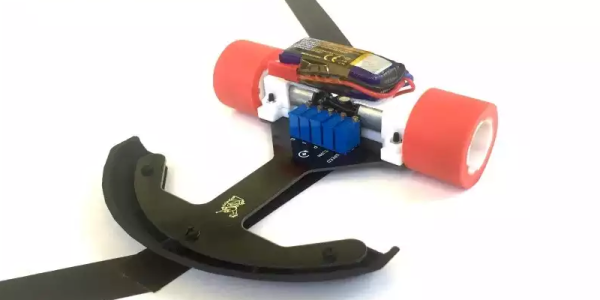
[Will Moore] has been interested in BEAM robotics — robots with analog hardware instead of microcontollers. His latest project is a sophisticated line follower. You’ve probably seen “bang-bang” line followers that just use a photocell to turn the robot one way or the other. [Will’s] uses a hardware PID (proportional integral derivative) controller. You can see a video of the result below.

Continue reading “Line Follower With No Arduino”

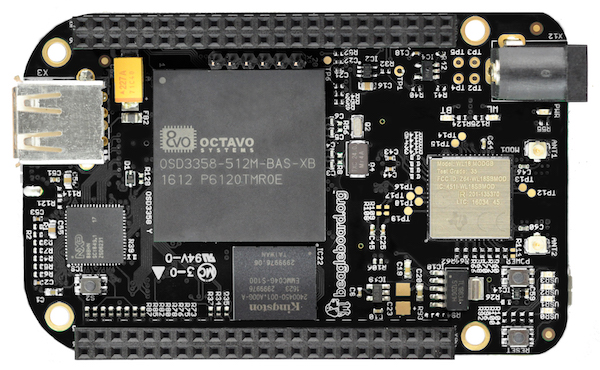
New Part Day: Wireless BeagleBones On A Chip

The BeagleBone is a very popular single board computer, best applied to real-time applications where you need to blink LEDs really, really fast. Over the years, the BeagleBone has been used for stand-alone CNC controllers, the brains behind very large LED installations, and on rare occasions has been used to drive CRTs. If you just want a small Linux board, get a Pi. If you want to do something interesting with hardware, get a BeagleBone.

The BeagleBone ecosystem has grown a lot in the last year, from the wireless and Grove connector equipped BeagleBone Green, the robotics-focused BeagleBone Blue, the Zoolander-inspired Blue Steel. Now there’s a new BeagleBone, built around a very interesting System on Module introduced earlier this year.

The new board is called the BeagleBone Black Wireless, and it brings to the table all you know and love about the BeagleBone. There’s a 1GHz ARM355x with two 32-bit 200MHz PRUs for the real-time pin toggling. RAM is set at 512MB, with 4GB of eMMC Flash and Debian pre-installed, and a microSD card for larger storage options. The new feature is wireless connectivity: a TI WiFi and Bluetooth module with provisions for 802.11s replaces the old Ethernet connector.

Taken at face value, the new BeagleBone Black Wireless deserves a mention — it’s a BeagleBone with wireless — but isn’t particularly noteworthy. But when you get to the gigantic brick of resin dropped squarely in the middle of the board does the latest device in the BeagleBone family become very, very interesting. The System on Module for this version of the BeagleBone is the BeagleBone On A Chip released a few months ago. The Octavo Systems OSD335x is, quite literally, a BeagleBone on a chip. It’s a BGA with big balls, making it solderable with hand-applied solder paste and a toaster oven reflow conversion. In fact, the BeagleBone Wireless was designed by [Jason Kridner] in Eagle as a 6-layer board. It’s still a bit beyond the standard capabilities of OSHPark, but the design can still be cut down, and shows how this BeagleBone on a Chip can be applied to other Open Hardware projects.

Automatic Resistance: Resistors Controlled By The Environment

Resistors are one of the fundamental components used in electronic circuits. They do one thing: resist the flow of electrical current. There is more than one way to skin a cat, and there is more than one way for a resistor to work. In previous articles I talked about fixed value resistors as well as variable resistors.

There is one other major group of variable resistors which I didn’t get into: resistors which change value without human intervention. These change by environmental means: temperature, voltage, light, magnetic fields and physical strain. They’re commonly used for automation and without them our lives would be very different.

Continue reading “Automatic Resistance: Resistors Controlled By The Environment”