Driving BB-8 - More than one way to move this bot

Driving BB-8: More Than One Way To Move This Bot

BB-8 is the much loved new droid introduced in the 2016 movie Star Wars: The Force Awakens, though in my case from the very first trailer released in 2014 I liked it for the interesting engineering problems it posed. How would you make a robot that’s a ball that rolls along, but with a head that stays on top while the ball rolls under it?

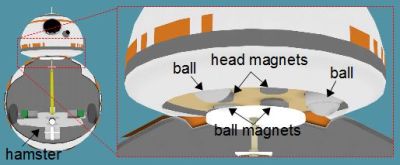
To make the ball roll, the answer most people found obvious at first was to use the analogy of a hamster wheel. The hamster running inside makes the wheel turn. In the BB-8 building world, which is quite large, the drive mechanism has come to be called a hamster drive, or just a hamster.
Magnets holding the head on

For the head, it seemed obvious that there would be magnets inside the ball, perhaps held in place near the top of the ball by a post extending up from the hamster. Corresponding magnets in attraction would then be attached to the underside of the head, and balls (also mounted under the head) would keep the head moving smoothly over the ball.

The magnet approach for the head has turned out to be the method used by all BB-8 builders that I’ve seen. However, the hamster has turned out to be only one of multiple solutions. Since the original debut many different methods have been used in builds and we’re going to have a lot of fun looking at each separate approach. It’s almost like revealing a magic trick; but really it’s all just clever engineering.

Note that for the actual movie, a combination of 7 or 8 props and CGI were used. The official working BB-8s that are shown at various promotional events were built after the movie was made and as of this writing, few details of their construction have been released. One notable detail, however, is that they aren’t using hamster drives.

Below are details of all the different BB-8 drive systems I’ve seen so far that have been built along with how they work.

Continue reading “Driving BB-8: More Than One Way To Move This Bot”

Fail Of The Week: Arachno∙fail∙ia

Going down the list (FCC, CE, UL, etc.) we can’t think of a regulating body that will test for this failure mode. Reportedly, a $1M irrigation system was taken down by a spider. And an itsy-bitsy spider at that.

This fail turned up as a quick image post over on /r/mildlyinteresting but I wasn’t the only electronics person attracted like a moth to a flame. Our friend [Sprite_TM] popped in to answer a question about conformal coating. Seems this board was sealed in a waterproof enclosure but was obviously not conformally coated.

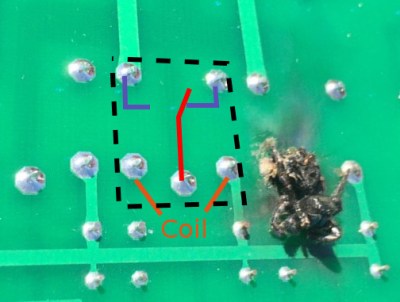
fotw-spider-short-relay-diagram[Sprite_TM] also helped out with some armchair-engineering to guess at what happened. It’s not hard to tell that the footprint on the board looks like a set of mechanical relays all in a line. He looked up the most likely pinout for the relay.

We’ve superimposed that pinout on the board to help illustrate the failure. High voltage comes in on the pin shown with the red trace leading away from it. On either side of that pin are the connections for the low voltage coil which switches from normally closed (the pin in the upper right that is not connected to anything) to the normally open pin (which has the wide trace leading away from it).

So there sat the high voltage pin in between the coil pins when, along came a spider. It shorted the pins and presumably all the way back to the power supply for the low voltage rail. [Fugly_Turnip] (the OP) share some additional detail about the system and this failure; in addition to this card it fried the control module as well.

Another comment on the same thread shares a different story of two boards mounted next to each other with a bug shorting a 1/4″ air gap between two boards and causing similar carnage. Have you encountered Arachno-fail-ia of your own? Let us know below.


2013-09-05-Hackaday-Fail-tips-tileFail of the Week is a Hackaday column which celebrates failure as a learning tool. Help keep the fun rolling by writing about your own failures and sending us a link to the story — or sending in links to fail write ups you find in your Internet travels.

150,000 Members Strong, Hackaday.io Flies Past Another Milestone

We’re growing so fast that soon your mom will be on Hackaday.io. That’s fine, everyone who loves hardware is welcome. 150,000 members have made Hackaday.io a home for their creativity — looking for inspiration in the work of others, sharing successes and temporary failures, and building their dream team to take on amazing new challenges. There is no place in the world that can come close to matching the Open Hardware ecosystem that is Hackaday.io.

What is in that one number, 150k? It is a monumental chunk of a much bigger picture: the thriving Hackaday ecosystem that spans from staking down your own workshop full of projects and skills, to following the editorial pulse of hardware used in new and creative ways. Looking over the last twelve months on all of the Hackaday sites we’ve seen about 18.5 Million visitors and registered nearly 85 Million views. Hackaday is not a passive community. We all have an insatiable hunger to delve into the next big trick, and to celebrate the accomplishments that made it happen.

Want to find a new and unique way to use the tech you find most interesting? Your leap forward needs input to pollinate the idea. Hackaday has a critical mass of hackers, designers, and engineers waiting with excitement to hear and help out in exploring and expanding the frontier. These interaction are what has packed Hackaday.io with interesting people. Most would say: I came for a specific hack or to see what a particular hacker was up to, but then I felt at home and decided to stick around and share what I’ve spent way to much time doing (but I wouldn’t have it any other way).

As we continue to knock down one membership milestone after another I want to thank you all for being involved, for valuing the free and open sharing of information and ideas, and for sharing your own time and talent. You are what moves this community of hardware hackers to dizzying heights of excellence and awesome.

This is all too good to be a secret. Talk to your hardware-loving friends, colleagues, family, and acquaintances and invite them to Hackaday.io if they’re not already with us.

Espressif Releases ESP8266-Killer!

It’s no secret that we love the ESP8266 chip, and the community of hackers that have contributed to making it useful. We often joke about this or that new WiFi-enabler being an ESP8266 killer, but so far none have stepped up. Here we go again!

Espressif has released a chip that’s going to be an ESP8266 killer, and no, it’s not the ESP32. The ESP8285 went into mass production in March, and should start to appear in the usual outlets fairly soon.

What makes it an ESP8266 killer? It’s an ESP8266, but with the flash memory onboard. Nothing more, but also nothing less. What does this mean? Tiny, tiny designs are possible. And, if the street price ends up being right, there’s no reason you wouldn’t opt for built-in flash. (Unless you were planning on doing some ROM hacking.)

Continue reading “Espressif Releases ESP8266-Killer!”

Capacitors Made Easy The Hackaday Way

If you build electronic circuits on a regular basis the chances are you will have used capacitors many times. They are a standard component along with the resistor whose values are lifted off the shelf without a second thought. We use them for power supply smoothing and decoupling, DC blocking, timing circuits, and many more applications.

Different capacitor applications. By Elcap (Own work) [CC0], via Wikimedia Commons
A capacitor though is not simply a blob with two wires emerging from it and a couple of parameters: working voltage and capacitance. There is a huge array of capacitor technologies and materials with different properties. And while almost any capacitor with the right value can do the job in most cases, you’ll find that knowing more about these different devices can help you make something that doesn’t just do the job, but does the best possible job. If you’ve ever had to chase a thermal stability problem or seek out the source of those extra dBs of noise for example you will appreciate this.

Continue reading “Capacitors Made Easy The Hackaday Way”

FCC To Investigate Raised RF Noise Floor

If you stand outside on a clear night, can you see the Milky Way? If you live too close to a conurbation the chances are all you’ll see are a few of the brighter stars, the full picture is only seen by those who live in isolated places. The problem is light pollution, scattered light from street lighting and other sources hiding the stars.

The view of the Milky Way is a good analogy for the state of the radio spectrum. If you turn on a radio receiver and tune to a spot between stations, you’ll find a huge amount more noise in areas of human habitation than you will if you do the same thing in the middle of the countryside. The RF noise emitted by a significant amount of cheaper modern electronics is blanketing the airwaves and is in danger of rendering some frequencies unusable.

Can these logos really be trusted? By Moppet65535 (Own work) [CC BY-SA 3.0], via Wikimedia Commons
If you have ever designed a piece of electronics to comply with regulations for sale you might now point out that the requirements for RF interference imposed by codes from the FCC, CE mark etc. are very stringent, and therefore this should not be a significant problem. The unfortunate truth is though that a huge amount of equipment is finding its way into the hands of consumers which may bear an FCC logo or a CE mark but which has plainly had its bill-of-materials cost cut to the point at which its compliance with those rules is only notional. Next to the computer on which this is being written for example is a digital TV box from a well-known online retailer which has all the appropriate marks, but blankets tens of megahertz of spectrum with RF when it is in operation. It’s not faulty but badly designed, and if you pause to imagine hundreds or thousands of such devices across your city you may begin to see the scale of the problem.

This situation has prompted the FCC Technological Advisory Council to investigate any changes to the radio noise floor to determine the scale of the problem. To this end they have posted a public notice (PDF) in which they have invited interested parties to respond with any evidence they may have.

We hope that quantifying the scale of the RF noise problem will result in some action to reduce its ill-effects. It is also to be hoped though that the response will not be an ever-tighter set of regulations but greater enforcement of those that already exist. It has become too easy to make, import, or sell equipment made with scant regard to RF emissions, and simply making the requirements tougher for those designers who make the effort to comply will not change anything.

This is the first time we’ve raised the problem of the ever-rising radio noise floor here at Hackaday. We have covered a possible solution though, if stray RF is really getting to you perhaps you’d like to move to the National Radio Quiet Zone.

[via Southgate amateur radio news]

Mosaic Palette: Single Extruder Multi-Color And Multi-Material 3D Printing

Lots of solutions have been proposed and enacted for multi-color and multi-material 3D printing, from color mixing in the nozzle to scripts requiring manual filament change. A solution proposed fairly early on was to manually splice the filament together, making a custom spool. The printer would print as normal, but the filament would change color. This worked pretty well, but it was tedious and it wasn’t entirely possible to control where the color change happened on the model.

You’ll find some examples of the more successful manual splicing hacks in the pictures below. Scroll down a bit further to find our interview with Mosaic Manufacturing at Bay Area Maker Faire 2016. They have a new product that automates the filament splicing process with precision as the ultimate goal. It unlocks a single extruder printer to behave like a multi-extruder model without stopping and starting.

Mosaic pulled off a very difficult combination of two methods mentioned above. Their flagship product is a machine they’ve dubbed, “Palette”. It’s an automatic filament splicer. Up to four different filaments can feed into Palette, and it will splice them at determined intervals. This would be cool by itself, if only to save the tedium of splicing and winding a custom spool by hand.

The real killer app with Palette, however, is the software that runs alongside it. Palette can take the GCODE output of any properly prepared multi material file from any slicer, and then precisely combine and splice the filament. This can feed into any printer without modifying it, aside from sticking an encoder somewhere in the filament path. The results are indistinguishable from a dual, or quad extruder set-up.

Continue reading “Mosaic Palette: Single Extruder Multi-Color And Multi-Material 3D Printing”