Another Small Linux Computer With Pi In Its Name

Since the introduction of the Raspberry Pi, the embedded Linux scene has been rocked by well supported hardware that is produced in quantity, a company that won’t go out of business in six months, and a huge user base. Yes, there are a few small problems with the Raspberry Pi and its foundation – some stuff is still closed source, the Foundation itself plays things close to their chests, and there are some weird binary blobs somebody will eventually reverse engineer. Viewed against the competition, though, nothing else compares.

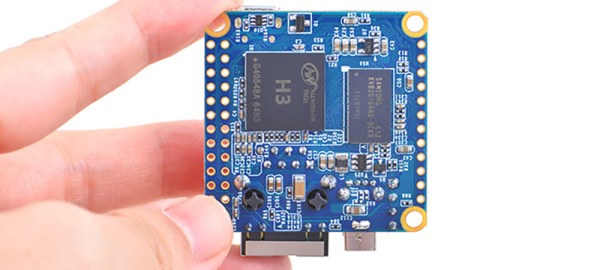
Here’s the NanoPi Neo, the latest quad-core Allwinner board from a company in China you’ve never heard of.

The NanoPi Neo is someone’s answer to the Raspberry Pi Zero, the very small and very cheap single board Linux computer whose out-of-stock percentage has led some to claim it’s completely fake and a media conspiracy. The NanoPi Zero features an Allwinner H3 quad-core Cortex-A7 running at 1.2 GHz, 256MB RAM, with a 512MB version being released shortly. Unlike the Raspberry Pi Zero, the NanoPi Neo features a 10/100 Ethernet port. No, it does not have PoE.

As with anything comparing itself to the Raspberry Pi Zero, only two things are important: size and price. The NanoPi Neo is a mere 40mm square, compared to the 65x30mm measurements of the Pi Zero. The NanoPi Neo is available for $7.99, with $5 shipping to the US. Yes, for just three dollars more than a Pi Zero with shipping, you get a poorly supported Linux board. What a time to be alive.

If you’re looking for another wonderful tale of what happens with cheap, powerful ARM chips and contract manufacturers in China, check out my review of the Pine64.
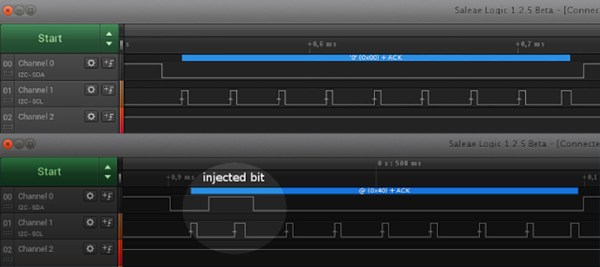
I2C Bit Injection Adds Memory Banks To Everything

[Igor] wished to upgrade his newly acquired radio — a Baofeng UV-82 — with a larger memory for storing additional scanning channels, and came up with a very elegant solution: Replacing it’s EEPROM with a larger one and injecting the additional memory address bits into the I2C data line.

Continue reading “I2C Bit Injection Adds Memory Banks To Everything”

Micropython Binaries For The ESP8266 To Be Released

MicroPython is a Kickstarted project that brings Python to small, embeddable devices. As part of the terms of the Kickstarter, supporters were to get exclusive access to binary builds, with a few exceptions. Now it looks like the ESP8266-version is going to be added to the binary list. This is awesome news for anyone who enjoys playing around with the popular WiFi chip.

But even more heartwarming is the overwhelming response of the Kickstarter’s backers for making the binary builds public. Basically everyone was in favor of opening the binaries up to the general public, and many wrote that they wanted public binaries all along. People can be so giving.

But there’s also something in it for them! The more people get behind MicroPython, the more (free and paid) development support it will warrant, and the more bug reports it will garner. Wins all around. So keep clicking refresh on the binary list until you see it live. Or better yet, if you’re interested, head over to the forum. (Or just wait for us to cover it here. You know we will.)

The Dubious Claim Of A World Helium Shortage

If you’ve been reading the news lately, you doubtless read about the find of a really big new helium gas field in Tanzania. It’s being touted as “life-saving” and “game-changing” in the popular media, but this is all spin. Helium is important for balloon animals, scientists, and MRI machines alike, but while it’s certainly true that helium prices have been rising steadily since 2000, this new field is unlikely to matter all that much in the grand scheme of things.

helium_uses
Source: USGS

The foundation of every news story on helium is that we’re running out of the stuff. As with most doomsday scenarios, the end of the world’s supply of helium is overstated, and we don’t just mean in light of the new Tanzanian field. Helium is the second-most abundant element, making up 24% of the total mass of the universe. And while the earth has a disproportionate amount of heavier elements, helium is in rocks everywhere. It’s just a question of getting it out, and at what price that’s viable.

So while we’re stoked that the era of (relatively) cheap helium can continue onwards for a few more years, we’re still pretty certain that the price is going to continue to rise, and our children’s children won’t be using the stuff for something so frivolous as blowing up party balloons — it’ll be used primarily, as it is now, where it’s more valuable: in science, medicine, and industry.

Let’s take this moment to reflect on the economics of second-lightest element. Here’s to you, Helium!

Continue reading “The Dubious Claim Of A World Helium Shortage”

What’s Special About Fifty Ohms?

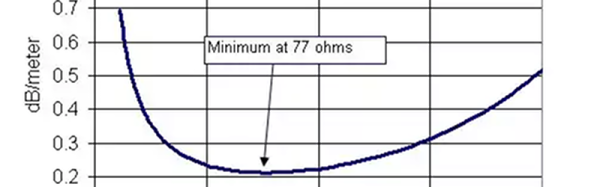
If you’ve worked with radios or other high-frequency circuits, you’ve probably noticed the prevalence of 50 ohm coax. Sure, you sometimes see 75 ohm coax, but overwhelmingly, RF circuits work at 50 ohms.

[Microwaves 101] has an interesting article about how this became the ubiquitous match. Apparently in the 1930s, radio transmitters were pushing towards higher power levels. You generally think that thicker wires have less loss. For coax cable carrying RF though, it’s a bit more complicated.

First, RF signals exhibit the skin effect–they don’t travel in the center of the conductor. Second, the dielectric material (that is, the insulator between the inner and outer conductors) plays a role. The impedance is also a function of the dielectric material and the diameter of the center conductor.

Continue reading “What’s Special About Fifty Ohms?”

Open Source Solar

What’s the size of a standard euro-palette, goes together in 15 minutes, and can charge 120 mobile phones at one time? At least one correct answer is Sunzilla, the open source solar power generator. The device does use some proprietary components, but the entire design is open source. It contains solar panels, of course, as well as storage capacity and an inverter.

You can see a video about the project below. The design is modular so you can pick and choose what you want. It also is portable, stackable, and easy to transport. The team claims they generate 900W of solar power and can store 4 kWh. Because of the storage device, the peak power out is 1600W and the output is 230V 50Hz AC.

Continue reading “Open Source Solar”

A Jailbreak For Every Kindle

[Geekmaster] wrote in to tell us about a new hack for the Amazon Kindle. It’s a jailbreak. Universal jailbreak for almost every eInk Kindle eReader eOut eThere.

This jailbreak is a pure software jailbreak for the Kindle Paperwhite 2, the Kindle Paperwhite 3, Kindle Touch, Kindle Voyage, and Kindle Oasis. If you’re keeping track, that’s any 6th, 7th, or 8th generation device, running any firmware version. Already the jailbreak has been tested by over one thousand people, after the cloud served up half a Terabyte of jailbreak image downloads. That’s extraordinarily popular for a device that hasn’t seen much action of late.

Several years ago, [Geekmaster] made a name for himself – and for [NiLuJe], [KNC1], and other developers over at the Mobileread forums – for jailbreaking the Kindle Paperwhite. This jailbreak was, and is extremely simple; just upload a file to the root directory, restart, and the Kindle is jailbroken. The latest development extends this to nearly all Kindle models, while still being as easy to deploy as the original hack from four years ago.

If you’re looking for something to do with a neat jailbroken device with an eInk screen, they make a great serial consolethermostat, and wallpaper.