Suspension bridges are far and away the target of choice in America’s action blockbusters. In just the past three years, the Golden Gate Bridge has been destroyed by a Kaiju, Godzilla, a Skynet-initiated nuclear blast, and a tsunami. Americans don’t build real bridges anymore, or maintain the ones that we have, but we sure love to blow them up in movies.
There is logic here: A disaster scene involving a famous bridge serves both to root the film in the real world and to demonstrate the enormity and the immediacy of the threat. The unmaking of these huge structures shocks us because many bridges have gained an aura of permanence in our collective consciousness. Although we know when the Brooklyn Bridge was built and who built it, we feel like it has always been there and always will be. The destruction of our familiar human topography is even more disturbing than the deaths of the CGI victims, and I’m not just saying that as a misanthrope who loves bridges.
However, in all of the planning, storyboarding, rendering, and compositing of these special effects shots, nobody pauses to consider how suspension bridges actually behave. I can accept messianic alien orphan superheroes and skyscraper-sized battle robots, but I will not stand for inaccurate portrayals of structural mechanics. It’s fine to bend the laws of physics if the plot warrants it, but most suspension bridge mistakes are so needless and stupid that their only function seems to be irritating engineers.
The 2015 Hackaday Prize challenged people to build something that matters. Specifically, to solve a problem faced by a lot of people and to make the solution as open as possible. If the average hacker can build it, it puts the power to vastly improve someone’s life in their hands. This is a perfect example of how powerful Open Design can be.
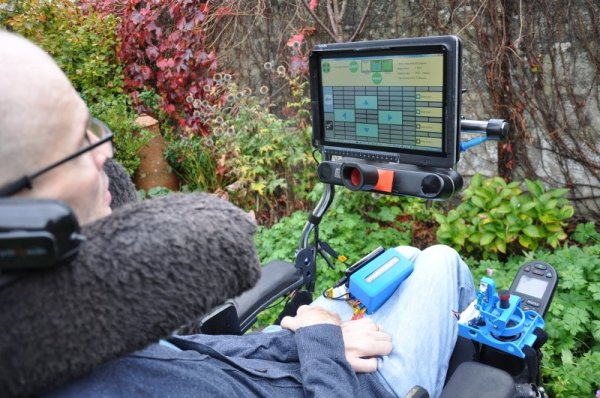
Patrick Joyce, Steve Evans, and David Hopkinson, developed a way to control an electric wheelchair using eye movements. The project, called Eyedrivomatic, is a set of non-invasive hardware modules that connect the wheelchair joystick with existing Eyegaze technology.
You’re probably already familiar with Eyegaze, which allows people suffering from diseases like MND/ALS to speak through a computer using nothing but their eyes. Eyedrivomatic extends this gaze control to drive a wheelchair. The catch is that the wheelchair’s user may not actually own the chair, and so permanent modifications cannot be made.
Thus Eyedrivomatic connects a wheelchair to the existing Eyegaze hardware without permanently altering either. This has never been done before, and the high level to which the team executed this project netted them the Grand Prize of the 2015 Hackaday Prize. The team will receive their choice of a Trip into Space or $196,883.
Check out their acceptance video, then join us after the break to learn what went into this amazing undertaking.
A lot of us take roads for granted, at least until they are icy or torn up by construction. The concept of creating fixed paths seems to be in our firmware. Finding the shortest distance to food or water and marking a trail to it from home base has always been its own reward.
Roads have come a long way from the simple paths beaten by man and beast. But the basic configuration of paved roads hasn’t changed all that much since the Roman empire. Whatever they’re made of, they need to be able to drain water and support heavy loads.
New issues arose as modes of transportation shifted in favor of the automobile. Road surfaces needed to provide friction against tires. But how did we get from the stone-paved roads of Rome to the asphalt and concrete roads of today?
Best. Conference. Ever. And believe it or not, I don’t think this is a biased opinion.
I am of course talking about the Hackaday SuperConference – the first full-blown hardware conference we’ve ever put together. I had very high hopes going into this and was still utterly astounded by how the two-day event turned out. Let me give you three reasons why it was spectacular: The people, the people, the people.
The Presenters
[Shanni Prutchi] presenting her talk about Quantum EntanglementOur call for proposals didn’t go out months ahead of time, instead it was mere weeks, yet we were flooded with around 160 proposals. It was a tough proposition to whittle this down to 30+ talks and workshops, but we had to because of time and space limits. Every presenter made it count. We are honored by this diverse set of people who laid down an enthralling collection of talks about hardware creation.
Just to give you a taste: the first talk, presented by Shanni Prutchi, covered the hardware used in quantum entanglement research. Quantum Entanglement Research! This highly technical subject might seem like a lot for a Saturday morning, but Shanni has a gift for explaining her work. Every person in the room was engaged throughout and stayed this way through the entire weekend.
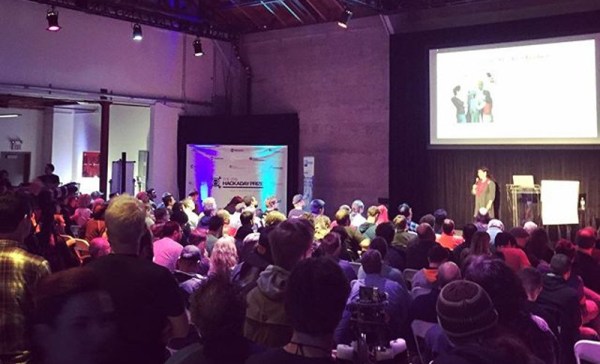
Packed house during the talks
SuperCon was a hardware conference that was actually about hardware. We could tell something magical was happening when we had to hunt down more chairs (borrowed from an off-site venue) to accommodate all of the people who wanted to hear the presentations. We know that the hardware community yearns for talks that go far beyond being shiny and deliver the details you need to grow your own set of engineering talents. The extra-chair anecdote proves the need for more opportunities to learn and interact with experts of hardware creation.
Don’t worry, we recorded every single one of these fantastic presentations. It will take time to edit the content but it will be freely available soon. If you’re excited about your own work and can speak about it with authority, you need to be at next year’s Hackaday SuperConference. I promise we’ll call for proposals further in advance for the next one, but start your talk prep now. You won’t want to miss it.
[Paul Stoffregen] leading his Advance Microcontroller Based Audio workshopConspicuously missing from our story so far are the hands-on workshops which ran concurrently with the talk track. Every workshop was sold out, and every extra chair was occupied by those who wanted to audit. Much of the workshop material is already online, and we’ll get a dedicated post out to help link you with that information.
The Attendees
Talk about the most amazing group of people to spend 30 hours with over two days. The 300 people who packed Dogpatch Studios to capacity made it impossible to have anything but a great time at the conference. These are all people with passion for hardware – I was tripping over fascinating conversations at every step.
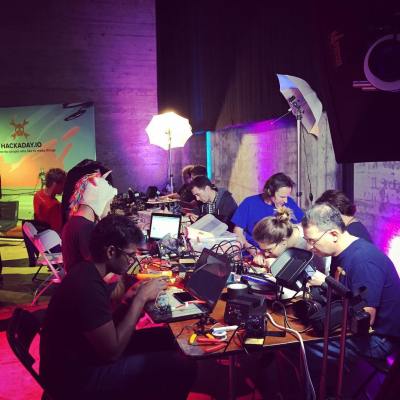
Badge hackers hard at work as talks continue just to the left
We blocked out a few places in the schedule for lightning talks. Everyone was encouraged to sign up and participate. Since the majority of people at the conference brought hardware to show off, these blocks were as popular as the more formal presentations.
This is also how the badge hacking was presented. Conference badges were PCBs with no components. Off to the side were tables strewn with components and tools so that you could work on your badge and watch the talks at the same time. Those seats were constantly occupied. As the end of the day approached on Sunday, we had around twenty people present what they had created on this blank slate. And yes, we’ll be covering this in-depth soon so stay tuned.
The Workers
Registration did a great job of clearing this line once the doors opened
You can have talented presenters and eager attendees, but it takes a lot of hard work to keep everything running smoothly and bring the two groups together.
We had an army of volunteers and a gaggle of staff who worked together like a high-functioning machine. Registration was quick and efficient and transitions between workshops were smooth and calm. The WiFi worked (conferences are notorious for not having connectivity) and the speakers had the A/V resources they needed. There were plenty of beverages, snacks, and meals. The workers of the SuperCon — all of them hardware-lovers too — had a personal stake in pulling this off. Mission accomplished. You all rock!
We Are a Community
The SuperConference felt like home. New acquaintances treated each other like life-long friends. Everyone brought their hardware passion and treated one another as equals. And as has been proven time and again, Hackaday is a community and great things happen when we all get together with purpose. Thank you, thank you, thank you to everyone who made this possible.
For all the destruction and human misery unleashed during World War II, it was also a time of incredible creativity and ingenuity. In America, it was a time when everyone wanted to pitch in. Young men and women enlisted and were shipped overseas, and those left behind kept the factories running full tilt. Even Hollywood went to war, with its steady output of films that gave people a little glamour and provided an escape from the horror and loss of the war. Hollywood stars lined up to entertain troops and raise money for the war effort, and many joined up and fought too.
But one Hollywood star made an unconventional contribution to the war effort, and in the process proved that beauty and brains are not always mutually exclusive. This is the story of Hedy Lamarr, movie star and inventor.
“The Most Beautiful Woman in the World”
By the time she was 23 in 1937, Hedwig Eva Maria Kiesler was a genuine film star in her native Austria. She was also trapped in an unhappy marriage to a rich and powerful Austrian munitions magnate, Fritz Mandl. Hedy was miserable as a trophy wife, adorning the dining room as her husband entertained rich and powerful guests – including Mussolini and Hitler – over long dinners in one of his mansions. They dismissed her; clearly a woman so beautiful could have nothing else to offer, an empty head perched on a graceful neck. But she was far from stupid, and while her husband discussed business with the men who were building the Axis arsenal, Hedy listened and learned.
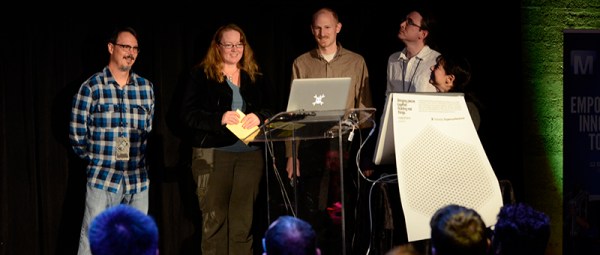
Eyedriveomatic are the Grand Prize winners of the 2015 Hackaday Prize. The winners were just announced on stage at the Hackaday Superconference, and awarded by the prize Judges. Eyedriveomatic is a non-invasive method of adding eye-control to powered wheelchairs. Many times these wheelchairs are rented and permanent alterations cannot be made. This inexpensive and easily adaptable hardware has the power to improve life for those who need more options for controlling powered wheelchairs.
We will be publishing more information about this year’s winners in the coming week. The full standings are listed below. Please check out all of the 2015 Hackaday Prize Finalist and the Best Product Finalists.
There’s a truism in the security circles that says physical security is security. It doesn’t matter how many bits you’ve encrypted your password with, which elliptic curve you’ve used in your algorithm, or if you use a fingerprint, retina scan, or face print for a second factor of authentication. If someone has physical access to a device, all these protections are just road bumps in the way of getting your data. Physical access to a machine means all that data is out in the open, and until now there’s nothing you could do to stop it.
This week at Black Hat Europe, Design-Shift introduced ORWL, a computer that provides the physical security to all the data sitting on your computer.
The first line of protection for the data stuffed into the ORWL is unique key fob radio. This electronic key fob is simply a means of authentication for the ORWL – without it, ORWL simply stays in its sleep mode. If the user walks away from the computer, the USB ports are shut down, and the HDMI output is disabled. While this isn’t a revolutionary feature – something like this can be installed on any computer – that’s not the biggest trick ORWL has up its sleeve.
The big draw to the ORWL is a ‘honeycomb mesh’ that completely covers every square inch of circuit board. This honeycomb mesh is simply a bit of plastic that screws on to the ORWL PCB and connects dozens of electronic traces embedded in this board to a secure microcontroller. If these traces are broken – either through taking the honeycomb shell off or by breaking it wide open, the digital keys that unlock the computer are erased.
The ORWL specs are what you would expect from a bare-bones desktop computer: Intel Skylake mobile processors, Intel graphics, a choice of 4 or 8GB of RAM, 64 to 512GB SSD. WiFi, two USB C ports, and an HDMI port provide all the connections to the outside world.
While this isn’t a computer for everyone, and it may not even a very large deployment, it is an interesting challenge. Physical security rules over all, and it would be very interesting to see what sort of attack can be performed on the ORWL to extract all the data hidden away behind an electronic mesh. Short of breaking the digital key hidden on a key fob, the best attack might just be desoldering the chips for the SSD and transplanting them into a platform more amenable to reading them.
In any event, ORWL is an interesting device if only for being one of the few desktop computers to tackle the problem of physical security. As with any computer, if you have physical access to a device, you have access to all the data on the device; we just don’t know how to get the data off one of these tiny computers.



![[Shanni Prutchi] presenting her talk about Quantum Entanglement](https://hackaday.com/wp-content/uploads/2015/11/shanni-prutchi-talk-contrast-adjusted.jpg?w=800)

![[Paul Stoffregen] leading his Advance Microcontroller Based Audio workshop](https://hackaday.com/wp-content/uploads/2015/11/dsc7228.jpg?w=800)


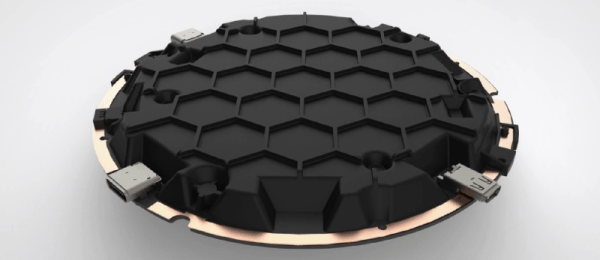
 The big draw to the ORWL is a ‘honeycomb mesh’ that completely covers every square inch of circuit board. This honeycomb mesh is simply a bit of plastic that screws on to the ORWL PCB and connects dozens of electronic traces embedded in this board to a secure microcontroller. If these traces are broken – either through taking the honeycomb shell off or by breaking it wide open, the digital keys that unlock the computer are erased.