From Gates To FPGA’s – Part 1: Basic Logic

It’s time to do a series on logic including things such as programmable logic, state machines, and the lesser known demons such as switching hazards. It is best to start at the beginning — but even experts will enjoy this refresher and might even learn a trick or two. I’ll start with logic symbols, alternate symbols, small Boolean truth tables and some oddball things that we can do with basic logic. The narrative version is found in the video, with a full reference laid out in the rest of this post.

Invert
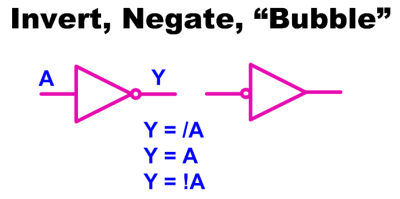
1The most simple piece of logic is inversion; making a high change to low or a low change to high. Shown are a couple of ways to write an inversion including the ubiquitous “bubble” that we can apply almost anywhere to imply an inversion or a “True Low”. If it was a one it is now a zero, where it was a low it is now a high, and where it was true it is now untrue.

AND
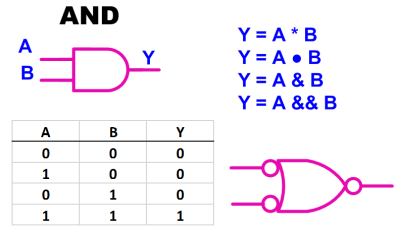
2Moving on to the AND gate we see a simple truth table, also known as a Boolean Table, where it describes the function of “A AND B”. This is also our first opportunity to see the application of an alternate symbol. In this case a “low OR a low yields a low”

NAND
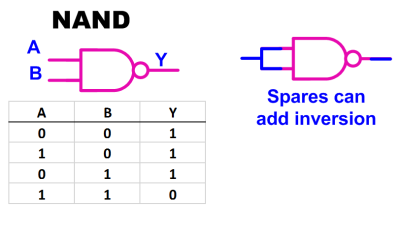
3Most if not all of the standard logic blocks come in an inverted form also such as the NAND gate shown here. The ability to invert logic functions is so useful in real life that I probably used at least three times the number of NAND gates as regular AND gates when doing medium or larger system design. The useful inversion can occur as spares or in line with the logic.

Continue reading “From Gates To FPGA’s – Part 1: Basic Logic”

Covert Remote Protest Transmitters

As a piece of protest art, “Covert Remote Protest Transmitters” ticks all the boxes. An outdoor covert projector that displayed anti-globalization messages at a G20 summit is protest. To disguise it inside a surveillance camera body housing — sticking it to the man from inside one of his own tools — is art. And a nice hack.

However you feel about the politics of globalization (and frankly, we’re stoked to be able to get cheap tech from anywhere in the world) the open-source DIY guidebook to building the rig (PDF) makes up for it all.

They installed the camera/projector long before the summit, where it sat dormant on a wall. A cell phone inside turned on the projector’s light with each ring because they attached a relay to the cell phone’s speaker circuit. In the instructions there’s an example of using a light-dependent resistor (CdS cell) to do the same thing, relying on the phone’s backlight functionality instead. There are a lot of ways to go here.

The optics consist of a couple of lenses aligned by trial and error, then fixed in place to a balsa wood frame with hot glue. A big fat Cree LED and driver provide the photons.

The video documentation of the piece is great. It’s mostly the news media reacting to the art piece as a “security breach”. A security breach would be a gun or a bomb. This was an overhead projector displaying messages that were out of the organizers’ control. Equating security with the supression of dissent is double-plus-ungood. Touché, CRPT.

Anyway, while you’re getting prepped for your next protest, have a look at the Image Fulgurator.

Making a Hackerspace Passport Stamp

How To Make A Hackerspace Passport Stamp

A few years ago, [Mitch Altman] from Noisebridge came up with the idea of a Hackerspace Passport. The idea behind it was not to hinder or monitor travels but to encourage visiting other hackerspaces. These passports can be purchased for just a few dollars or, in true open source fashion, be made with nothing more than a computer printer… the Hackerspace Passport design files are totally free and available here.

So next time you’re visiting a new hackerspace, bring your passport and get it stamped to document the trip…. and that brings us to the point of this post: The Stamp. At around $25, having a custom ink stamp made at an office supply store isn’t that much money, but buying a stamp is not as fun as making one! That is what we are going to do today; make a stamp… or more specifically, several stamps using different techniques. Then we’ll compare the performance of each method.

DESIGN

Since this is Hackaday, we will be making a Hackaday Logo stamp. Back a couple years ago we ran a contest asking folks to make unique things with the Hackaday logo. To make it easy for the entrants, the Hackaday logo was made available in SVG format. We’ll start with that, since it is available, and make a minor change by adding some lettering, as most soon-to-be stamp makers will probably want letters on their stamps too. This is easily done in the FOSS vector graphic editor software: Inkscape.

The stamp size is important. A Hackerspace Passport page has room for 4 stamps up to 41 x 47mm and we’ll try to keep our stamp within those limits.

Continue reading “How To Make A Hackerspace Passport Stamp”

Hackaday BAMF Meetup Reaches Critical Mass And Overflows Awesome

I love the Hackaday crowd. Despite a long day standing at a booth or crawling the fairgrounds as a spectator, everyone still made it on Saturday night to the 2nd Annual Hackaday BAMF meetup and made it one for the annals of hacker history. Just look at that crowd… I see a couple of Hackaday Prize Judges, a friend I met in Germany (who I actually found out I first met at this same event last year), and many many more great people. I don’t want to spoil the fun so check out the full size over on [Rich Hogben’s] photo log and see how many you can identify.

We started this gathering last year as a come-as-you-are and bring-what-you’re-proud-of after party to Bay Area Maker Fair. We don’t rent out the bar — O’Neil’s Irish Pub in San Mateo — but we had a handshake agreement for drink tickets (thank you to Supplyframe for buying the first round for everyone) with the bartenders. The place feels like the perfect size, and before long we were packed into every available space. The ramp to the restroom area in the back was a gauntlet of conversation — enough room to walk by but you felt like you were interrupting people talking to those across from them.

The amount of hardware on hand was spectacular. Taking pictures of it was tough in the tight quarters. I got a look at the first prototype of the Pebble smart strap. I really enjoyed seeing OSHChip (pictured above) which is an ARM Cortex-M0 chip and BLE rolled into a DIP-16 form factor. [Sophi’s] HeartBeat Boombox was a big hit; it uses the heartrate and blood oxygen sensors seen above to drive a drumbeat. Those blinky glasses should look familiar. [Garrett Mace] and his colleague [Jason] were on hand. These Macetech glasses are from a couple of years back but don’t worry, they were sporting the newest RGB flavor which I’m told will have black solder mask and integrated controller among other tasty goodies.

Perhaps the best way to tell the success of the night is that there were a lot of friends in the room that I never realized were even there. The next day I met up with [Sarah Petkus] and [Mark Koch] and was surprised to find they had been at the Hackaday meetup and I missed them. The same thing happened when I looked at [Rich’s] album from the night and saw [Trey German] was there too. I wasn’t hiding and I wasn’t stuck in one conversation, it was just that kind of a party that makes the room feel like a TARDIS but somehow the night doesn’t last forever.

It’s hard to imagine BAMF without this Saturday gathering. If you missed it this year, add it to your calendar for next.

Adafruit And The Arduinos At Maker Faire

The apparent lull on the Arduino front the last few weeks was just the calm before the storm that is the Bay Area Maker Faire (BAMF). Both companies claiming the Arduino name were there over the weekend, with news and new products in tow. Ironically, you could see from one booth straight over to the other. Small world.

Perhaps the biggest news from Arduino LLC is that hacker-friendly Adafruit is now going to be making officially-licensed boards in the US. Competing with this news, Arduino SRL brought its new boards, including the Yun Mini and ARM-powered Arduino M0. And [Massimo Banzi] and Arduino LLC seem to be taking an end-run around the Arduino SRL trademark by announcing the “Genuino” brand for European production. For all the details, read on!

Continue reading “Adafruit And The Arduinos At Maker Faire”

Inside The Amazon Dash Button

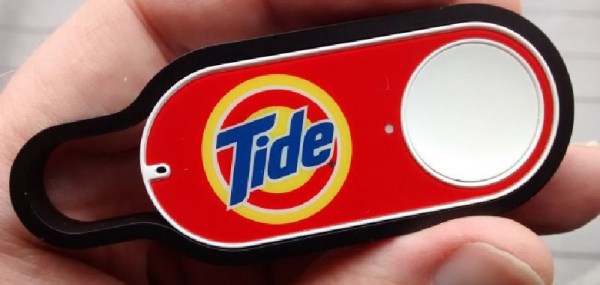
The Amazon Dash Button is a tiny WiFi-enabled device that’s a simple button with a logo on the front. If you get the Tide-branded version, simply press the button and a bottle of laundry detergent will show up at your door in a few days. Get the Huggies-branded version, and a box of diapers will show up. Get the sugar-free Haribo gummi bear-branded version, and horrible evil will be at your doorstep shortly.

[Matt] picked up one of these Dash Buttons for 99 cents, and since a button completely dedicated to buying detergent wasn’t a priority, he decided to tear it apart.

The FCC ID reveals the Amazon Dash Button is a WiFi device, despite rumors of it having a Bluetooth radio. It’s powered by a single AA battery, and [Matt] posted pictures of the entire board.

Since this piece of Amazon electronics is being sold for 99 cents, whatever WiFi radio chip is inside the Dash Button could be used for some very interesting applications. If you have an idea of what chips are being used in [Matt]’s pictures, leave a note in the comments.

drawing of hacker in jail

Ask Hackaday: Fixing Your Tractor Could Land You Behind Bars

It’s 9AM on any given Sunday. You can be found in your usual spot – knee-deep in wires and circuit boards. The neighbor’s barking dog doesn’t grab your attention as you pry the cover off of a cell phone, but the rustling of leaves by the back door does. Seconds later, several heavily armed SWAT officers bust in and storm your garage. You don’t have time to think as they throw your down on the cold, hard concrete floor. You’re gripped by a sharp stinging pain as one of the officers puts his knee in the square of your back. Seconds later, you’re back on your feet being lead to the back of an awaiting police cruiser. You catch the gaze of one of your neighbors and wonder what they might be thinking as your inner voice squeaks: “What did I do wrong?”

The answer to this question would come soon enough. Your crime – hacking your dad’s tractor.

“That’s like saying locking up books will inspire kids to be innovative writers, because they won’t be tempted to copy passages from a Hemingway novel.”

-Kyle Wiens

John Deere is trying to convince the Copyright Office that farmers don’t really own the tractors they buy from them. They argue that the computer code that runs the systems is not for sale, and that purchasers of the hardware are simply receiving “an implied license for the life of the vehicle to operate the vehicle.”

In order to modify or “hack” any type of software, you have to copy it first. Companies don’t like the copying thing, so many put locks in place to prevent this. But because hackers are hackers, we can easily get past their childish attempts to keep code and information out of our hands. So now they want to make it illegal. John Deere is arguing that if it is legal for hackers to copy and modify their software, that it could lead to farmers listening to pirated music while plowing a corn field. No I am not making this up — dig into this 25-page facepalm-fest (PDF) written by John Deere and you’ll be just as outraged.

Trying to keep hackers out using the DMCA act is not new. Many companies argue that locking hackers out helps to spur innovation. When in fact the opposite is true. What about 3D printers, drones, VR headsets…all from us! The Copyright Office, after holding a hearing and reading comments, will make a decision in July on whether John Deere’s argument has any merit.

Let us know what you think about all this. Can hackers and the free market learn to live in harmony? We just want to fix our tractor!

Thanks to [Malachi] for the tip!