It Came From Outer Space: Listening To The Deep Space Network

Ham radio operators love to push the boundaries of their equipment. A new ham may start out by making a local contact three miles away on the 2m band, then talk to somebody a few hundred miles away on 20m. Before long, they may find themselves chatting to fellow operators 12,000 miles away on 160m. Some of the adventurous return to 2m and try to carry out long-distance conversations by bouncing signals off of the Moon, waiting for the signal to travel 480,000 miles before returning to Earth. And then some take it several steps further when they listen to signals from spacecraft 9.4 million miles away.

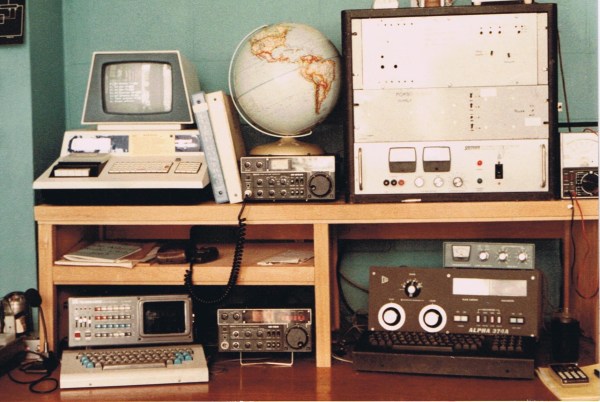
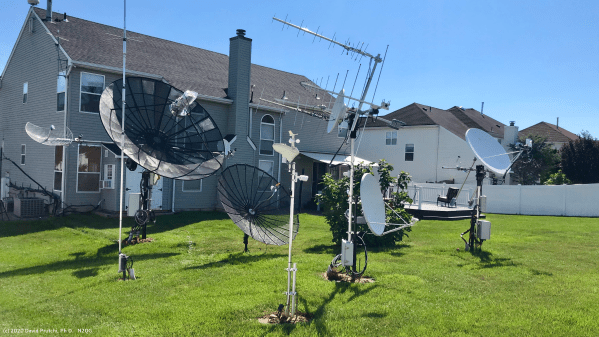
That’s exactly what [David Prutchi] set out to do when he started building a system to listen to the Deep Space Network (DSN) last year. The DSN is NASA’s worldwide antenna system, designed to relay signals to and from spacecraft that have strayed far from home. The system communicates with tons of inanimate explorers Earth has sent out over the years, including Voyager 1 & 2, Juno, and the Mars Reconnaissance Orbiter. Because the craft are transmitting weak signals over a great distance (Voyager 1 is 14 billion miles away!), the earth-based antennas need to be big. Real big. Each of the DSN’s three international facilities houses several massive dishes designed to capture these whispers from beyond the atmosphere — and yet, [David] was able to receive signals in his back yard.

Sporting a stunning X-band antenna array, a whole bunch of feedlines, and some tracking software, he’s managed to eavesdrop on a handful of spacecraft phoning home via the DSN. He heard the first, Bepi-Colombo, in May 2020, and has only improved his system since then. Next up, he hopes to find Juno, and decode the signals he receives to actually look at the data that’s being sent back from space.

We’ve seen a small group of enthusiasts listen in on the DSN before, but [David]’s excellent documentation should provide a fantastic starting point for anybody else interested in doing some interstellar snooping.

Getting Rid Of All The Space Junk In Earth’s Backyard

Space, as the name suggests, is mostly empty. However, since the first satellite launch in 1957, mankind began to populate the Earth orbit with all kinds of spacecraft. On the downside, space also became more and more cluttered with trash from defunct or broken up rocket stages and satellites. Moving at speeds of nearly 30,000 km/h, even the tiniest object can pierce a hole through your spacecraft. Therefore, space junk poses a real threat for both manned and unmanned spacecraft and that is why space agencies are increasing their efforts into tracking, avoiding, and getting rid of it.
Continue reading “Getting Rid Of All The Space Junk In Earth’s Backyard”

Orbital Tracking On The NES

It’s easy to dismiss the original Nintendo Entertainment System as just, well, an entertainment system. But in reality the 6502 based console wasn’t so far removed from early home computers like the Apple II and Commodore 64, and Nintendo even briefly flirted with creating software and accessories geared towards general purpose computing. Though in the end, Mario and friends obviously won out.

Still, we’re willing to bet that nobody at Nintendo ever imagined their plucky little game system would one day be used to track the course of a space station in low Earth orbit. But that’s precisely what [Vi Grey] has done with his latest project, which is part of his overall effort to demonstrate the unexpected capabilities of the iconic NES. While you’ll need a bit of extra hardware to run the program on a real console, there’s no fundamental trickery that would have kept some developer from doing this in 1985 if they’d wanted to.

Raspberry Pi Zero and TAStm32

If you want to see your own 8-bit view of the International Space Station, the easiest way is with an emulator. In that case, [Vi] explains how you can load up his Lua script in Mesen or FCEUX to provide the ROM with the necessary tracking data from the Internet.

To run it on a real NES you’ll not only need some type of flash cart to get the ROM loaded, but also a TAStm32 board that’s used for tool-assisted speedruns. This allows the computer to essentially “type” the orbital data into the NES by emulating rapid controller button presses. That might seem like a tall order, but it’s important to note that neither device requires you to modify the original console; the code itself runs on a 100% stock NES.

If tracking spacecraft isn’t your thing, perhaps you’d be more interested in the some of the work [Vi] has previously done on the NES. We’re particularly fond of his polyglot ROM that is a ZIP file of its own source code.

Continue reading “Orbital Tracking On The NES”

Apollo DSKY Replica Looks The Part

It’s hard to say what exactly it is about the Apollo DSKY that captures so many hackers’ imaginations. Whatever it is, the “Display and Keyboard” unit from the Apollo Guidance Computer has inspired dozens of teardowns, simulations, and reproductions over the years, to varying degrees of success. But this mechanically faithful DSKY replica really knocks it out of the park in terms of attention to detail.

The product of [M. daSilva], this DSKY replica takes a somewhat different path than many of the others we’ve seen. By working from as many original documents as possible, he was able to reproduce the physical size and shape of the DSKY very accurately — no mean feat when working from copies of copies of the original paper prints. Still, the details that are captured, like the gussets and reinforcements that were added to strengthen the original die-cast parts, really make this DSKY look the part. It’s functional, too, thanks to a Raspberry Pi running VirtualAGC, with a Nextion 4.3″ LCD display standing in for the original electroluminescent display. We were surprised to learn the DSKY had a port for nitrogen purging the case; check out the video tour below for that and other tidbits.

Of course, just because [M. daSilva] chose to concentrate on dimensional accuracy for this go-around doesn’t preclude more faithful electronics in the future. Perhaps he can team up with [Ben Krasnow] or [Fran Blanche] and really make this a showpiece.

Continue reading “Apollo DSKY Replica Looks The Part”

SpaceX Sending Tom Cruise To The Space Station In 2021

Several months after NASA Administrator Jim Bridenstine confirmed the project was in the works, sources are now reporting that Tom Cruise and director Doug Liman will officially be making the trip to the International Space Station in October of 2021 to film scenes for an as of yet untitled movie. Cruise and Liman previously worked together on the science fiction spectacle Edge of Tomorrow in 2014, which may give us a hint at what the duo are planning for their trip to the final frontier.

Industry insiders claim that the two film makers and potentially a female co-star will fly aboard a SpaceX Crew Dragon capsule under the command of Michael López-Alegría, a veteran astronaut who currently holds the American record for number and duration of extra-vehicular activities (EVAs). The mission is being organized by Axiom Space, which previously announced they would perform a series of privately funded flights to the ISS as a precursor to constructing their own commercial expansion to the orbiting laboratory.

Mars One living units under regolith
This never happened.

Of course, with more than a year before liftoff, anything could happen. SpaceX has been linked, officially or otherwise, to several private trips to space that literally and figuratively never got off the ground.

Mars-One was touting concept art that showed a fleet of modified SpaceX Dragons on the Red Planet as far back as 2012, and Elon Musk himself once announced that the Falcon Heavy would send private passengers on a trip around the Moon by the end of 2018. But to date, a pair of NASA astronauts have been the only humans to actually fly on SpaceX hardware.

Undoubtedly, some will see this flight of fancy as a waste of valuable resources. After all, there’s no shortage of scientists and researchers who would be more deserving of trip to a space than Jerry Maguire. But according to Bridenstine, the hope is that a big budget Hollywood film featuring scenes shot on the ISS could do for NASA what Top Gun once did for the Navy:

There was a day when I was in elementary school and I saw Top Gun. From that day, I knew I was going to be a Navy pilot. If we can get Tom Cruise to inspire an elementary kid to join the Navy and be a pilot, why can’t we get Tom Cruise to inspire the next Elon Musk? That’s what we need.

While we might not all agree on who the next generation of engineers should look to for inspiration, the impact that Top Gun had on Navy recruitment in the 80s and 90s is well established. If sending Tom Cruise to space for a few weeks might help inspire more kids to look into a STEM education, it’s probably worth a shot. Though it seems like Tom Hanks and his fellow Apollo 13 crew mates did a respectable enough job celebrating the incredible engineering behind NASA’s greatest triumph without actually going into orbit themselves.

Exploring The Clouds Of Venus; It’s Not Fantasy, But It Will Take Specialized Spacecraft

By now, you’ve likely heard that scientists have found a potential sign of biological life on Venus. Through a series of radio telescope observations in 2017 and 2019, they were able to confirm the presence of phosphine gas high in the planet’s thick atmosphere. Here on Earth, the only way this gas is produced outside of the laboratory is through microbial processes. The fact that it’s detectable at such high concentrations in the Venusian atmosphere means we either don’t know as much as we thought we did about phosphine, or more tantalizingly, that the spark of life has been found on our nearest planetary neighbor.

Venus, as seen by Mariner 10 in 1974

To many, the idea that life could survive on Venus is difficult to imagine. While it’s technically the planet most like Earth in terms of size, mass, composition, and proximity to the Sun, the surface of this rocky world is absolutely hellish; with a runaway greenhouse effect producing temperatures in excess of 460 C (840 F). Life, at least as we currently know it, would find no safe haven on the surface of Venus. Even the Soviet Venera landers, sent to the planet in the 1980s, were unable to survive the intense heat and pressure for more than a few hours.

While the surface may largely be outside of our reach, the planet’s exceptionally dense atmosphere is another story entirely. At an altitude of approximately 50 kilometers, conditions inside the Venusian atmosphere are far more forgiving. The atmospheric pressure at this altitude is almost identical to surface-level pressures on Earth, and the average temperature is cool enough that liquid water can form. While the chemical composition of the atmosphere is not breathable by Earthly standards, and the clouds of sulfuric acid aren’t particularly welcoming, it’s certainly not out of the realm of possibility that simple organisms could thrive in this CO2-rich environment. If there really is life on Venus, many speculate it will be found hiding in this relatively benign microcosm high in the clouds.

In short, all the pieces seem to be falling into place. Observations confirm a telltale marker of biological life is in the upper levels of the Venusian atmosphere, and we know from previous studies that this region is arguably one of the most Earth-like environments in the solar system. It’s still far too early to claim we’ve discovered extraterrestrial life, but it’s not hard to see why people are getting so excited.

But this isn’t the first time scientists have turned their gaze towards Earth’s twin. In fact, had things gone differently, NASA might have sent a crew out to Venus after the Apollo program had completed its survey of the Moon. If that mission had launched back in the 1970s, it could have fundamentally reshaped our understanding of the planet; and perhaps even our understanding of humanity’s place in the cosmos.

Continue reading “Exploring The Clouds Of Venus; It’s Not Fantasy, But It Will Take Specialized Spacecraft”

Historical Satellite Tracker Saved From Scrap Heap

In a bit of rare Australian space news, the  Arnhemland Historical Society has managed to save one of the satellite trackers used during the 1960s and 1970s from the scrap heap. As the Space Race intensified during the 1950s and 1960s, every nation wanted a piece of this new technology. A number of European nations banded together in the form of ELDO, the European Launcher Development Organisation.

Australia was a partner in this program, with launches of the Europa-1 and Europa-2 rockets taking place from Woomera, South Australia. Initially the UK’s cancelled Blue Streak IRBM program provided the first stage for Europa-1, but this was later replaced with the French Diamant. France also provided the Coralie second stage in addition to the German-developed Astris third stage.

The satellite tracker being dismantled at the South Australian defence base before it was trucked north. (Photo: Arnhemland Historical Society)

The first launch of the Europa-1 took place in 1966, with the rocket performing well, but inaccurate readings from a radar station leading to the rocket to be wrongly instructed to self-destruct. Of nine launches, four were successful, with the satellite trackers at Arnhemland providing tracking support. Ultimately, the many technical setbacks led to the demise of ELDO, and it was merged by the 1970s into what is now the European Space Agency, with its main launch site in Kourou, French Guiana.

Despite the lack of success, these early days at Woomera were instrumental in getting Europe’s feet wet in the development of the Ariane rockets. Woomera’s rocketing days may also not be over yet, with NASA having announced  in 2019 plans to use Woomera for launches.

Maybe one day Arnhemland will have its own space port, with the old satellite track on display to remind of those early days.

[Top photo: The ELDO satellite trackers were state-of-the-art when they stood in Gove in the 1960s. (Supplied: Arnhemland Historical Society)]

(Thanks, David)