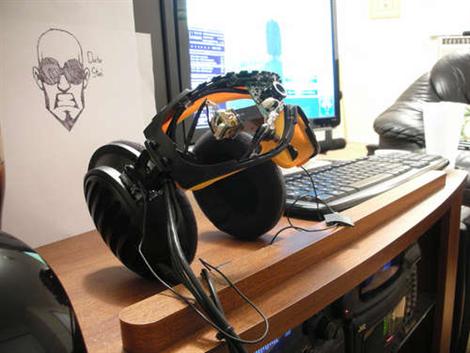
HMD Upgrade

[Banfield Design] has put together this instructable on how to upgrade or re build a head mounted display to be more immersive and add features.  Though you can already buy glasses style viewers for your media devices, they can use some upgrades. For one, you have to supply your own sound, and putting headphones on, over bulky glasses can be painful on your ears. Another area that could use improvement is the light that comes in around the glasses. The current trend is to make them as small as possible, but that tends to let your peripheral vision see the outside world. [Banfield design] wanted to make them more immersive, so he built them into some ski goggles. This not only helped block the light, but allowed for an over the ear style headphone assembly which is much easier on the ears.

A functional improvement came next, by adding a webcam front and center. He could now switch between a live feed of his environment and whatever other inputs he wanted. This could be really fun with some augmented reality. He has a list of future improvements, but he doesn’t mention adding a second camera for stereoscopic viewing of his surroundings. Why would you do that? because it would make augmented reality much cooler.

Stroke To Unlock

If you’re into embedded clothing this stroke sensor is for you. As demonstrated in the video after the break, stroking the threads in a particular direction will create a circuit that senses and, in this case, turns on an LED. The concept uses two conductive buses on the back of a piece of neoprene. Conductive and non-conductive threads are then  added for a furry or bristly finish. When stroked perpendicular to the power buses the conductive threads come together and form a circuit.

For some reason this just seems a bit creepy to us but perhaps that’s only because we haven’t come up with the right application for the technology. We’re pretty sure that a sweatshirt with an LED marquee and a “hairy” back that you stroke to illuminate is the wrong application.

Continue reading “Stroke To Unlock”

Bluetooth Bracelet Hacked

[Jeffery] hacked the Bluetooth standard in order to use this bracelet as a custom display. He took up our challenge to hack the device when we first saw it back in February.

In order to display his own messaged he looked into how the HFP is implemented in the Bluetooth stack. The details are shared in his readme file but it goes something like this: The Bluez package needs to be compiled with a dummy backend that is not phone-specific and that will then allow external manipulation of the data being sent. This provides something of an API that a Python script can manipulate. His proof-of-concept allows for the script to be called with the message you want displayed as the command line argument. This should be simple enough to incorporate for just about any purpose that suits your fancy. Unfortunately, messing with the Bluetooth package in this way makes it impossible to use other devices with your phone, but that’s a hack for another day.

Scan Room, Explore Virtually

[Patrick] directed us to his project for alternate realism. The final goal is to be able to walk around in a space wearing a head mounted display, exploring a virtual representation of that space. This virtual representation could be altered, stylized, augmented and modified in countless ways. It is an exploration in perception, similar to enjoying different styles of painting, we could enjoy different styles of viewing a real space. Currently, it isn’t quite real time. He has to scan a room with a somewhat bulky device, then plug into his display to explore it. Being able to scan quickly and reliably enough shouldn’t be far off. [Patrick] notes that others have done almost real time scans at home already.

Tiny Keyboard/touchpad Has “hack” Written All Over It

Yes, we know, this is not a hack, yet it just has the vibe of something we’ll likely be seeing in many small form-factor systems and wearable hacks in the future.

The USB Wireless Handheld Keyboard is a diminutive keyboard and mouse replacement with a passing resemblance to a BlackBerry PDA — where the screen has been replaced with a laptop-style trackpad sensor. This seems a shoo-in for home theater PC use; it’s unobtrusive and won’t look out of place on the coffee table alongside the universal remote. But any tiny system requiring only occasional input could likely benefit.

The keyboard layout is funky as heck, though likely adequate for its intended use of couch web-surfing and interactive messaging (or whatever wild applications our readers will surely come up with). A USB wireless receiver and a charging cable are included in the $62 package. Video after the break…

[USB Geek via Engadget]

Continue reading “Tiny Keyboard/touchpad Has “hack” Written All Over It”

Make Any Gloves Work With A Touch Screen

The chill of autumn is upon us, and with it comes the awkward sport of trying to work touch-sensitive phones and gadgets with gloved fingers. One can try toughing it out with fingerless gloves, or we’ve seen some costly solutions in the forms of specialized gloves and capacitive-compatible styluses, but sometimes simple is best: all it takes is a few stitches of conductive thread in the fingertips.

Conductive thread is available from various sources; SparkFun Electronics comes naturally to mind, but most vendors carrying the LilyPad Arduino will stock a suitable thread as well. Don’t fret if you’ve never sewn before — just a few simple loops are required, and it doesn’t need to be especially tidy. In principle this should work for trackpads and capacitive mice as well, if you use those in the field. For multitouch devices, add a separate conductive bit to each fingertip.

[via Lifehacker]

TI Sports Watch For Hacking

How would you like to have a 3-axis accelerometer, pressure sensor, temperature sensor, RF wireless, and an LCD screen in a development package?  What if we told you that you can have it in the form factor of a wristwatch offering from Texas Instruments? How much would you pay for such a device? Quit guessing, you can pick it up for just $49 with an estimated delivery in mid-February of next year.

Our tip-line has been packed with emails about this since it was announced on Monday. The device ships with the firmware to serve as a sports watch with heart rate monitor. The price is pretty good just for that functionality but this package also includes a USB programming and emulation dongle so that you can develop your own firmware. It looks like the included development software is written for Windows but we’re hoping you can get it running on other platforms as well.

The LCD is a segment display, so you won’t see DOOM running on board. That said, we expect your first project to turn this into a wireless controller using the buttons and accelerometer.