Comparing 12 VDC Air Fryers With Regular 240 VAC Ones

That boiling water is a contentious topic of discussion is clear, but what about hot air? When you take a 12 VDC, 280 Watt-rated air fryer and pit it against a bog-standard 240 VAC, 1400 Watt unit, which one would you want to use when you’re doing some camping or other exciting off-the-grid opportunities? Unlike with boiling water the physics aren’t as clear-cut here, so [Cahn] did some testing to figure out exactly what the efficiency numbers look like

Since air fryers rely on the transfer of thermal energy from the resistive heating element into the food, any thermal energy that’s not immediately transferred is effectively wasted. This, combined with the relatively low power rating and thus much higher time demand of the low-voltage air fryer is enough to set one’s expectations pretty low.

As scientific test samples chicken nuggets were used with the test, following a preheating period for the 12 VDC unit. Both units managed to hit a safe temperature inside the nuggets after 20 minutes, thus successfully staving off food poisoning, but the browning with the 240 VAC air fryer was much better.

As for the efficiency, the 12 VDC unit required 150 Wh for 20 minutes plus the 10 minutes of preheating, with 45 minutes total at 225 Watt to get proper browning. Meanwhile the 240 VAC unit burned through 250 Wh in 20 minutes, with no pre-heating, though only 230 Wh with no inverter losses included. As a final test, the 12 VDC unit was run at 400 Watt using 14.6 VDC input, which did indeed get it up to temperature much faster.

Thus both are equivalent, just with the caveat that the low-voltage unit will take considerably more time to get the same result. This mirrors the results with boiling water, where most options mostly vary in how much time they require to get water up to a boiling temperature.

Continue reading “Comparing 12 VDC Air Fryers With Regular 240 VAC Ones”
Intel 486 Support Likely To Be Removed In Linux 7.1

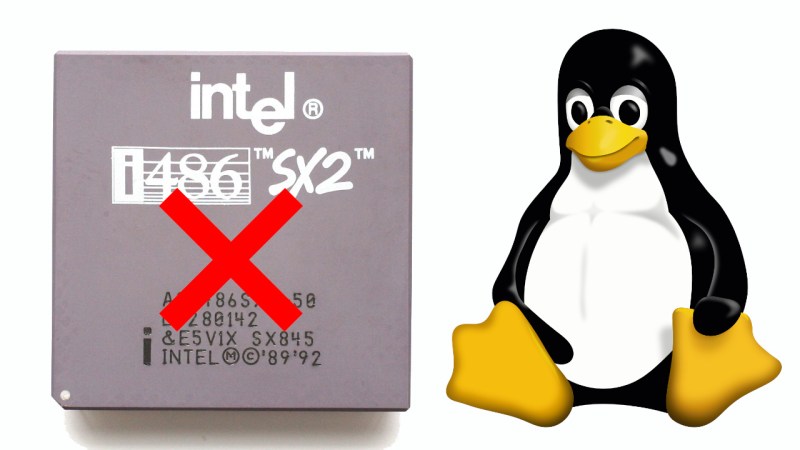
Although everyone’s favorite Linux overlord [Linus Torvalds] has been musing on dropping Intel 486 support for a while now, it would seem that this time now has finally come. In a Linux patch submitted by [Ingo Molnar] the first concrete step is taken by removing support for i486 in the build system. With this patch now accepted into the ‘tip’ branch, this means that no i486-compatible image can be built any more as it works its way into the release branches, starting with kernel 7.1.

No mainstream Linux distribution currently supports the 486 CPU, so the impact should be minimal, and there has been plenty of warning. We covered the topic back in 2022 when [Linus] first floated the idea, as well as in 2025 when more mutterings from the side of [Linus] were heard, but no exact date was offered until now.

It remains to be seen whether 2026 is really the year when Linux says farewell to the Intel 486 after doing so for the Intel 386 back in 2012. We cannot really imagine that there’s a lot of interest in running modern Linux kernels on CPUs that are probably older than the average Hackaday reader, but we could be mistaken.

Meanwhile, we got people modding Windows XP to be able to run on the Intel 486, opening the prospect that modern Windows might make it onto these systems instead of Linux in the ultimate twist of irony.

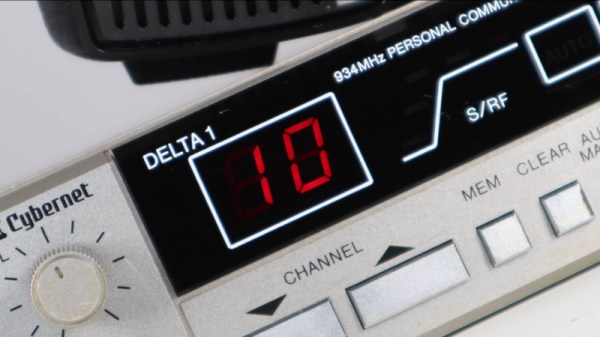
934 MHz: When The Government Really Doesn’t Want You To Have CB

In the mid 1970s there were a spate of movies depicting the romance and lifestyle of truck drivers in the southern half of the United States. Over on the other side of the Atlantic these were naturally received not as works of drama but as documentaries, and thus began a craze for British drivers to do up their Ford Capri so in the right light and with your eyes nearly closed, it almost looked like Burt Reynolds’ Pontiac Trans Am from Smokey and the Bandit.

Such a fine automobile was of course incomplete without a CB radio, highly illegal at the time, which led to an underground CB craze and its eventual legalization in 1981. [Ringway Manchester] is here with a tale from that era, of 934 MHz CB, an odd and underused allocation that was eventually phased out for commercial services.

When UK CB was eventually legalized by the government, it was very obvious that they really didn’t want to. Brits got 27 MHz as FM only with meager power and a weird set of frequencies that nobody else had, and a second band way up in the UHF range, at 934 MHz. We remember they originally tried to make a UHF band the only allocation on purpose because it was nearly useless for mobile operation, and Brits only got 27 MHz by fighting back in the political lobbying space.

The video below tells the story of the band, with relatively scarce and expensive equipment leading to it being an exclusive band more similar to the amateur bands, with little resemblance to its raucous 27 MHz counterpart. How much activity there was depended very much on where in the country you were, which of course wasn’t where your Hackaday scribe was as a teenager even if it had been affordable. Eventually the government saw the little flashing pound signs and grabbed it back for a mobile radio service that never materialized, and now the frequencies are part of the mobile phone spectrum.

Have a watch for an odd bit of UK radio nostalgia and some 2020s illegal CB’ers, and if you want more it’s a subject we’ve touched on before.

Continue reading “934 MHz: When The Government Really Doesn’t Want You To Have CB”

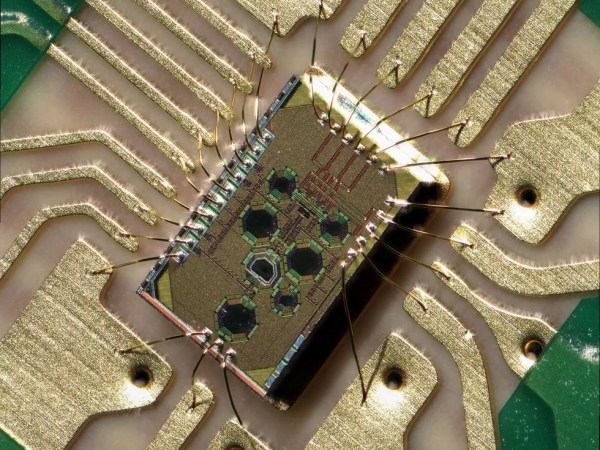
Exposing A Radiation-Hardened 2.4 GHz Wi-Fi Receiver To 500 Kilograys

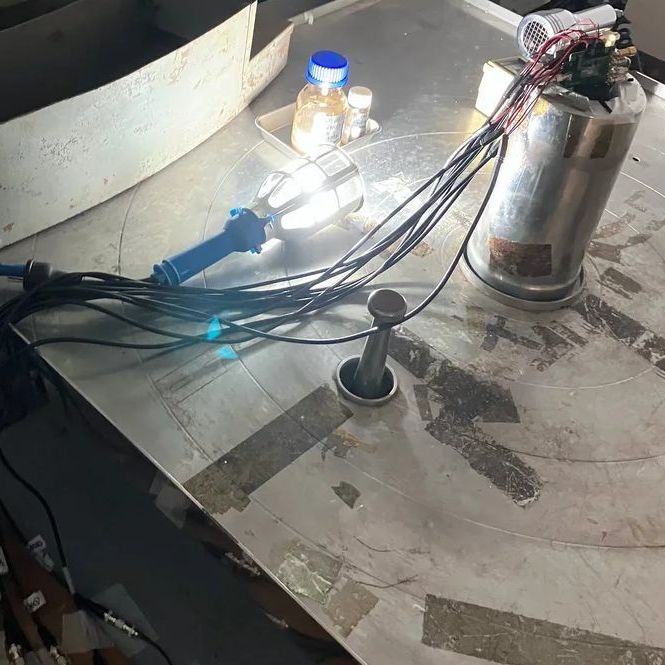
Exposing the Wi-Fi chip to gamma radiation. (Credit: Yasuto Narukiyo et al, 2026)

From outer space to down here on Earth, there are many places where ionizing radiation levels are high enough that they effectively bar access for humans, but also make life miserable for anything containing semiconductor technology. This is especially true for anything involving wireless communications, such as Wi-Fi. However, recently Japanese researchers have created a Wi-Fi chip that is claimed to be so radiation-hardened that it can be used even in gamma ray-rich environments, such as in the worst contaminated depths of the Fukushima Daiichi nuclear reactor.

The indicated dose exposure of 500 kilograys that the chip survived during testing is quite significant. A single gray (Gy) is the absorption of one joule of energy per kilogram of matter. In radiation therapy, a solid epithelial tumor can receive as much as 60 to 80 Gy in a single dose, for example.

Continue reading “Exposing A Radiation-Hardened 2.4 GHz Wi-Fi Receiver To 500 Kilograys”

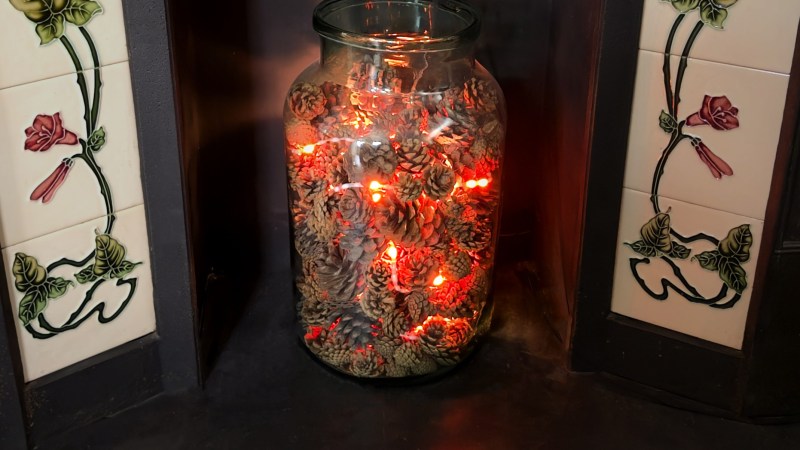
A jar of pine cones that appears to glow like the embers of a fire

Simulating A Glowing Fireplace With An RP2040

Today, fireplaces, their cozy glow once a household staple, are mostly a thing of the past. In fact, a decent amount of old fireplaces are completely blocked up! [David Capper] brings back the atmosphere without the actual flames, with his RP2040-based fireplace glow simulator.

It’s not just a string of LEDs with some PWM brightness control, either. No, [David] goes into detail about the black body radiation that gives these fires their colors. He then uses the theory of black-body radiation to determine the colors that the LEDs glow to simulate the colors of a real fire.

But the colors alone don’t make for a good simulated fire, so [David] adds the heat equation. It starts with a grid wherein each cell has a temperature. Over time, cells are randomly selected to have heat added to them (increasing the cell’s temperature), then he applies the heat equation to diffuse and decay the heat within the grid for a nice simulated crackling fire. Add in a custom PCB and a nice little 3D-printed case and you’re ready for a cozy hacker time.

Hackaday Podcast Episode 364: Clocks, Cameras, And Free Will

This week, Hackaday’s Elliot Williams and Kristina Panos met up over assorted beverages to bring you the latest news, mystery sound results show, and of course, a big bunch of hacks from the previous seven days or so.

In the news, there’s quite a bit to talk about. Regarding Hackaday Europe, you can rest assured that the talks will be announced soon. The Green-Powered Challenge is still underway, and we need your entry to truly make it a contest. You have until April 24th to enter, so show us what you can do with power you scrounge up from the environment!

As usual, we published a handful of April Fool’s posts, which you may or may not find amusing. And finally — no fooling — our own Tom Nardi wrote up the Artemis moon launch, and is going to update the post every day until the mission ends.

On What’s That Sound, we can score one for Kristina, which brings her record to approximately three wins and sixty-eight losses. She knew without a doubt that the dialogue was from the Day the Earth Stood Still (1951). Oh, what? There was a remake in 2008? Kristina should get bonus points, then.

After that, it’s on to the hacks, beginning with the basics of making clean enclosures that are decidedly not 3D-printed, a couple of sweet lo-fi cameras, and a nice way to tame the tape when it comes to SMT parts. We also discuss a clock that marks time in a mathematical way, watch an electro-permanent magnet in action, and improving soda by turning it into mead. Finally, we discuss the solar balconies taking Europe by storm, and Copilot’s terrifying terms of service.

Check out the links below if you want to follow along, and as always, tell us what you think about this episode in the comments!

Download in DRM-free MP3 and savor at your leisure.

Continue reading “Hackaday Podcast Episode 364: Clocks, Cameras, And Free Will”

The Raspberry Pi 4 With 3 GB RAM Is No Joke

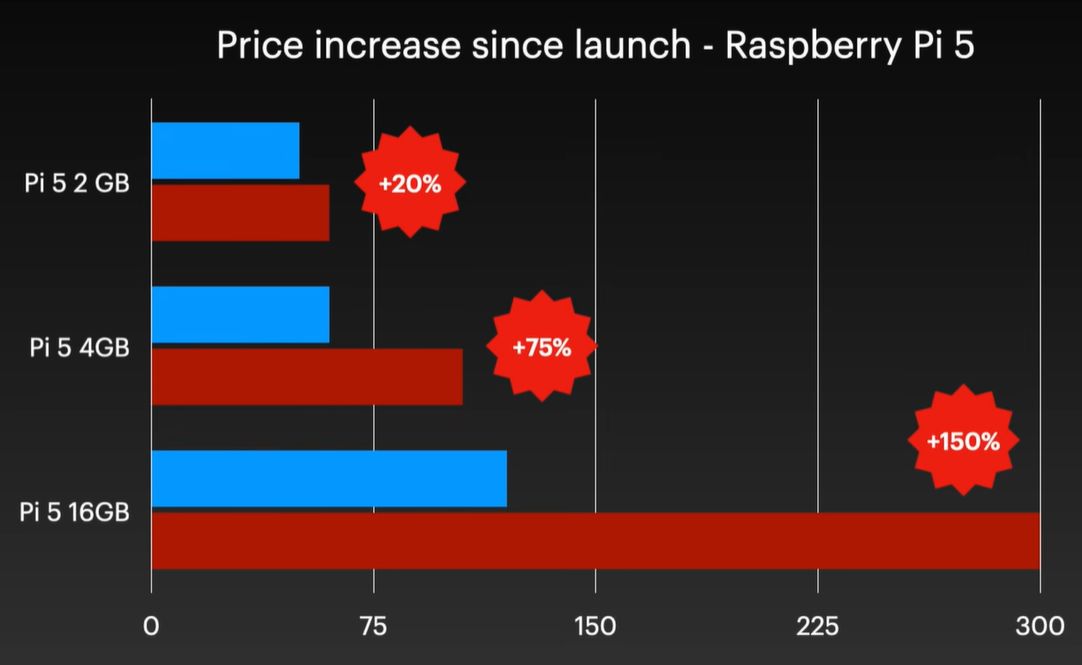
Raspberry Pi 5 price increases. (Credit: Jeff Geerling)

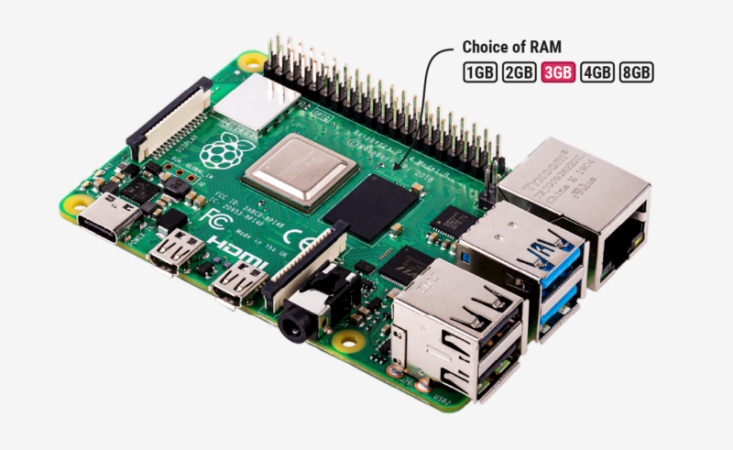
Although easily dismissed by some as another cruel April Fools joke, Raspberry Pi’s announcement of a new 3 GB model of the Raspberry Pi 4 along with (more) price increases for other models was no joke. Courtesy of the ongoing RAMpocalypse, supplies of LPDDR4 and LPDDR5 are massively affected, leading to this new RPi 4 model with two 1.5 GB LPDDR4 chips, as these are apparently cheaper to source.

Affected in this latest price increase across RP’s product range are RPi 4 and 5 models with 4 or more GB of RAM, with price bumps ranging from $25 on the low end to $150 for the Raspberry Pi 500+. If you wanted a Raspberry Pi 5 with 16 GB of RAM, you’re now paying $300 for the privilege.

Obviously, this news has got people like [Jeff Geerling] rather down in the dumps, essentially stating that using SBCs like the RPi is now beyond the means of many hobbyists. While you can still use SBCs that use e.g. LPDDR2 RAM, such as the older RPi Zero, 2 and 3 models, [Jeff] himself is now moving more towards wrangling with snakes on MCUs, as these boards are so far not significantly affected in terms of price.

With current projections in the RAM market being that this year will still see more price increases, it remains hard to tell exactly how ‘temporary’ this situation will be. That said, using readily available, powerful and cheap MCUs like the ESP32 variants for projects isn’t a bad idea if you really don’t need to be running more than perhaps FreeRTOS.

Continue reading “The Raspberry Pi 4 With 3 GB RAM Is No Joke”