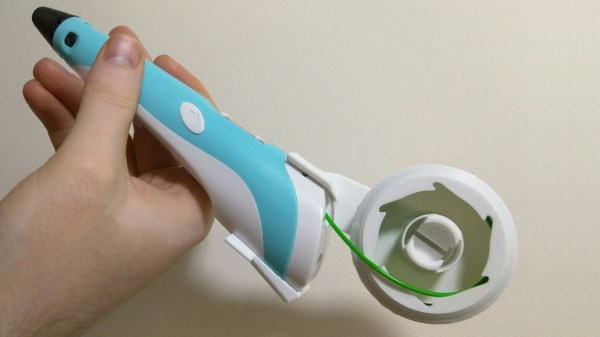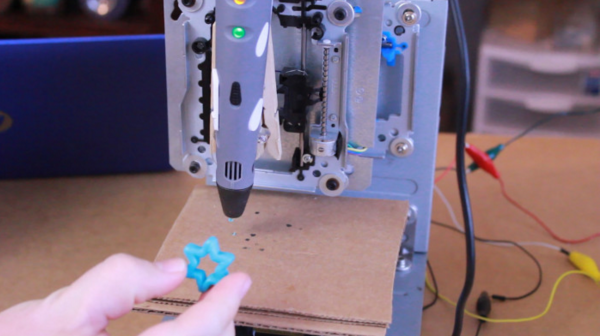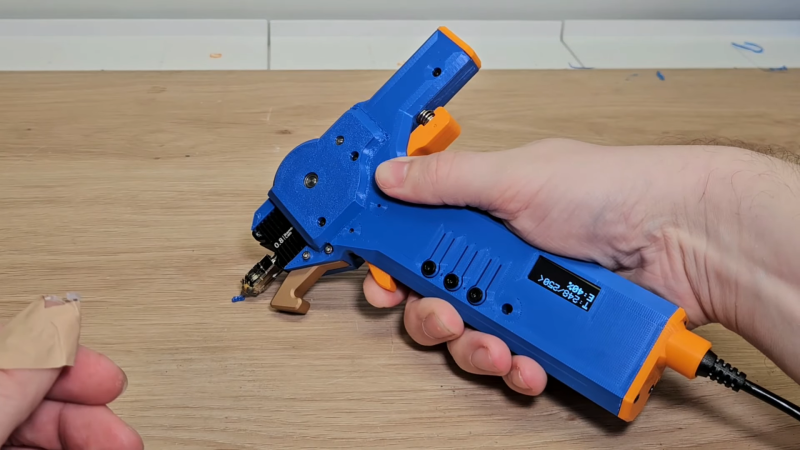
Depending who you ask, 3D pens are silly toys or handy tools. Those who use them as tools find them handy to fill gaps in printed assemblies or to use them as a PLA or PETG-based hot glue gun for their prints. [half-baked-research] on YouTube is in the second category, but knows that welding is better than gluing — so he built himself a 3D pen designed for plastic welding.
You can weld with a regular 3D pen, and [half-baked] demonstrates that in the video. But thanks to the low-conductivity tips on commercial pens, it’s a slow, fiddly business. By using a normal 3D printer hot-end, with its conductive brass nozzle, [half-baked] is able to get a lot more heat where it’s needed. That means the plastic on either side of the weld melts for a good bond with the stuff coming out the nozzle. He’s also able to push plastic much faster with the modified extruder he’s squeezed into the hot-glue-gun looking contraption. Those two things together conspire to make the whole process go much faster than with a commercial 3D pen. He calls his build a 3D pen, but given the form factor it might be more accurate to call it a ‘plastic extrusion gun’.
Starting at around 13:38 in the video, he performs some strength tests, something we wish more YouTubers would do. He’s able to demonstrate a stronger bond with his welding pen than the normal 3D pen, and a much, much stronger join than the usual superglue. A traditional plastic weld with hot air is even stronger, but [half-baked] points out elsewhere in the video that on thin-walled prints (as opposed to the solid test articles) hot air welding can be a very dicey business. Pen-welding offers much greater control, so is an interesting technique to keep in mind.
Alas, [half-baked-research] apparently still considers this idea too half-baked to release the design. If you don’t have time to wait or reinvent this particular wheel, we featured a much simpler implementation of a similar idea years ago, using PLA in a hot glue gun. If that won’t work for you — maybe you aren’t a fan of PLA — perhaps you might try friction welding with filament.