NASA Making Big Upgrades To Their Big Dish DSS43

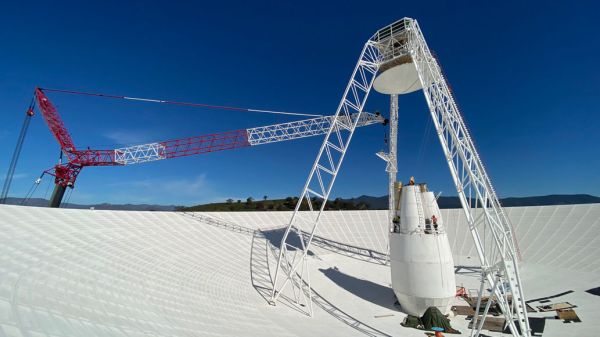
When it comes to antenna projects, we usually cover little ones here. From copper traces on a circuit board to hand-made units for ham radio. But every once in a while it’s fun to look at the opposite end of the spectrum, and anyone who craves such change of pace should check out DSS43’s upgrade currently underway.

Part of NASA’s Deep Space Network (DSN) built to communicate with spacecraft that venture far beyond Earth, Deep Space Station 43 is a large dish antenna with a diameter of 70 meters and largest of the Canberra, Australia DSN complex. However, the raw reflective surface area is only as good as the radio equipment at its center, which are now outdated and thus focus of this round of upgrades.

The NASA page linked above offers a few pieces of fun trivia about DSS43 and its capabilities. If that whets an appetite for more, head over to Twitter for a huge treasure trove. Whoever is in charge of Canberra DSN’s Twitter account has an endless fountain of facts and very eager to share them in response to questions, usually tagged with #DSS43. Example: the weight of DSS43 is roughly 8.5 million kilograms, 4 million of which is moving structure. They also shared time lapse video clips of work in progress, one of which is embedded after the break.

Taking the uniquely capable DSS43 offline for upgrades does have some consequences, one of which is losing our ability to send commands to distant interplanetary probe Voyager 2. (Apparently smaller DSN dishes can be arrayed to receive data, but only DSS43 can send commands.) Such sacrifices are necessary as an investment for the future, with upgrade completion scheduled for January 2021. Just in time to help support Perseverance (formerly “Mars 2020”) rover‘s arrival in February and many more missions for years to come.

Continue reading “NASA Making Big Upgrades To Their Big Dish DSS43”

Life-Saving Surgery For A Telescopic Antenna

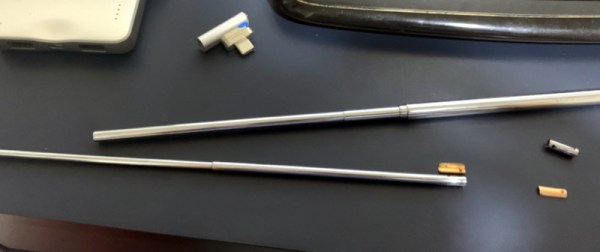
Whether it was as an impulsive youth or an impatient adult, there’s probably few among us who haven’t broken a telescopic antenna or two over the years. It doesn’t take much to put a bend in the thin walled tubing, and after that, all bets are off. So [The Amateur Engineer] couldn’t really be too upset when his son snapped the antenna off the transmitter of an old RC truck. Instead, he decided to take it apart and see how it could be repaired.

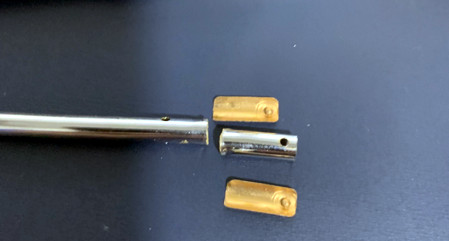
Taking a thin screwdriver to the antenna’s bottom most segment, he was able to widen up the opening enough to remove the upper sections as well as recover the broken piece and copper locking plates. He cut out the damaged area and drilled new holes for the pins on the copper plates to fit into. Inserting the repaired section back into the lowest segment was no problem, but he says it took a little trial and error before he was able to roll the edge over enough to keep the antenna from falling apart.

Buying a replacement would certainly have been easier, but as the radios in our devices have moved into the higher frequencies, these collapsible antennas have become a bit harder to come by. Modern RC vehicles operate on 2.4 GHz, so they don’t need the long antennas that the older 27 MHz systems utilized. [The Amateur Engineer] did find a few direct replacements online, but none for a price he was willing to pay.

We might have used the broken transmitter as an excuse to switch the RC vehicle over to WiFi control, but we appreciate [The Amateur Engineer] showing how this type of antenna can be disassembled and repaired if necessary.

Sky Anchor Puts Radios Up High, No Tower Needed

When it comes to radio communications on the VHF bands and above, there’s no substitute for elevation. The higher you get your antenna, the farther your signal will get out. That’s why mountaintops are crowded with everything from public service radios to amateur repeaters, and it’s the reason behind the “big stick” antennas for TV and radio stations.

But getting space on a hilltop site is often difficult, and putting up a tower is always expensive. Those are the problems that the Sky Anchor, an antenna-carrying drone, aims to address. The project by [Josh Starnes] goes beyond what a typical drone can do. Rather than relying on GPS for station keeping, [Josh] plans a down-looking camera so that machine vision can keep the drone locked over its launch site. To achieve unlimited flight time, he’s planning to supply power over a tether. He predicts a 100′ to 200′ (30 m to 60 m) working range with a heavy-lift octocopter. A fiberoptic line will join the bundle and allow a MIMO access point to be taken aloft, to provide wide-area Internet access. Radio payloads could be anything from SDR-based transceivers to amateur repeaters; if the station-keeping is good enough, microwave links could even be feasible.

Sky Anchor sounds like a great idea that could have applications in disaster relief and humanitarian aid situations. We’re looking forward to seeing how [Josh] develops it. In the meantime, what’s your world-changing idea? If you’ve got one, we’d love to see it entered in the 2020 Hackaday Prize.

Dipole Antenna Is Off Balance

A dipole antenna is easy, right? Two wires, each a quarter wavelength long, emanate from a coax or other feedline. Unless it is an off-center dipole. The length is still the same, but you move the feed point to a different part. [KB9VBR] explains how this changes the antenna’s impedance from the nominal 70 ohms of a standard dipole.

Why would you want to do that? The trick is to find a feed point that has acceptable impedance on multiple ham radio bands. Most automatic tuners can handle a certain range of mismatch so using an antenna like this with a tuner can allow one antenna to serve multiple bands with no traps or switches.

Continue reading “Dipole Antenna Is Off Balance”

Beat Your Coat Hangers Into Antennas, Not Plowshares

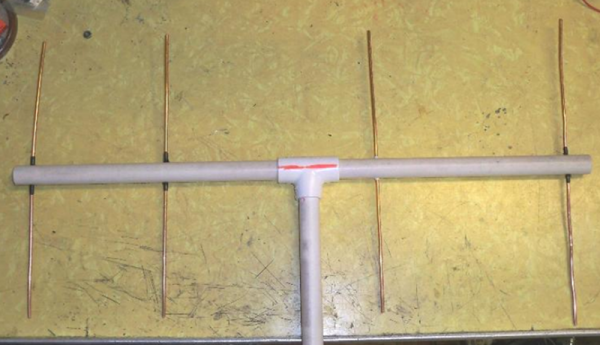
If you are looking for a fun project while you are cooped up and you have some spare coathangers, why not try this 4-element Yagi antenna (PDF)? [Pete N8PR] showed it off at his local ham radio club and it looked like something good for a lazy afternoon. If you aren’t a ham, you could adjust it all for a different VHF or UHF frequency.

For the boom, [Pete] mentions you can use wood, but it isn’t weather resistant. He chose half-inch PVC pipe. He also offers you a choice of material for the elements: #8 wire, welding rod, or — our favorite — coat hangers.

This is a big upgrade from a simple dipole or a vertical made from coax. The yagi should have about 8 dBi gain in the direction it is pointing. The center of the boom doesn’t have any elements, so that simplifies mounting. The insulating boom also makes mounting the driven element a breeze.

If you use the coat hangers, we’ve heard an easy way to get them very straight is to put one end on a vise and the other end in a drill chuck (see the video below). The method will weaken the wire, but the elements won’t have much stress. If it worries you, just go slow on the drill and you might consider annealing the wire with a torch afterward.

It would be easy to make this portable like some other designs we’ve seen. If you want the history and theory behind the venerable yagi antenna, you’ll want to revisit this post.

Continue reading “Beat Your Coat Hangers Into Antennas, Not Plowshares”

The Rusty Nail Award For Worst WiFi Antenna

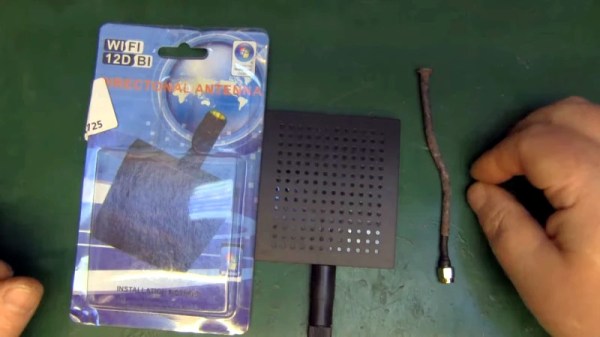
In general, you get what you pay for, and if what you pay for is a dollar-store WiFi antenna that claims to provide 12 dBi of signal gain, you shouldn’t be surprised when a rusty nail performs better than it.

The panel antenna that caught [Andrew McNeil]’s eye in a shop in Rome is a marvel of marketing genius. He says what caught his eye was the Windows Vista compatibility label, a ploy that really dates this gem. So too does the utterly irrelevant indication that it’s USB compatible when it’s designed to plug into an SMA jack on a WiFi adapter. [Andrew]’s teardown was uninspiring, revealing just a PCB with some apparently random traces to serve as the elements of a dipole. We found it amusing that the PCB silkscreen labels the thru-holes as H1 to H6, which is a great way to make an uncrowded board seem a bit more important.

The test results were no more impressive than the teardown. A network analyzer scan revealed that the antenna isn’t tuned for the 2.4-GHz WiFi band at all, and practical tests with the antenna connected to an adapter were unable to sniff out any local hotspots. And just to hammer home the point of how bad this antenna is, [Andrew] cobbled together a simple antenna from an SMA connector and a rusty nail, which handily outperformed the panel antenna.

We’ve seen plenty of [Andrew McNeil]’s WiFi antenna videos before, like his umbrella and tin can dish. We like the sanity he brings to the often wild claims of WiFi enthusiasts and detractors alike, especially when he showed that WiFi doesn’t kill houseplants. We can’t help but wonder what he thinks about the current 5G silliness.

Continue reading “The Rusty Nail Award For Worst WiFi Antenna”

Lock Your Keys In The Car On Purpose With Aluminum Foil

[TJ] is a surfer, and drives his car to get to the beach. But when he gets there he’s faced with a dilemma that most surfers have: either put his key in your baggies (shorts) or wetsuit and hope it doesn’t get lost during a wipeout, or stash it on the rear wheel of his car. Hiding the keyfob by the car isn’t an option because it can open the car doors just by being in proximity to the car. He didn’t want to risk losing it to the ocean either, so he built a waveguide of sorts for his key out of aluminum foil that lets him lock the key in the car without locking himself out.

Over a series of trials, [TJ] found out that his car, a 2017 Chevy Cruze, has a series of sensors in it which can determine the location of the keyfob based on triangulation. If it thinks the keyfob is outside of the car, it allows the door to be locked or unlocked with a button on the door handle. If the keyfob is inside the car, though, it prevents the car from locking via the door handles so you don’t accidentally lock yourself out. He found out that he could “focus” the signals of the specific sensors that make the car think the keyfob is outside by building an open Faraday cage.

The only problem now is that while the doors can be locked, they could also can be unlocked. To solve that problem he rigged up an ESP32 to a servo to open and close the opening in the Faraday cage. This still means there’s a hidden device used to activate the ESP32, but odds are that it’s a cheaper device to replace than a modern car key and improves security “through obscurity“. If you have any ideas for improving [TJ]’s build, though, leave them in the comments below. Surfers across the world from [TJ] to the author would be appreciative.