We’re really sorry to have missed GLOW. It was a unique all-night art and music event that took place the evening of July 19, 2008, in Santa Monica, and lasted until dawn. We were most intrigued by [Shih Chieh Huang]’s haunting robotic sculptures. They were eerily beautiful, and appeared to be alive and “breathing”. He took some unusual materials – plastic bags and bottles, computer fans and circuit boards, among others, and combined them all to give the creatures otherworldly auras. Simultaneously familiar and strange, the sculptures are designed to evoke marine life, yet they’re completely different, in both materials and structure. More coverage and pictures of the event can be found at LAist, NOTCOT, and on Flickr.
art378 Articles
Microfluidic Art
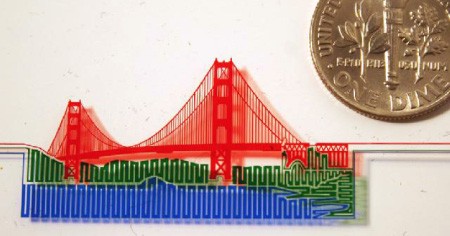
Microfluidics expert [J. Tanner Neville] decided to turn his work into art. Along with his student, [Austin Day], they turned lab chips into miniscule works of art by developing a technique of patterning proteins onto substrates. Each colored line you see is actually a groove full of liquid about 20 microns in width. Another student of [Neville’s], [Albert Mach], is currently working on a method of preserving the liquid for longer amounts of time. As you can probably guess, the dye tends to dry up within a few days. He is also taking submissions for artwork, so we encourage you to submit! We’re certainly looking forward to what else [Neville] and his students come up with next.
[via io9]
Pulse, The Emotional Visualization Organism
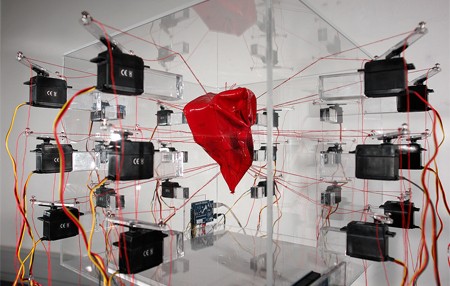
[Markus Kison] built a device called Pulse, which is part art installation and part data visualization tool. What the emotional visualization organism called Pulse actually does is scan new posts on Blogger.com blogs for synonyms of keywords related to 24 distinct emotions from eight emotional groups. A red cone in the center expands when keywords are detected, in effect acting as a mood indicator for Blogger.com blogs.
The 24 distinct emotions are based on [Robert Plutchik]’s psychoevolutionary theory of emotion, and the device itself is built from a glass case, various servo motors, and custom controller for the servos. This is a compelling idea, but we wonder whether it scans for modifying words or just the keywords alone. It wouldn’t make a lot of sense to have the sadness region expand drastically if many people simultaneously post the sentence “I’m not sad at all.” Video embedded after the break.
Continue reading “Pulse, The Emotional Visualization Organism”
Making Art With Javascript
Mozilla coder [Aza] is connected to the past and the present: he wanted to celebrate the release of Firefox 3, but pines for the days when one could use small amounts of code to make compelling art. As a way of addressing both things, he has released ContextFree.js, a javascript port of [Chris Coyne]’s Context Free Art. Users can visit Algorithm Ink, where they can draw various compelling designs with just a few lines of script. ContextFree.js compiles the scripts and turns them into visually arresting geometric designs. Users can also browse through designs made by others, easily save them as JPGs, or even modify them by adding their own bits of code. What’s more, it’s not out of the question to use this to generate random images on a website, creating a unique visual experience for every single visitor. You all know what we want to see, though: JavaScript gurus working some real magic with this. Better yet, said gurus can play around with the core open-source code and make something truly their own on the most fundamental level. Definitely check out the video above to get an idea of how easy this is.
[via Waxy]
Twilight For Zune
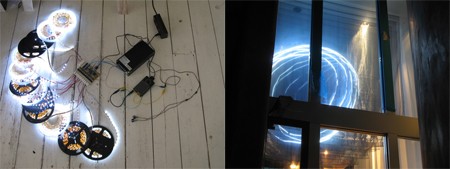
[Mortiz Waldermeyer], the man who brought us the interactive LED pong table, has recently completed a project commissioned by Microsoft: an interactive chandelier that can receive and react to music from a Zune mp3 player. The technology behind this project which [Waldemeyer] calls Twilight is not all that complex: at the core of the chandelier is a Zune, which acts as the receiver for other Zunes in the area. The central chandelier Zune then feeds graphic equalizer display data to another device, which in turn feeds a microcontroller running the LEDs embedded in the chandelier. The chandelier itself is constructed of 15 sheets of organza fabric. The result is a rich, dancing display of lights that people in the room with a Zune can take turns controlling. The installation has just opened in LA.
Playing The Building With David Byrne
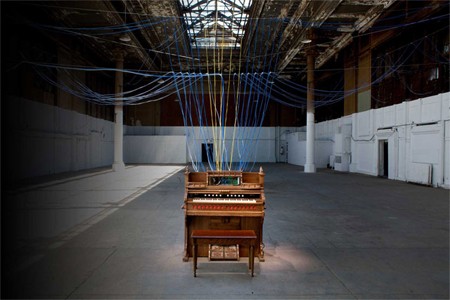
Do you remember the solenoid concert that used a sequencer to control several solenoids striking different surfaces? Musician David Byrne has taken the concept and executed it on a much larger scale with his “Playing the Building” installation in an old municipal ferry terminal in New York. Devices that bang the girders, rattle the rafters, and blow through the pipes of the building are attached to the only object inside, a weathered pipeorgan. Every key is wired to different device in the building, each producing a unique sound. Attendees are invited to fiddle with keys of the organ to produce sounds from the building’s various materials, thus playing the building like an instrument. Here’s a video from the installation.
[via Today and Tomorrow]
Biggest Drawing In The World Created With GPS
UPDATE: The text: “This is fictional work. DHL did not transport the GPS at any time” has been added to the bottom of the page since the original posting.
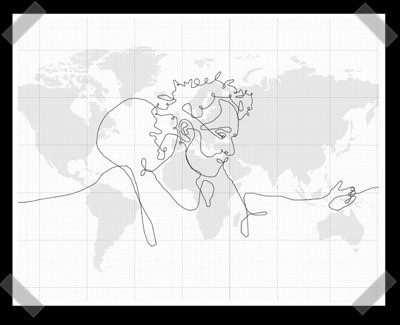
Artist [Erik Nordenankar] has created the Biggest Drawing In The World. At least that’s what his URL says. He used the movement of a GPS device to create a giant single line self portrait on the globe. His Pelican case containing four large batteries and the GPS data logger was handed off DHL with very specific travel instructions for its 55 day journey. It’s a pretty amazing feat, but we really wish the case had managed to make the trip without the close watch shown in the video.
Continue reading “Biggest Drawing In The World Created With GPS”