Minimalist LED Light Detecting Candle

[youtube=http://www.youtube.com/watch?v=sPe5RtUOOdc]

Our flickering LED circuit combined two known circuit, and certainly wasn’t graceful because of it. [sprite_tm] saw quite a few areas where the circuit could be reduced. He ended up taking it down to just two LEDs, a battery, and an ATtiny13. The first step was getting rid of the current limiting resistors. The datasheet shows that with a 3V supply the AVR will limit the current well below the maximum current. The light sensor was removed next. [sprite_tm] referenced an earlier post on sensing with LEDs. He measures the voltage across one of the LEDs while it is off to see how much light is hitting it. The current draw while on is 10mA and 50uA while off.

Arduino Duemilanove

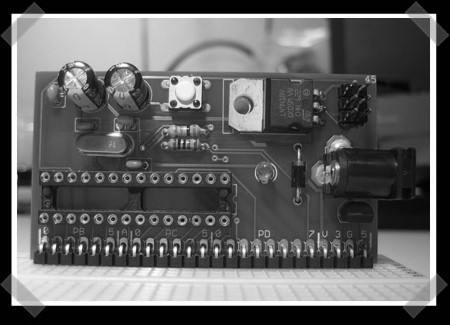
The latest generation of Arduino hardware has been released. The Arduino Duemilanove (2009 in Italian) has the same form factor as previous generations. The specs are essentially identical to the Diecimila, but there have been a few changes to the hardware. The power source is no longer chosen using a jumper. A MOSFET and dual OPAMP have been added to the board to automatically selected between USB power and the external plug. Automatic hardware resets are optional now. Next to the USB port are two solder pads labeled RESET-EN. Cut the trace between them to kill the reset. If you ever want it back, just bridge the pads. The hardware was updated to correspond with the release of Arduino cofounder [Massimo Banzi]’s new book.

Tiny Arduino Ethernet Board

[sgk] built this tiny ethernet board to be used with the Arduino. It’s based on a WIZnet W5100 chip. The chip handles all of the TCP/IP communication and you talk to it via SPI. It’s compatible with the standard Arduino ethernet library. [sgk] hand soldered these boards including the 80pin LQFP main chip. His next project is to put the AVR and W5100 all on the same board. It sounds like he’ll use components larger than 1005 though.

Playstation Tank Controller

[stuart] wanted a more intuitive way to control his rover platform than the software solution he had been using. He settled on using a Playstation controller with an AVR to operate the rover wirelessly. He found a couple references for talking to the controller using SPI on a PIC and adapted that for his ATMega88. The code is available on his site. He removed the rumble motors from the controller and stuffed the chip plus the transmitter package inside. The Linx TX/RX pair are mounted to pluggable boards so he can use them on other projects. A video of the tank in motion is after the jump. Continue reading “Playstation Tank Controller”

Accelerometer Controlled Pong

[youtube=http://www.youtube.com/watch?v=jYVgXYtxk4E]

[Perry’s] awesome AcceLED Pong project gives new life to a classic game by adding acceleration-based control. The pong paddles are moved by tilting the circuit left or right. Motion is measured by an ADXL203 dual axis accelerometer, and an ATMEGA32 microcontroller converts acceleration into ball and paddle movement. The game display is a three-color SparkFun 8×8 LED matrix with serial interface.

[Perry] also used a similar setup to make a USB LED spectrum analyzer fed by the Linux XMMS media player.

SMD Soldering Practice Kit


Here’s an interesting kit put together just to help you work on your SMD soldering skills. It’s got 49 SMD LEDs on the front with a programming header and switch jumper. The back has an ATtiny26L and a coin cell. At only 3V, power management is essential; all of the example programs are only addressing one LED at a time (imperceptible to the human eye). If you turn on too many LEDs at the same time, the voltage drop could cause the AVR to reset. Included example programs are a scrolling marque, bouncing balls, and Conway’s game of life. SparkFun has tutorials for regular SMD soldering and using a reflow skillet. The video below shows the kit builder attaching just one LED using the heat and slide method.

Continue reading “SMD Soldering Practice Kit”