[Glen], at Maker Space Newcastle Upon Tyne, is refreshingly honest. As he puts it, he’s too cheap to buy a proper battery.
He needed a 1AH battery pack to power his quadcopter controller and FPV headset, and since inadequate discharge warnings had led him to damage lithium polymer cells with these devices, he wanted his pack to use lithium-ion cells. His requirements were that the cells be as cheap, lightweight, and small as possible, so to satisfy them he turned to a stack of mobile phone cells. Nokia BL-4U cells could be had for under a pound ($1.46) including delivery, so they certainly satisfied his requirement for cheapness.
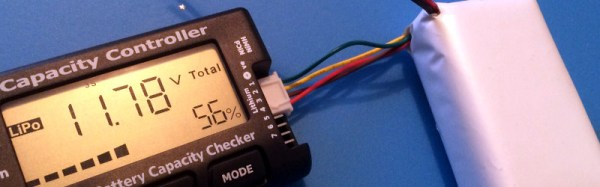
It might seem a simple procedure, to put together a battery pack, and in terms of physical wiring it certainly is. But lithium-ion cells are not simply connected together in the way dry cells are, to avoid a significant fire risk they need to have the voltage of each individual cell monitored with a special balanced charger. Thus each cell junction needs to be brought out to another connector to the charger.
[Glen]’s write-up takes the reader through all the requirements of safe lithium-ion pack construction and charging, and is a useful read for any lithium-ion newbies. If nothing else it serves as a useful reminder that mobile phone cells can be surprisingly cheap.
Lithium cells have captured our attention before here at Hackaday. Our recent Hackaday Dictionary piece provides a comprehensive primer, we’ve featured another multi-cell build, and an interesting app note from Maxim for a battery manager chip.



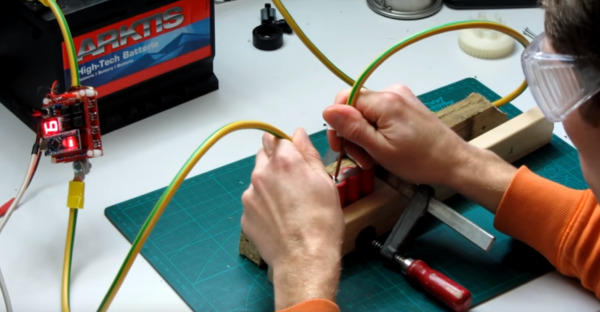
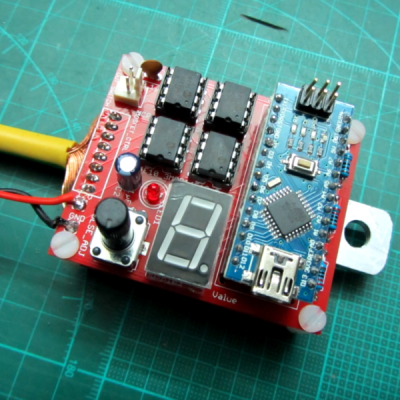 When it comes to delivering the high currents necessary for spot welding, the Arduino Nano is not necessarily the first thing that comes to mind. But the need for a precisely controlled welding pulse makes the microcontroller a natural for this build, as long as the current handling is outsourced. In [KaeptnBalu]’s build, he lets an array of beefy MOSFETs on a separate PCB handle the welding current. The high-current wiring is particularly interesting – heavy gauge stranded wire is split in half, formed into a U, tinned, and each leg gets soldered to the MOSFET board. Welding tips are simply solid copper wire, and the whole thing is powered by a car battery, or maybe two if the job needs extra amps. The video below shows the high-quality welds the rig can produce.








