Superbike Gets Bootstrapped Instrument Refit

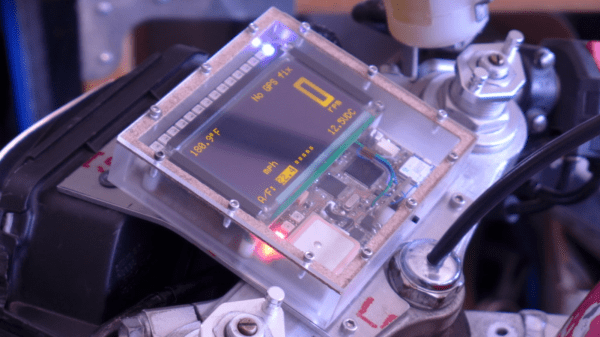
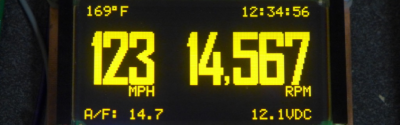
[Josh] got rid of the standard, factory gauges on his GSXR Super-bike and installed a custom built instrument panel which displays some additional parameters which the regular instrumentation cluster did not. He was working on converting his bike in to a Streetfighter – a stripped down, aggressive, mean machine. The staid looking gauges had to go, besides several other mods to give his bike the right look.

GSXR_03Luckily, he had the right skills and tools available to make sure this DIY hack lives up to the Streetfighter cred of his bike. The important parameter for him was to log the Air / Fuel mixture ratio so he could work on the carburation. Along the way, he seems to have gone a bit overboard with this build, but the end result is quite nice. The build centers around a Planar 160×80 EL graphic display lying in his parts bin. The display didn’t have a controller, so he used the Epson S1D13700 graphic controller to interface it with the microcontroller. An Atmel ATmega128L runs the system, and [Josh] wrote all of his code in “C”.
Continue reading “Superbike Gets Bootstrapped Instrument Refit”

Bluetooth Thermometer Minds Your Meats

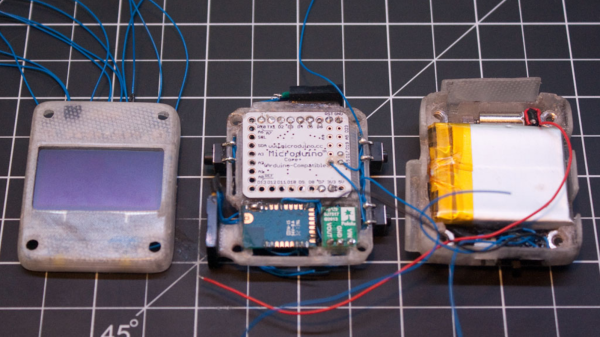
The summer may have come to a close here in the USA, but any time of the year is a good time for grilling. In the colder weather, it’s a drag to have to stay near the hot grill to keep an eye on your burgers and franks. [Eric Ely] thought it would be smarter to have a meat thermometer that sent his phone the current reading via Bluetooth.

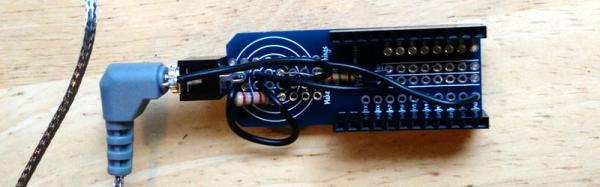
Instead of starting from scratch, [Eric] took an off the shelf electronic thermometer and removed its temperature probe (which was a thermistor). The hardware used an off the shelf Bluetooth board with a companion battery board and prototype board. If you can’t bear to cut up a good thermometer, you can get replacement probes that ought to work just as well.

In addition to the boards and the scavenged thermistor, [Eric] used a couple of resistors. One resistor is in parallel with the thermistor to improve the linearity of the device’s response curve. The second resistor forms a voltage divider that the Bluetooth board reads.

The software (using Node.js and C) is available on Github. The C program reads the temperature and pushes it out using JSON. Node.js provides a server that [Eric] can hit with his phone’s Web browser.

Sure, you can buy wireless thermometers, but what self-respecting hacker wants to carry around a store-bought box just to display meat temperature? Viewing it on your phone has much more street cred.  Of course, a real hacker isn’t going to cook on a conventional grill, either.

Continue reading “Bluetooth Thermometer Minds Your Meats”

Toy Television’s Dreams Come True

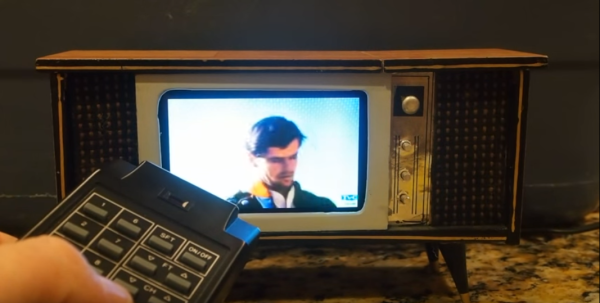
A couple of years ago, [Alec]’s boss brought him a souvenir from Mexico City—a small mid-century console television made of scrap wood and cardboard. It’s probably meant to be a picture frame, but [Alec] was determined to give it a better life.

As it turns out, the screen of [Alec]’s old Samsung I9000 was a perfect fit for the cabinet with room to spare. It was on its way to becoming a real (YouTube) TV once [Alec] could find a way to control it remotely. A giant new-old stock remote that’s almost bigger than the TV was just the thing. There’s enough room inside the remote for a non-LE Bluefruit module, which is what the I9000 will accept as input without complaint.

Trouble is, Bluefruit doesn’t support matrix keypads, so [Alec] used a bare ATMega328 running on the internal clock. Since the Bluefruit board provides voltage regulation, the remote was able to keep its native 9V power. [Alec] is happy with the results, though he plans to refine his button choices and maybe make a new overlay for the remote. Stay tuned for a tiny TV tour.

Continue reading “Toy Television’s Dreams Come True”

New Part Day: Tiny, Tiny Bluetooth Chips

The future of tiny electronics is wearables, it seems, with companies coming out with tiny devices that are able to check your pulse, blood pressure, and temperature while relaying this data back to your phone over a Bluetooth connection. Intel has the Curie module, a small System on Chip (SoC) meant for wearables, and the STM32 inside the Fitbit is one of the smallest ARM microcontrollers you’ll ever find. Now there’s a new part available that’s smaller than anything else and has an integrated Bluetooth radio; just what you need when you need an Internet of Motes of Dust.

The Atmel BTLC1000 is a tiny SoC designed for wearables. The internals aren’t exceptional in and of themselves – it’s an ARM Cortex M0 running at 26 MHz. There’s a Bluetooth 4.1 radio inside this chip, and enough I/O, RAM, and ROM to connect to a few sensors and do a few interesting things. What makes this chip so exceptional is its size – a mere 2.262mm by 2.142mm. It’s a chip that can fit along the thickness of some PCBs.

To provide some perspective: the smallest ATtiny, the ‘tiny4/5/9/10 in an SOT23-6 package, is 2.90mm long. The smallest PICs are similarly sized, and both have a tiny amount of RAM and Flash space. The BTLC1000 is surprisingly capable, with 128kB each of RAM and ROM.

The future of wearable devices is smaller, faster and more capable devices, and with a tiny chip that can fit on the head of a pin, this is certainly an interesting chip for applications where performance can be traded for package size. If you’re ready to dive in with this chip the preliminary datasheets are now available.

Mechanical Keyboard Goes BLE

Like many programmers, [Daniel Nugent] loves his old mechanical keyboard (a WASD Code Keyboard). What he didn’t love was the cord. Sure, you can get a modern wireless keyboard, but it won’t be the same as the keyboard you’ve spent so much time with. Armed with a Bluetooth Low Energy (BLE) module, a rechargeable battery and some coding, he kept his keyboard but got rid of the wires.

Although he has some specific handling for the WASD, the code would very likely handle any PS/2 keyboard. The PS/2 interface is a simple synchronous serial port with a single clock and single data line. Handling it with a microcontroller isn’t very difficult.

Continue reading “Mechanical Keyboard Goes BLE”

Hackaday Prize Semifinalist: Bendy Solar Bluetooth Tags

Last January, [DrYerzina]’s sister couldn’t find her cat. The family searched the neighborhood for two hours until the cat came out from underneath a bed, proving once again cats own humans, not the other way around. A solution to this problem would come in the form of technology, specifically as [DrYerzinia]’s entry for the Hackaday Prize, a solar-powered Bluetooth tracking device. Yes, you can go on Amazon or eBay and buy a BLE tracker, but this version comes in a handy package: it’s built of a flexible circuit board to fit just about everywhere, including on the collar of a cat.

[DrYerzina]’s Bluetooth tracker is built around an Bluetooth LE module, with a few added passives, LEDs, and other parts glued and soldered onto a double sided, flexible PCB. To this, he’s added a flexible solar cell and a flexible LiPo battery. All of this is stuffed inside an enclosure 3D printed in flexible filament.

While the Hackaday Prize is filled with wearables, [DrYerzina]’s project is at the forefront of hombrew wearable technology. Nowhere else in the prize have we seen a dedication to making a device that bends. The best part is, he’s actually building a useful device; with just 15 minutes of sunlight a day (a condition very likely for a sleeping cat), this Bluetooth tag can work for weeks.

The 2015 Hackaday Prize is sponsored by:

Hipster Rotary Dial Adds Bluetooth 4.0

We have seen a few projects that convert a rotary dial for use with modern technology, but this one adds a new twist to the mix: it uses Bluetooth 4.0. [Silent] used a Nordic Semiconductor NRF51 DK development board for the project, which was built from the Nordic SDK source code for creating an HID (Human Interface Device). After what he claims was an hour or so of hacking, he was able to get this Arduino-compatible SoC dev board to detect the pulses from the rotary dial, then pass the appropriate number to a connected device as a key press. This means that his design should work with any device that has Bluetooth 4.0 support. It is powered from a big dry cell because, to quote [Silent], “small coin batteries are not hipster enough”.

It’s a simple project, and we have seen rotary cell phones before, but this still is ripe for expansion. You could either use a smaller, cheaper version of the Nordic chip at the center of this hack, as most of the dev board features aren’t used. Or you could do some more hacking, add support for the Bluetooth HSP headset profile, then wire it up to a vintage phone for the most hipster Bluetooth headset ever. We can’t wait until we see a hipster sitting in a coffee shop banging away on a typewriter and answering this. Get to it, people!

Continue reading “Hipster Rotary Dial Adds Bluetooth 4.0”