Shake Phone To Start Scooter

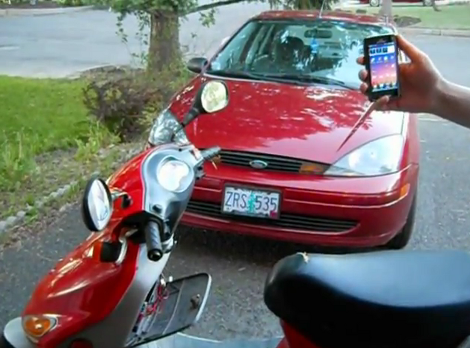
This scooter starts right up with a shake of your Android device. This shake must be done from front-to-back, because a side-to-side shake is reserved for unlocking the saddle ([Brad] stores his helmet within).

Connectivity is facilitated over Bluetooth, with a rocker switch near the left handle bar to disable the receiver so that you don’t run down the battery. You can see the locking panel hanging open on the front portion of the scooter. Inside he installed the driver board which patches into the ignition system and drives a solenoid for the seat latch. It sounds like the latching mechanism used a bowden cable whose handle was inside that locking panel. By adding a solenoid and generously lubricating the cable he  managed to get it functioning from the driver board.

Check out the video after the break for a proper demonstration. The phone is running a Python script via SL4A, which takes care of the user interface.
Continue reading “Shake Phone To Start Scooter”

Update: Androcade 2.0

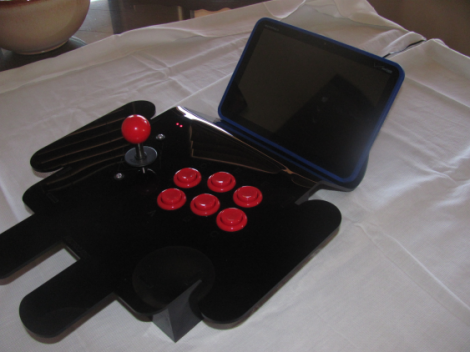
[Chris] has been going about his business, letting his interest guide him as it will. But always in the back of his mind is his Androcade project, and he’s spent the last year making improvements. It’s an arcade controller for playing games on an Android tablet. It connects to the device via Bluetooth, and includes a built-in stand.

His original version was featured here last year. It was made from wood (with a nice Android green finish) and included three buttons and a joystick. This time around he moved to some black laser-cut acrylic for the case, and has doubled up on the buttons. It also now enumerates as an HID Bluetooth device, whereas before it was pushing serial data over the BT connection.

He’s had enough interest from his friends to also create an iPad version all in white. It connects and works just the same as the Android flavor. Check out a bit of Donkey Kong gameplay after the break.

Continue reading “Update: Androcade 2.0”

Outdoor Stereo Helps Your Neighbors Learn To Issue Noise Complaints

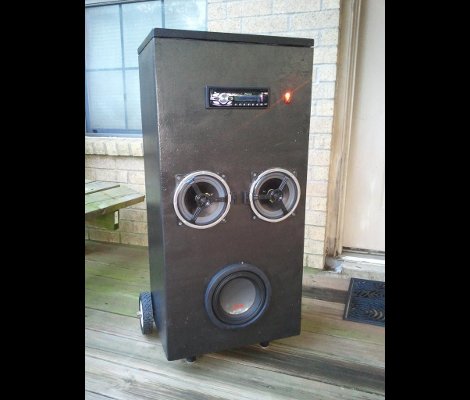
Backyard parties are going to rock over at [Effin_dead_again’s] house. That’s because he just finished building this outdoor stereo. It carries its own power supply so you can take it on the road with you, and we don’t think you’ll have trouble hearing it with the 240 Watt amplifier hidden inside.

He shared the equipment details in his Reddit conversation. A 12V lawn mower battery sits in the base of the wooden enclosure. One of the commenters mentioned the dangers of hydrogen off-gassing from that power source, but [Effin_dead_again] thought of that and included venting around the lid. The subwoofer is an 8″ Alpine, and speakers are out of a Hyundai car. The head unit has Bluetooth built in for easy connection to your smart phone. It of course has the ability to play CDs and MP3s too, and we’d bet you can tune the radio if there’s an antenna connected.

Need similar power but a bit more portability? Check out this stereo built into a cooler.

NES Controllers For Any Bluetooth Application

[Dustin Evans] wanted to used his original NES controllers to play emulated games. The problem is he didn’t want to alter the classic hardware. His solution was to use the connectors and enclosure from a dead NES to build a Bluetooth translator that works with any NES controller.

Here he’s showing the gutted half of an original NES. Although the motherboard is missing, the connectors for the controllers are still there. They’ve been rewired to an Arduino board which has a BlueSMiRF modem. The controller commands are harvested by the Arduino and sent to whatever is listening on the other end of the Bluetooth connection. He also has plans to add a couple of SNES ports to the enclosure so that those unaltered controllers may also be used.

In the video after the break [Dustin] walks us through the hardware setup. He then demonstrates pairing the device with an Android phone and playing some emulators with the pictured controllers.

Continue reading “NES Controllers For Any Bluetooth Application”

Classic VW Bug Stereo Gets Bluetooth

If any of you deal with older car fanatics, you’ll know that the original dash stereo is a coveted piece of equipment. If they haven’t been removed and replaced with something more modern over the years, they’re usually non functional. [Hadrien] has gone through some trouble to retain his original stereo in his 69 Volkswagen Beetle. First, he did a common hack we see even in modern cars. He added an auxiliary input.

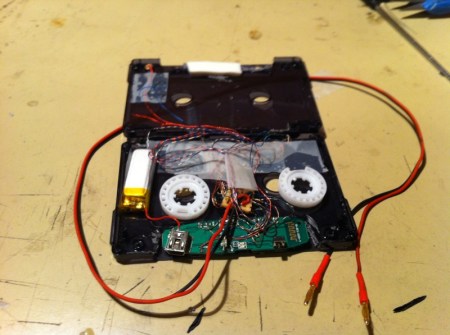
This satiated his desire for modern audio for a while, but he really found the necessity for a cable attachment annoying. He decided he was going to add bluetooth (google translated from french).  To do this, he took a pair of bluetooth headphones and tore them apart. Using an old cassette tape as the case, he rebuilt them as something that could be wired directly to his dash stereo. He even kept the mic just in case he wanted to use this as a hands free device.

Being build in 1969, his car stereo doesn’t use a cassette, so he just keeps it in the glove box. This isn’t optimal, but as he says, at least he doesn’t have to plug in his phone.

Hackaday Links: May 21, 2012

Turning anything into a touch sensor

Makey Makey is a small board with a USB plug and bunch of contact points for alligator clips. Plug the Makey into your computer and attach just about anything to the contacts, and you can make anything into a video game controller, a keyboard, a piano, or pretty much anything you can imagine. If [Sprite_tm] copied it, you know it has to be cool.

RepRaps will finally cost a million dollars

The Pentagon is throwing money at 3D printers. It’s “only” $60 Million the DoD is putting into 3d printer research, but hopefully our most brilliant researchers will help refine some of the ‘unsolved problems’ – like metal and circuit printing – the 3D printer community is facing.

Getting started with FPGAs

[Tim] found a neat little $40 FPGA board aimed right at the hobby hacker. The good news: It’s compatible with Arduino shields, and it’s very cheap. The bad news: it only has 1280 logic cells, so you probably won’t be emulating CPUs on this thing. If anyone has a teardown / project with this board, send it in.

Improving a Bluetooth dongle with a bit of wire

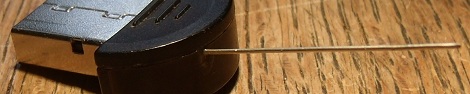
Unsurprisingly, the extremely cheap Bluetooth dongle [Mike] bought on eBay didn’t have great reception or range. No problem, because you can just replace the internal antenna with a piece of wire cut to length. Now bluetooth devices are recognized instantly, and there are no Bluetooth ‘dead spots’ around [Mike]’s computer.

Come to France, make stuff

The Toulouse Hackerspace is having a little shindig this coming weekend (May 25-27) featuring a conference, workshop, concerts and performances. If you’re in the area, drop on by,

Controlling Robots With A TRS-80

[DJ Sures], mastermind behind the EZ-B Bluetooth Robot controller, sent in a really interesting build where he controls a robot with a 1983 TRS-80 computer.

The robot in question is [DJ Sures]’ adorable WALL-E we’ve seen before. WALL-E is controlled through a Bluetooth connection to a desktop PC with the EZ-Builder hardware and software package.

To get the Trash-80 talking to WALL-E, [Sures] connected a tiny Bluetooth module to the TX pin of the 6402 UART. It’s a very, very simple modification that adds a Bluetooth serial connection to one of the first notebook computers. After syncing the TRS-80 and WALL-E to the computer running EZ-Builder, it’s a piece of cake to make the robot respond to the clanging of a 30-year-old keyboard.

There’s a video of [DJ Sures] going over his build after the break with a wonderful demo of WALL-E freaking out to a little dubstep. Check that out after the break.

Continue reading “Controlling Robots With A TRS-80”