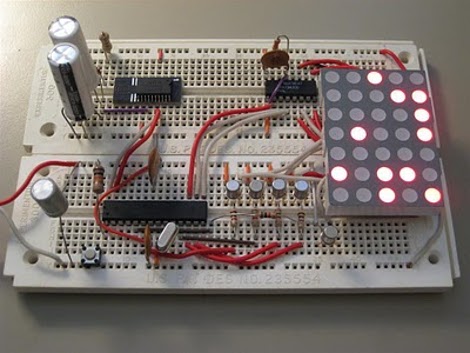
The Most Complicated, And Simplest Binary Clocks.

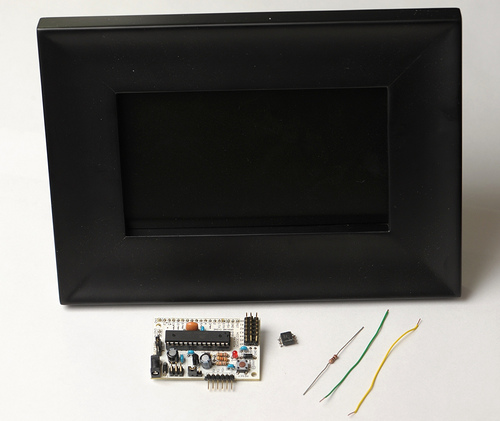
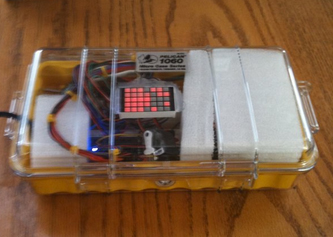
We were going to take a break from posting clocks. Really we were. This one came in the tip line today though, and we just couldn’t pass it up. [Alex] has built, what might be the most complicated clock we’ve seen. At least, it would appear that way initially. This Binary clock shows Hours, Minutes, Seconds, Days, and Months. He started with a picaxe, but eventually settled on an Mbed. Yes, he knows it is overkill, but it worked out pretty well.

As for the simplest, that came into our tip line as well. [Toby] sent this in, and agrees with us that it is hardly worthy of being called a hack. However, in light of the complicated one above, we didn’t see any harm in posting its opposite. Check it out after the break.

Continue reading “The Most Complicated, And Simplest Binary Clocks.”

Wine Glass Time Keeper

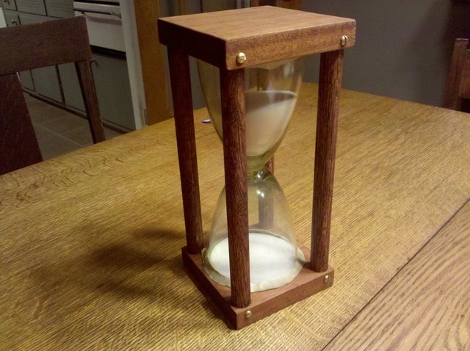
We’ve seen a glut of time-keeping projects lately. We guess time was the original motivator for technology so we’re okay with it (but we’re not calling ourselves Clockaday quite yet). This clock, or more appropriately this timer, is a homemade hourglass that [Andrei] put together. The finished look is simple but he put some real time into its production.

The glass portion is a combination of two wine glasses. He removed the stems, ground the bottoms flat, then drilled holes to allow the sand to pass. He used plumbers putty around the top of the upturned reservoir to create a temporary bowl of water which cooled the glass during drilling. This prevented cracking by keeping the friction generated heat at bay. Working with the glass took a total of around five hours.

To assemble, he epoxied the two wine glasses together, routed out a ring in the wood bases for the lips, and used dowels to connect the two ends. [Andrei] concluded that the gentle slope at the bottom of the wine glasses is not the ideal shape as some sand can get stuck in them. Perhaps champagne flutes for his next build? At any rate, we think it’s a unique, non-automated hourglass build.

Volt Meter Clock

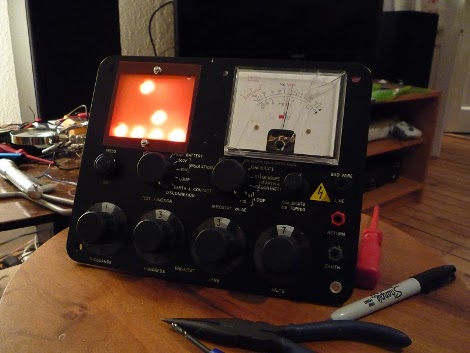
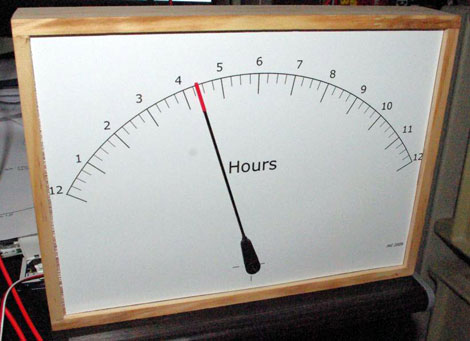
The Volt meter clock continues our recent slew of interesting clock projects. Though considerably easier to read than the resistor clock, it is in the same frame of mind. Set up to look like the face of an analog volt meter, it almost looks like something official or scientific. Since [Jon] couldn’t simply drop a clock mechanism in, he used a PIC microcontroller. The circuit is pretty simple, but he deserves some credit just for the unique layout.

Know Your Resistors… Tell The Time

[Darren] built a clock that uses a resistor to display the time. Well, it really uses a model of a resistor. This extremely tardy entry in the Hackaday design challenge houses all of the electronics on a PCB the size of a business card. Four RGB LEDs shine up through holes in the wooden base to light bands on an acrylic tube. The colors correspond to the values used in the Resistor Color Code. In the picture above the clock is displaying 5:26 (that’s supposed to be a red band but the camera didn’t pick it up too well). The band in the center fades up over 60 seconds to signify AM, and down to show PM.

It may be late, but it’s a clever design. It looks sleek and it uses no buttons for an interface. [Darren] sourced the LEDs themselves as light sensors to display the date, and enter time setting mode.

Neon Lamp And Other Crazy Clocks

Quick quiz, what came before transistors? Why vacuum tubes of course. If this clock doesn’t make you thankful for the luxury of integrated circuits, nothing will.

We had never heard of using Neon Lamps as logic circuits, and they definitely produce a much cooler effect when counting.
[Thanks Philippe]

And finally, we’re just suckers for a good Nixie Clock. The scope clock is also pretty interesting.

Weather Clock

[Sean_Carney] build this clock that tells the weather instead of the time. The two hands display the current conditions and the temperature. Forty below zero seems amazingly cold if you’re on the Fahrenheit scale but [Sean’s] from Winnipeg so he’s operating on the Celsius side of things.

Two servos move the hands to match the data scraped off of the Internet. An Arduino does the scraping with the help of an Ethernet shield. This reminds us of the Harry Potter clock that tells a persons location.

[via Flickr]

Steampunk Nixie Clock

This single-digit Nixie clock is a thing of beauty. You might hate Steampunk or you might love it, but you have to respect projects where the design gets equal (or more) consideration compared to the function. The electronics used in the project build upon an existing single Nixie design. Instead of hiding the guts inside the clock the PCB has been laid out to augment the design. We think [Blue Metal] hit it out of the park with this one!