Move Over, Google Nest: Open Source Thermostat Is Heating Up The Internet Of Things

In the wake of Google’s purchase of connected devices interest Nest, the gents at [Spark] set about to making one in roughly a day and for a fraction of the cost it took Nest to build their initial offering. [Spark]’s aim is to put connected devices within reach of the average consumer, and The Next Big Thing within the reach of the average entrepreneur.

The brain is, of course, [Spark]’s own Spark Core wi-fi dev board. The display is made of three adafruit 8×8 LED matrices driven over I²C. Also on the bus is a combination temperature and humidity sensor, the Honeywell HumidIcon. They added some status LEDs for the furnace and the fan, and a Panasonic PIR motion detector to judge whether you are home. The attractive enclosure is made of two CNC-milled wood rings. The face plate, mounting plate, and connection from the twistable wood ring to the potentiometer is laser-cut acrylic.

[Spark]’s intent is for this, like the Nest, to be a learning thermostat for the purpose of increasing energy efficiency over time, so they’ve built a web interface with a very simple UI. The interface also displays historical data, which is always nice. This project is entirely open source and totally awesome.

If you have an old Android phone lying around, you could make this open source Android thermostat.
Continue reading “Move Over, Google Nest: Open Source Thermostat Is Heating Up The Internet Of Things”

Software Advice For Anyone Thinking About A CNC Router

Excellent results can come from a small CNC router, but don’t forget the software!

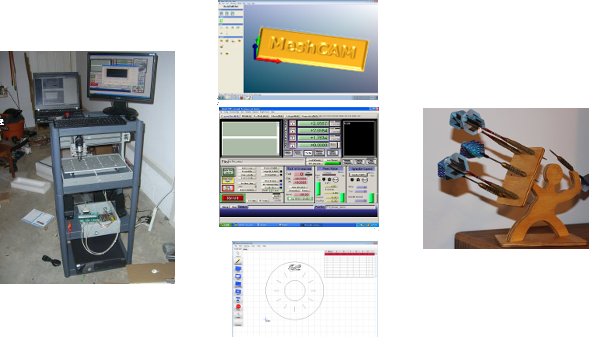
CNC tools, whatever their flavor, can greatly enhance your “making” or DIY ability. My current tool of choice is a CNC router. Being familiar with a manual milling machine, the concept seemed similar, and the price of these is quite reasonable when compared to some other tools. As described in this post, my machine is a Zen Toolworks model, but there are certainly other options to visit like this Probotix V90 model noted recently in this post.

Although any number of CNC router models look great in videos and pictures, rest assured that even the best machines require some patience to get one running satisfactorily. Setting up the machine can be a challenge, as well as figuring out what your machine is capable of, but one thing that might slip peoples’ minds is the software involved. Read on to find out all you need to know the basics of what goes on behind the scenes to “magically” produce interesting parts. Continue reading “Software Advice For Anyone Thinking About A CNC Router”

Fail Of The Week: Hackaday Writer’s First CNC Adventure

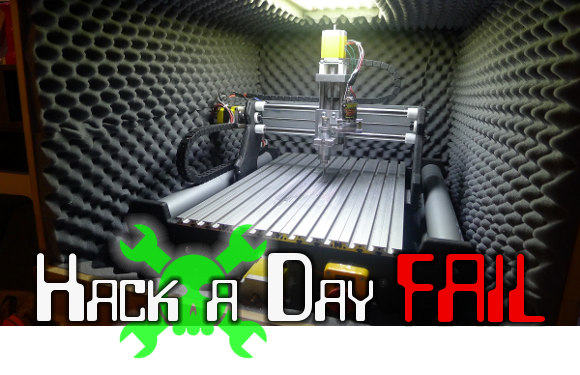
This Fail of the Week post focuses on a project from [Limkpin] aka [Mathieu Stephan], one of the Hackaday contributors. He wanted a CNC mill of his very own and decided to go with a kit that you assemble yourself. If it had been clear sailing we wouldn’t be talking about it here. Unfortunately he was met with a multitude of fails during his adventure. We’ll cover the highlights below.

Continue reading “Fail Of The Week: Hackaday Writer’s First CNC Adventure”

LearnCNC Game

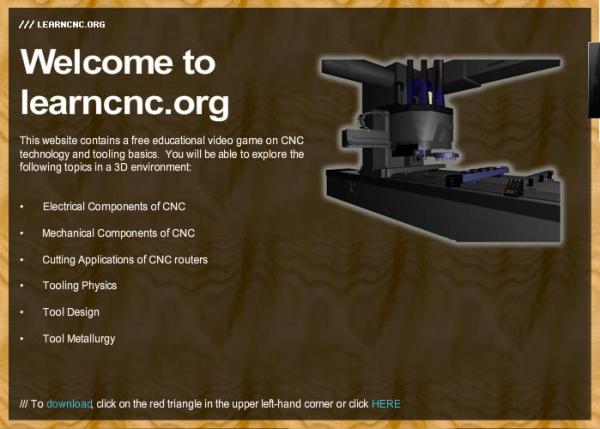
Do you want to learn how a CNC machine works, but don’t have access to one (yet)? One of our tipsters just informed us of this great project that was created by a team of students from the University of British Columbia, and it’s an interactive 3D learning system that teaches everything about CNC machining.

We downloaded the “game” and it’s pretty cool — you get to walk around a virtual workshop and can click on various things to learn about their functions. Alternatively, you can go just go through their lessons (that appear when you click on things) on the website. It’s a great summary to get your feet wet in the world of CNC machining.

Beyond how the machines themselves work, the website also goes into great detail about the various applications you can use CNC machining for and physics behind tooling design.

Even if you’ve had a brief introduction to CNC machining before, this site provides a great summary of most everything — it’ll be very handy if you’re hoping to use a school’s machine shop for personal projects…

[Thanks Chris!]

Raspi Mini Laser Engraver

If you’ve got a lot of spare parts lying around, you may be able to cobble together your own laser engraver without too much trouble. We’ve already seen small engraver builds that use an Arduino, but [Jeremy] tipped us off to [Xiang Zhai’s] version, which provides an in-depth guide to building one with a Raspberry Pi.

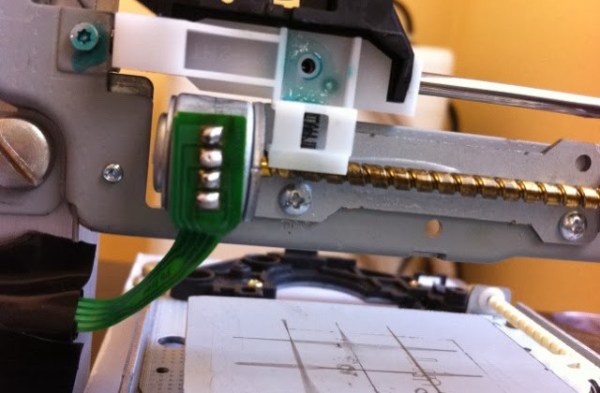
[Xiang] began by opening up two spare DVD writeable drives, salvaging not only their laser diodes but the stepper motors and their accompanying hardware, as well as a handful of small magnets near each diode. To assemble the laser, he sourced an inexpensive laser diode module from eBay and used a vise to push the diode into the head of the housing. With the laser snugly in place and the appropriate connecting wires soldered on, [Xiang] whipped up a laser driver circuit, which the Raspi will later control. [Xiang] worked out the stepper motors’ configuration by following [Groover’s] engraver build-(we featured it a few years back)-attaching the plate that holds the material to be engraved onto one axis and the laser assembly to the other.

Check out [Xiang’s] project blog for details explaining the h-bridge circuits as well as the Python code for the Raspi. As always, if you’re attempting any build involving a laser, please use all necessary precautions! And if you need more information on using DVD burners for their diodes, check out this hack from earlier in the summer

A Six Part CNC Machine

CNC

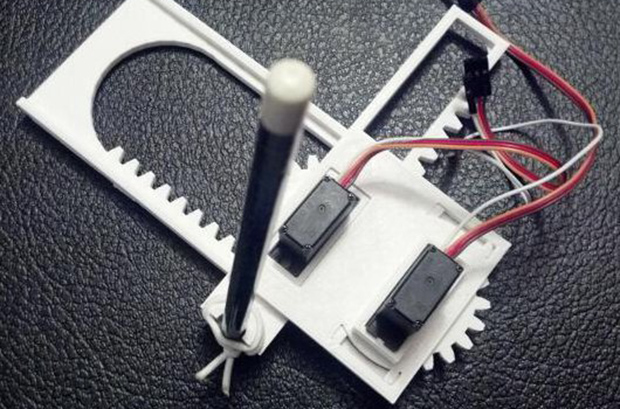
CNC machines are impressive pieces of kit. We’re all for seeing the big, burly, impressive machines, but there’s something to be said about seeing how small they can get. [Jay] has what is probably the most minimal CNC plotter we’ve ever seen, built from only six 3D printed parts.

[Jay]’s plotter is based on the Piccolo, an exceedingly small-scale CNC platform that can be built for $70 with laser-cut parts. This version, though, uses only six parts that can be downloaded from Thingiverse. Powered by an Arduino and two micro servos, this CNC plotter would be a great introduction to CNC for any robotics club or hackerspace tutorial series.

[Jay] has been doing some awesome work with CNC plotters; we saw his large format Plotterbot earlier this month, and his giant plotted HaD logo with HaD infill poster was a great submission to our Trinket contest.

Video of [Jay]’s plotter in action available after the break.

Continue reading “A Six Part CNC Machine”

A Nightmare On CNC Street

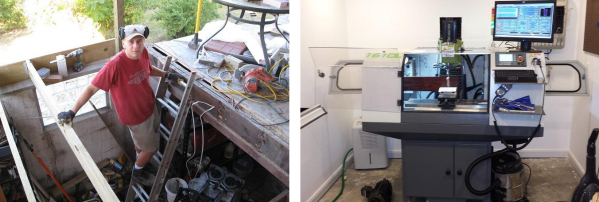
[James Dressman] emailed us about his two-year journey of getting a large CNC machine running in his home. He doesn’t currently have a webpage, however his story was so incredible that we just had to feature it.   [James] started by doing plenty of research online, and ordering a new CNC. The real fun started when he opened up a wall to fit the 2300 pound monster into his home. [James] found so much insect and water damage that he ended up rebuilding the entire rear half of his home.

Once the CNC was safely set up, the fun still wasn’t over. Not all family members are keen on having an industrial machine tool in the house. In [James’] case it was the smell of way oil that drove his wife nuts. This was all before spindle problems with the tool itself began to rear their ugly head. Illness and family tragedy put everything on hold for several months, however once [James] strength returned, he attacked the problems with renewed vigor. It was a long and winding road, but he now has a fully functional CNC.

But don’t just take our word for it. Continue after the break to see his photo album and to hear James tell the story in his own words.

Continue reading “A Nightmare On CNC Street”