ESP8266 As A Tape Drive

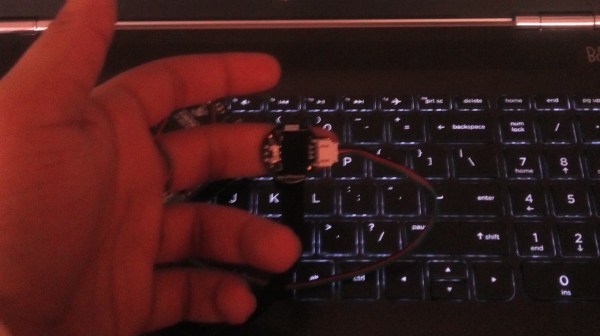
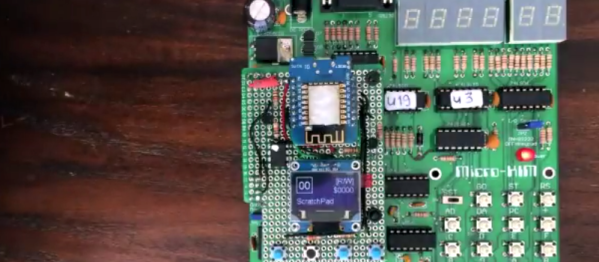
1976 was the year the Apple I was released, one of several computers based on the MOS 6502 chip. MOS itself released the KIM-1 (Keyboard Input Monitor) initially to demonstrate the power of the chip. The single board computer had two connectors on it, one of which could be used for a tape recorder for long-term storage. When [Willem Aandewiel] went to the Apple Museum Nederland in 2016, he saw one and felt nostalgic for his youth. He was able to get a replica, the microKIM, and build it but he wanted to use new technology to interface with this old technology, so he decided to use an ESP8266 as a solid state tape recorder.

One of the reasons the KIM-1 was so popular when it was released was that there was lots of documentation available. [Willem] used this documentation to figure out how the KIM-1 saves data to the recording device. An ATTiny85 is used to decode the pulse stream that the KIM-1 sends when saving because the timing was too tight to both “listen” and decode the bits as well as convert and store them. For loading programs, the data can be sent digitally as 1’s and 0’s to the KIM-1. This means that the ATTiny is only used for decoding and doesn’t have to re-encode the data.  Because of this, saving is slow, but loading is very quick.

To complete the project, [Willem] added four buttons, one each for rewind, record, play and fast-forward, and a screen so you can see which program is currently selected and can go from one program to another. As a nice throwback touch, record and play have to be pressed at the same time when saving. For more 6502 projects, check out this 6502 based DIY computer, or this 6502 built from discrete parts.


Continue reading “ESP8266 As A Tape Drive”

Eavesdropping With An ESP8266

In the old days, spies eavesdropped on each other using analog radio bugs. These days, everything’s in the cloud. [Sebastian] from [Hacking Beaver]  wondered if he could make a WiFi bug that was small and cheap besides. Enter the ESP8266 and some programming wizardry.

[Sebastian] is using a NodeMCU but suggests that it could be pared down to any ESP8266 board — with similar cuts made to the rest of the electronics — but has this working as a proof of concept. A PIC 18 MCU samples the audio data from a microphone at 10 kHz with an 8-bit resolution, dumping it into a 512-byte buffer. Once that fills, a GPIO pin is pulled down and the ESP8266 sends the data to a waiting TCP server over the WiFi which either records or plays the audio in real-time.

[Sebastian] has calculated that he needs at least 51.2 ms to transfer the data which this setup easily handles, but there are occasional two to three second glitches that come out of the blue. To address this and other hangups, [Sebastian] has the ESP8266 control the PIC’s reset pin so that the two are always in sync.

Continue reading “Eavesdropping With An ESP8266”

The Internet Of Jack-O’-Lanterns

As the candy rush fades, the Halloween hacks continue pouring in. [Jeremy S Cook] has taken a few fundamental concepts and dressed them up inside the smartest pumpkin on the block.

This pumpkin has a WEMOS D1 Mini ESP8266 brain, LED eyes in place of a candle for illumination, and a small USB power bank for power. The code [Cook] is using is a modified sketch by YouTuber [Innovative Tom], which creates a server on your network — don’t forget to insert your network credentials! — that enable control of the LEDs from your computer or smart phone.

[Cook] has wired the LEDs to the relevant pins on the D1 Mini, zip-tied the battery and board together and stuff them in a plastic bag to keep them dry. Stick that into the pumpkin, hot glue the LEDs in place, and test it out!

Continue reading “The Internet Of Jack-O’-Lanterns”

Hackaday Prize Entry: Thingspeak IoT Heart Rate Monitor

[Naman Chauhan]’s 2017 Hackaday Prize entry consists of a heartbeat detection and monitoring system that centers around everyone’s favorite WiFi board, the ESP8266. The monitor is hooked up to the patient’s finger, keeping track of his or her vitals and publishing the data on the cloud.

By using Thingspeak to manage the data, [Naman] leverages the platform’s data visualization and analytical features. Also, by making the data accessible on the cloud, he offers an intriguing opportunity to help friends and relatives to monitor the data. If you think about it, if you had a loved one in the hospital, wouldn’t having all of his or her chart available on your phone be great?

Don’t Miss The Bus: A One-Day Build

Sometimes the most satisfying hacks are those that spring from a situation where resources are limited, either by choice or by chance. Constraints tend to stir the creative juices.

Serial Hackaday poster [limpkin] limited himself to a one-day build with what he had on hand for this bus-route countdown timer. Full points for actually building something useful, and extra credit for making something to keep his wife from being late for work.

The principle is simple: scrape a web page to find out how much time is left before either of two busses leaves his wife’s stop, and display the number of minutes left on a huge LED display. The parts bin gave up everything needed, including an ESP8266, a boost converter, a charge controller, and the display and driver. We’re skeptical that the PCB was fabricated the same day; looks like [limpkin] is only counting the design and coding time in his 10-hour build. Still, it’s a testament to what’s possible with a deep inventory and the skills to put it to use.

Check out some of [limpkin]’s other hacks, like this Formula-E race car PCB or his adventures in laundry larceny. Oh, and he also used to write for Hackaday.

Super squirter automatic water gun

Motion Activated Super-Squirter Stands Guard

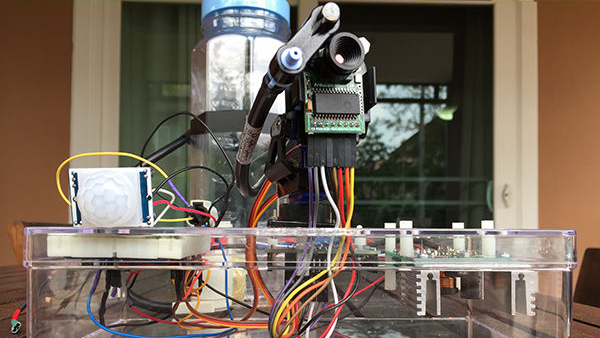
Thieves beware. If you prowl around [Matthew Gaber]’s place, you get soaked by his motion activated super-squirter. Even if he’s not at home, he can aim and fire it remotely using an iPhone app. And for the record, a camera saves photos of your wetted-self to an SD card.

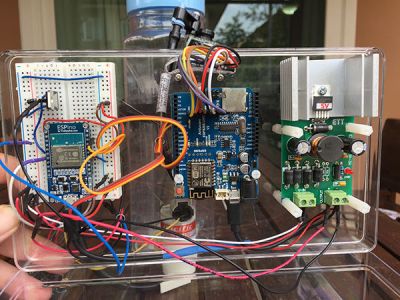
ESPino, ArduCAM UNO and voltage converter boards

The whole security system is handled by three subsystems for target acquisition, photo documentation, and communications. The first subsystem is centered around an ESPino which utilizes a PIR sensor to detect motion. It then turns on a windscreen washer pump and uses pan and tilt servos to squirt water in a pattern toward the victim.

The target acquisition hardware also sends a message to the second subsystem, an ArduCAM ESP8266 UNO board. It takes a burst of photos using an ArduCAM Mini Camera mounted beside the squirter outlet. The UNO can also serve up a webpage with a collection of the photos.

The final subsystem is an iPhone app which talks to both the ESPino and the UNO board. It can remotely control the squirter and provide a video feed of what the camera sees.

One detail of the build we really enjoyed is the vacuum relief valve he fabricated himself. It prevents siphoning through the pump when it’s not on. Don’t miss a demo of the squirter in action after the break.

Continue reading “Motion Activated Super-Squirter Stands Guard”

Drag Your Office Aircon Into The 21st Century With Wi-Fi Control

We’ll all have worked in offices that have air-conditioning, but a little too much of it. It’s wonderful on a baking-hot day to walk into the blessèd cool of an air-conditioned office, but after an hour or two of the icy blast you’re shivering away in your summer clothing and you skin has dried out to a crisp. Meanwhile on the other side of the building [Ted] from Marketing has cranked up the whole system to its extreme because he’s got a high metabolism and an office in the full force of the midday sun.

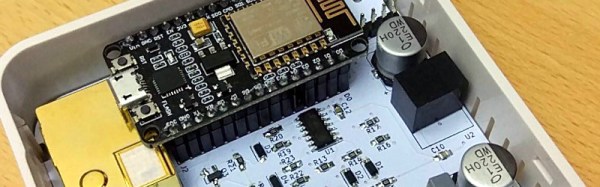
Wouldn’t it be nice if individual air-conditioning units could be easily controlled. To that end, [Maya Posch] has made a rather nicely designed board that takes a NodeMCU board with its ESP8266 processor, and uses four of its outputs as PWM to produce 0-10 volt analogue outputs via filters and op-amps to control individual units. In addition there is an onboard CO2 sensor and a temperature sensor, with provision for an external temperature sensor. The whole fits very neatly into a standard electrical outlet enclosure.

Software wise, the system uses the Sming framework providing an MQTT  communication with a backend server that allows the users to control their aircon experience. This is very much a work in progress, so the software has yet to be put up. (Hint, [Maya], hint!) The whole project though is an extremely tidy build, in fact a thing of beauty to a standard you’d expect from a high-quality commercial product. It’s this that tipped the balance into our featuring it before the software is released, it’s one to keep an eye on, because quality like this doesn’t come every day.

This isn’t the first aircon control we’ve brought you, take a look at this one controlled through Slack.