Graphic Calculator As A Spectrum Analyzer

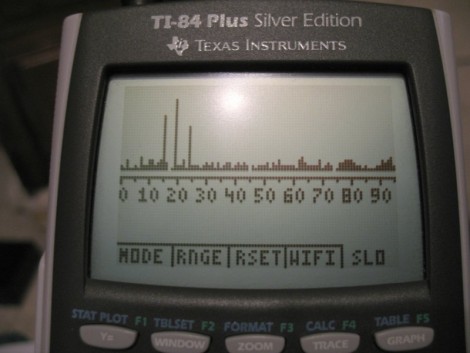
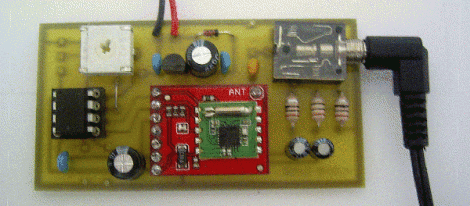
[Michael Vincent] turned his TI-84 Plus into a spectrum analyzer. By running some assembly code on the device the link port can be used as an I2C bus (something we’ll have to keep in mind). After being inspired by the cell phone spectrum analyzer he set out to build a module compatible with the calculator by using an I2C port expander to interface with a radio receiver module. Now he can sniff out signals between 2.400 and 2.495 GHz and display the finds like in the image above.

[Thanks Cecil]

Cathode Ray Tube Leads The Way On This Bot

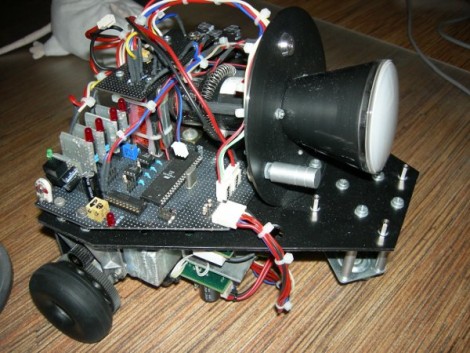
[Daqq’s] latest creation is this little robot with a CRT mounted on the front. Obviously ‘why?’ is the wrong question here, but we know this is right up his alley considering his propensity for the less common like this plasma ball Nixie tube. The solidly-built bot uses two stepper motor controlled wheels and an omni-wheel on the front to create a trike. An ATmega128 controls the system but the real story here is the CRT. It requires a hefty voltage regulator for the -600V to +200V the Tungsram DG7-123 tube needs. Trouble along the way ranged from dealing with stray magnetic fields from the power supply, to mounting the fragile tube itself. Take a look at his detailed writeup linked above and join us after the break for the demo videos.

Continue reading “Cathode Ray Tube Leads The Way On This Bot”

Wii Motion Plus Direct PC Interface

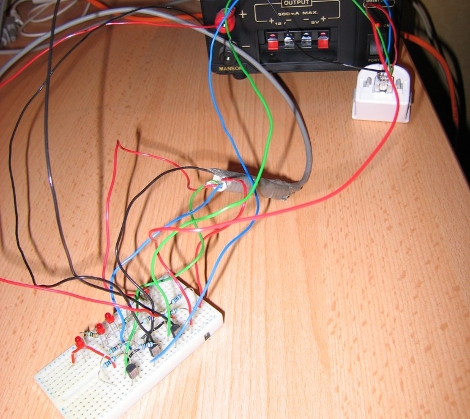
You can pick up a Wii Motion Plus module for under $20 and that’s not bad for an I2C gyroscope. This hack taps into the device through a PC parallel port. The connection calls for some level conversion to step down to the 3.3v needed by the module. The communication protocol borrows from the Wii on Arduino code examples that we saw last year. You can see the Wii Motion Plus controlling a virtual cube in the video after the break.

Continue reading “Wii Motion Plus Direct PC Interface”

RGB Display Development

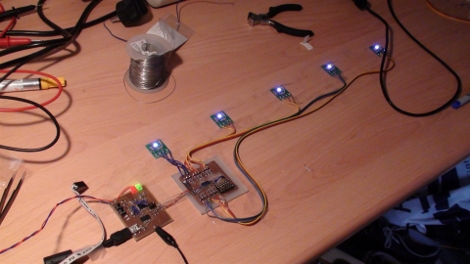
[SeBsZ] tipped us off that he’s working on a display using RGB LEDs. He’s etched some nice surface mount controller boards to carry the ATmega8 microcontroller and NXP PCA9635 drivers. This setup uses the I2C bus to address each expansion board of 5 LED modules. Theoretically this hardware would allow for 638 RGB modules but because of power and refresh rate issues he’s set his sights on reaching somewhere between 100-125, a total of about 25 expansion boards.

There’s not a ton to show off yet. But we expect big things from the project. Partly because one of his goals is to generate a display that can be rolled up and easily moved, and partly because his large-scale light bulb displays are so impressive. Take a look at the video of his 60-bulb unit after the break.

Continue reading “RGB Display Development”

Centipede Shield Design Contest

4084880398_cc349acfa6_b

Our friend [Garrett Mace] from macetech has finished a prototype of a new shield which allows the Arduino (or any other microcontroller with I2C) to add 64 digital I/O pins using only 2 of the analog pins. Currently he only has a few pre-production boards, and rather than selling them he is throwing a contest to win them. The contest is looking for people who have a specific project in mind that could use the centipede, and on Friday November 13th he will pick his favorite two. To submit an idea, just head over the Arduino forums and post an idea complete with details and relevant schematics, etc.

We will be sure to follow up with the winners of the contest, as well as let you all know when the Centipede Shield makes it into production.

Digital Tuner Reverse Engineering

hvr-1600-i2c-sniffing

Hackaday alum [Ian Lesnet] tipped us off about some reverse engineering of the HVR-1600, an analog and digital television encoder/tuner. The project was spawned when [Devin] noticed his Hauppauge HVR-1600 didn’t tune channels in Linux quite as well as it did in Windows. He had a hunch this was due to improper initialization settings for either the tuner chip or the demodulator.

To fix this he used two test points on the board to tap into the I2C bus. Using a logic analyzer he captured the command traffic from the bus while running Linux, then while running Windows. By filtering the results with a bit of Perl, and comparing them by using diff, he tracks down and finds the variation in the commands being sent by the two drivers. After a bit of poking around in the Linux source and making the necessary changes, he improved the tuning ability of the Linux package.

[Devin’s] work looks simple enough, and it is. The difficult part of this process is being smart enough to know what you’re looking for, and what you’ve got once you’ve found it.

Parts: ChronoDot RTC Module (DS3231)

ChronoDot

Macetech’s ChronoDot is a Real Time Clock module for projects requiring highly accurate time keeping and measurement. The ChronoDot uses the DS3231 chip, which features a TCXO to compensate for variations in temperature which affect normal oscillators, like the ones in most microcontrollers. The DS3231 uses simple I2C commands and registers for storing and retrieving time, but also features a variable output that goes all the way down to 1.000 hz for low power, interrupt style timekeeping applications. With the provided watch battery, the ChronoDot can keep time in idle mode for up to 8 years.

Normally the ChronoDot comes mostly assembled, requiring you to only solder on the watch battery. However, due to a manufacturing mistake, Macetech is selling a version with the header pins on the wrong side they call the ChronoDoh. This module is currently nearly half off the regular price of $14.99, which makes it a great low cost addition to a project. Macetech has sent us a couple of these modules to demonstrate how functional they still are.

Continue reading “Parts: ChronoDot RTC Module (DS3231)”