Control Your PC With A Remote

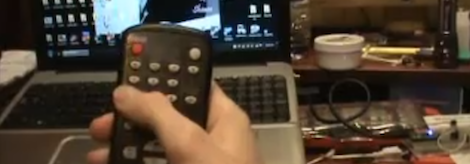
Because his computer is gradually turning into an all-inclusive media display device, [Shawn] figured a remote to control the volume and a video playlist would be a reasonable addition. TV remotes for computers have been around for years, but [Shawn] decided to go the DIY route and build his own computer remote.

For the build, [Shawn] used a Teensy dev board with an IR receiver module and the requisite infrared remote library. To translate infrared signals to keyboard commands,[Shawn] decided to base his project off a previous build that used a small program called AutoHotKey.

Right now the build can cycle through a pre-defined YouTube and Shoutcast playlist and change the volume of the currently playing track. There’s also support for moving the mouse with directional buttons on the remote, but we’re wondering if a better implementation would be using the Windows multimedia keyboard scan codes that should be supported by [Shawn]’s laptop.

Still, [Shawn] managed a very nice build that would fit into our computer battlestations quite nicely. Check out the demo of the remote in action after the break.

Continue reading “Control Your PC With A Remote”

Hexbug Code Rewrite Makes It A Walking Line-follower

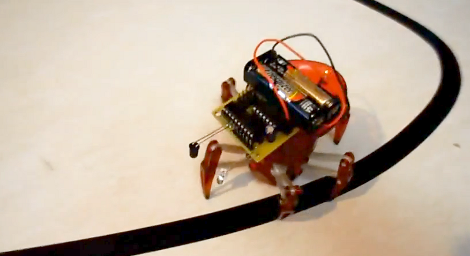
You know you’ve got a good hardware platform if you can easily repurpose it with a code rewrite. And that’s what [Eric] continues to do with these little Hexbugs. This time around he’s bent the IR emitter and receiver downward to use as a reflectance sensor. This gives it the ability to follow a dark line on a light surface.

He originally patched an MSP430 into the $25 RC toy. The IR pair was intended for obstacle avoidance, which we saw in a recent links post. This hack does a great job of repurposing the avoidance system. Since the add-on hardware is mounted on a motorized turret, the single sensor pair can sweep back and forth to find the line it will follow. In one way this is better than most line followers which use multiple sensors mounted to the body. But the drawback is that this results in slower travel and won’t be winning any contests. Don’t miss the demo clip after the break.

Continue reading “Hexbug Code Rewrite Makes It A Walking Line-follower”

Controlling Your Christmas Lights Without Ever Getting Off The Couch

remote-xmas-tree-light-switch

14 year-old [Connor Smith] has been busy this holiday season, thinking up ways to improve the lighting situation at home.

A few weeks ago he put together this 3-channel light controller to toggle his parents’ external lights, incorporating an Arduino for control. The Arduino was used to switch the channels on and off at specified intervals in order to create a simple light show on the house’s exterior. Not satisfied with just a few strings of blinky lights, he took his controller back inside for some additional modifications.

He had grown tired of crawling behind the Christmas tree to plug and unplug it every day, and decided to make things easier on himself. He stripped the IR receiver out of an old VCR and interfaced it with the Arduino in his light controller using the IRremote library. After taking a bit of time to decode the values for two infrequently used buttons on his TV remote, he had himself a Christmas tree light switch that he could activate from across the room.

Check out the short video below to see his remote switch in action.

Continue reading “Controlling Your Christmas Lights Without Ever Getting Off The Couch”

Lamp Fading And Remote Control For The Lazy

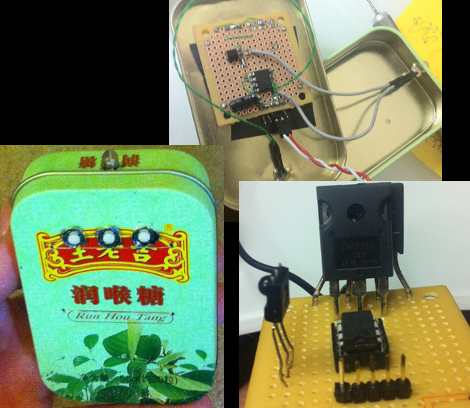
[Dmitry Grinberg] has to walk all the way across his bedroom to switch the lamp on and off. The drudgery of this finally became too much, so he built a remote control and added dimming for good measure. Above you can see the circuitry for the remote and the receiver, as well as the finished remote housed in what he calls a ‘Chinese Altoids tin’.

After the break you’ll find [Dmitry’s] demo video. The remote control is quite responsive, and the dimming has great resolution. That’s thanks to a power N-channel MOSFET which switches the AC with the help of a full wave rectifier. The PIC 12F617 that controls the MOSFET is powered separately, and [Dmitry] mentions that you must use a transformer and not a switch-mode power supply to avoid a fire. We’d like to know more about this, so leave a comment if you are able to explain further.

The remote and receiver communicate via Infrared. The protocol is operating with 38 kHz signals using an easily sourced receiver tuned to that frequency. [Dmitry] shares all the details about the encoding scheme that he uses. Recreating this communications pairing is a great way to test your understanding of this technique. But if you need a refresher, here’s a tutorial to push you in the right direction. Continue reading “Lamp Fading And Remote Control For The Lazy”

Building Optical Flex Sensors

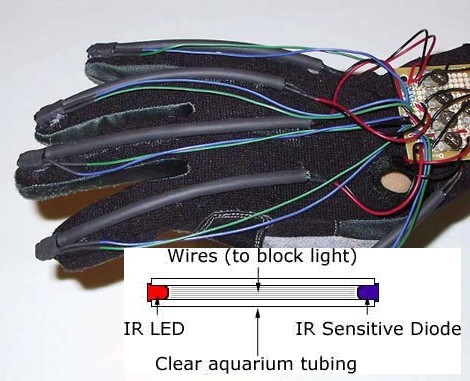
[Joel] dug up this hack that he pulled off over ten years ago. It’s inspired by the Nintendo PowerGlove, and uses flex sensors to react to movements of your fingers. The interesting thing is, he built these optical flex sensors himself.

He likes to say that this is a ghetto fiber-optic setup. The inlaid diagram above gives you an idea of how the sensors work. An IR LED and infrared diode are positioned at either end of a piece of clear aquarium tubing. When the tube is flexed, the amount of light that makes it to the diode is diminished, a change that can be measured by a microcontroller. [Joel] found that he could increase the resolution of the sensor by adding something to the center of the tube, blocking the light when not straight. In this case he used pieces of scrap wire. The outside of the sensor was also wrapped in shrink tubing to keep ambient light from interfering with measurements.

He uses a trimpot to tune the sensors but we wonder how hard it would be to add a calibration algorithm to the firmware?

Prototyping A Bluetooth To IR Remote Control Translator

[James] is one of those guys on a quest to control everything with one device. His tool of choice is an Android phone, which can do quite a lot right out of the box. But he was never satisfied with its lack of IR remote control abilities. He fixed that feature-gap by building a Bluetooth to Infrared translator.

The hardware he used for the prototype is quite simple. A cheap serial Bluetooth modem from eBay lets him connect to his phone. An Arduino board listens for data from the modem and converts incoming commands to flashes on an IR LED. Voila, he can control the tube with his phone.

We love the potential of this hack. The Bluetooth module runs from 3.3V, and reading serial data and flashing an LED is extremely simple. You should be able to use a small uC, say an ATtiny13, and a 3.3V regulator to miniaturize the module. We could see this plugging into the USB port on the back of a TV for power, with a wire extension to put the LED into position. The only shortfall is the inability to turn the TV on remotely when drawing power this way.

Remote codes aren’t particularly large to store either. So this would be pretty easy to extend to full control of all IR-compatible home entertainment devices. You just need a tool to discover the remote control codes.

Continue reading “Prototyping A Bluetooth To IR Remote Control Translator”

ATtiny Hacks: Infrared Guidance And Navigation

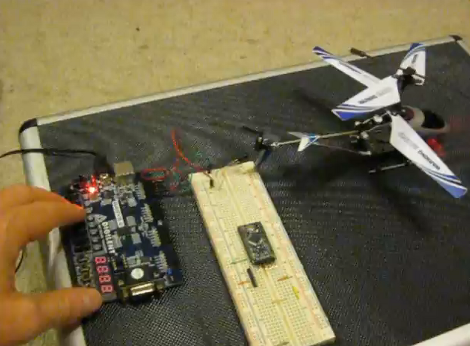
After [trandi] got his hands on a cheap R/C helicopter he realized the difficulties in actually flying a remote control helicopter. Instead of giving up, he decided to reverse-engineer the infrared protocol and then build a decoder around an ATtiny that would send commands to another microcontroller using a serial connection.

The remote’s communications protocol was decoded with the help of a Freeduino and an IR remote analysis sketch [trandi] found on the Arduino website. After importing the data into Gnuplot, there was enough data to write a sketch in Processing to visualize the infrared pulses.

After figuring out the protocol of his remote control, [trandi] built a tiny circuit to decrypt the IR commands and send them over a serial link to another microcontroller. The ATtiny45-based build doesn’t take up very much space on the perfboard making it very easy to mount on any robot of his choosing. He ended up connecting it to a Lego NTX brick allowing him to use the helicopter remote with any Lego build he can dream up.

[trandi] invested a lot of work around a cheap remote control; if the remote broke, all would be for naught. This was remedied with an IR beacon that replicates the function of the remote. The beacon is based on an ATtiny13 and can serve as a stand-alone beacon for autonomous robots or can accept serial commands from a computer. Not a bad build if you ask us.