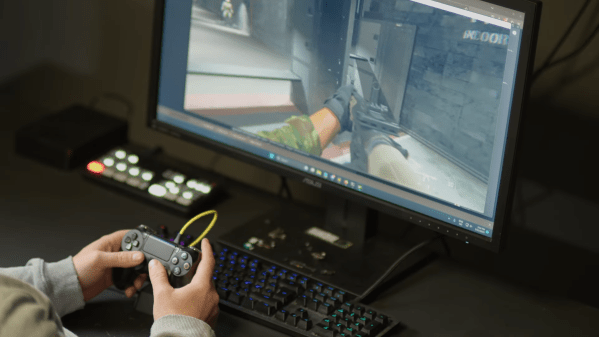
Hall Sensors Offer Drop-In Replacement For Drifting Game Console Joysticks

No bananas were harmed in the making of this Hall effect drift-proof joystick replacement. OK, not really — two bananas were turned to mush. But it’s OK, they’re just bananas, after all.

Why bananas, you ask? Because [Marius Heier] uses them to demonstrate what we all intuitively know — that rubbing something over and over again tends to wear it away — but engineers seem to have forgotten. Wear such as this, with resistance material rather than fruits, is what causes the dreaded drift, a problem that the world collectively spends $20 billion a year dealing with, according to [Marius].

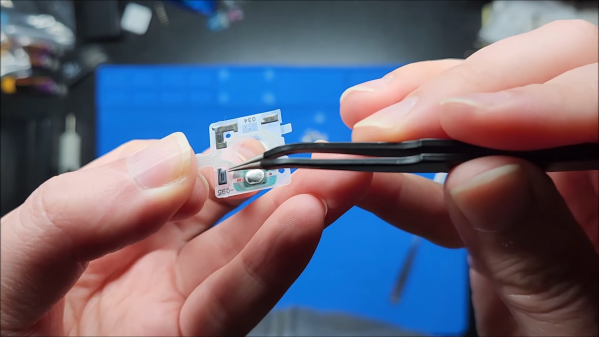
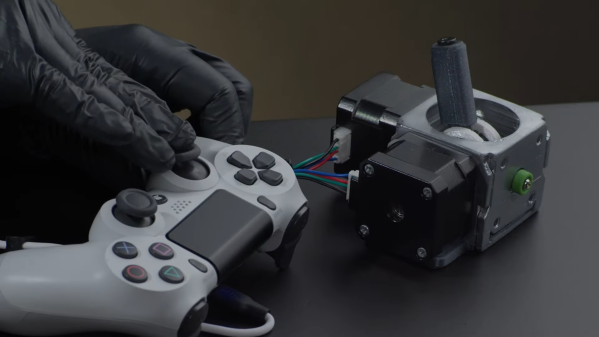
While numbers like that seem to be firmly in class-action lawsuit territory, sometimes it’s best to take matters into your own hands and not wait for the courts. The fix [Marius] shows here is to yank the potentiometers off a PS4 joystick and replace them with contactless Hall effect sensors. The end of the shaft for each axis gets a diametral neodymium magnet attached to it, while a 3D printed bracket holds a tiny custom PCB in close proximity. The PCB has an AS5600 Hall sensor, which translates the shaft angle to an analog voltage output. After programming the chip over its I2C bus, the sensor outputs a voltage proportional to the angle of each shaft, just like the original pots, but without all the wear and tear.

While [Marius] is selling these as drop-in replacements for PS4 controllers, he plans to release all the design files so you can build one yourself. He also has his sights set on replacements for PS5 and Xbox controllers, so watch for those. This isn’t his first foray into joystick hacking, having shared his 3D Hall effect and haptic feedback joysticks with us previously.

Continue reading “Hall Sensors Offer Drop-In Replacement For Drifting Game Console Joysticks”
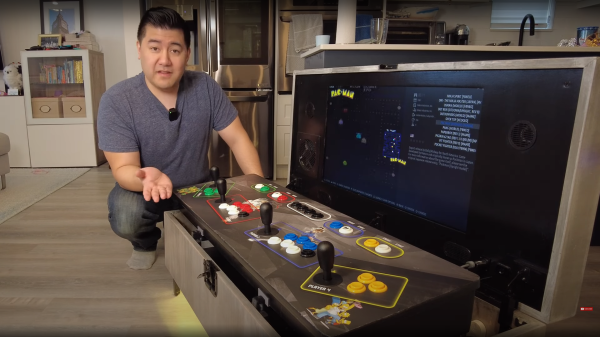
A 4-Player Arcade Hidden Inside A Coffee Table

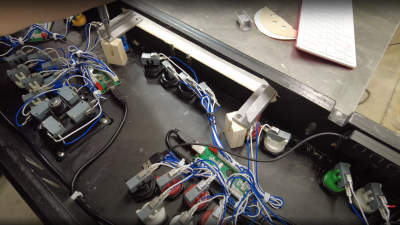
[Ed] from 50% Awesome on YouTube wanted to build a retro gaming system with a decent screen size, but doesn’t have a great deal of space to site it in, so a good compromise was to make a piece of useful furniture and hide all the fun parts inside.

Building an arcade machine usually involves a lot of wiring

This video two-part build log shows a lot of woodwork, with a lot of mistakes (happy accidents, that are totally fine) made along the way, so you do need to repeat them. Essentially it’s a simple maple-veneered plywood box, with a thick lid section hosting the display and some repositioned speakers. This display is taken from a standard LG TV with the control PCB ripped out. The power button/IR PCB was prised out of the bezel, to be relocated, as were the two downwards-facing speakers. The whole collection of parts was attached to a front panel, with copious hot glue, we just hope the heavy TV panel was firmly held in there by other means!

Continue reading “A 4-Player Arcade Hidden Inside A Coffee Table”

Autopsy Of A Drifting Thumbstick Reveals All

Analog sticks have become a core part of modern video game controllers. They also routinely fail or end up drifting, consigning expensive controllers to the garbage. [sjm4306] recently did a repair job on an Oculus VR gaming controller with drifting analog sticks, and decided to do an autopsy to figure out what actually went wrong.

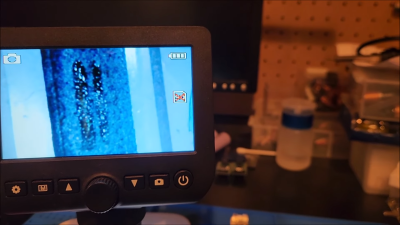
A microscope reveals gouges in the resistive material, caused by the metal contacts inside the analog stick. This happened via regular use.

The video starts by taking apart the analog joystick itself by prying off the metal case. Inside, we get a look at the many tiny individual components that make up a modern thumbstick. Of most interest, though, are the components that make up the potentiometers within the stick. Investigation revealed that the metal contacts that move with the stick had worn through the resistive coating on the thin plastic membrane in the base of the joystick, creating the frustrating drift problem.

It doesn’t have to be this way. Analog sticks in modern controllers could be manufactured with higher-quality components that don’t wear so easily. After all, it’s hard to imagine a 90s video game controller wearing out as fast as this modern Oculus unit. But everything is built to a price, at the end of the day, and that’s just how it goes. Video after the break.

Continue reading “Autopsy Of A Drifting Thumbstick Reveals All”

Fresh PCBs For The Quickshot II And II Plus Joysticks

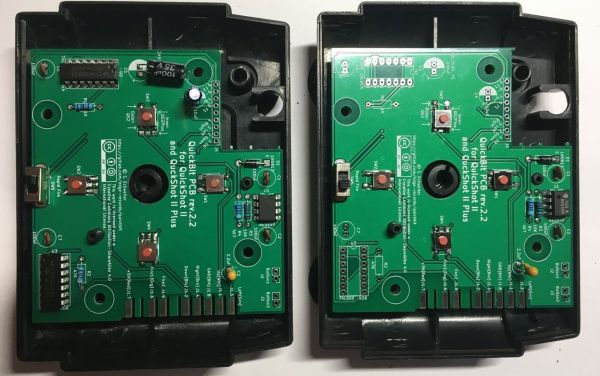
The Quickshot II was released by Spectravideo in 1983 for the Commodore 64 and compatible systems, with the Quickshot II Plus following the next year. After decades of regular use, it’s quite understandable that these old-timers may be having some functional issues, but as long as the plastic parts are still good, [Stephan Eckweiler]’s replacement PCBs may be just the thing that these joysticks need to revitalize them for another few decades.

What may be a matter of taste is that these replace the nice tactile clicky switches on the QS II Plus with SMD push buttons, but compared to the stamped metal ‘button’ construction of the original QS II, the new board is probably a major improvement. As for the BOM, it features two ICs: a 74LS00 latch and NE555 timer, along with the expected stack of passives and switches, both through-hole and SMD.

The PCB contains break-off boards for the switches within the joystick itself, requiring a bit of wiring to be run to the main PCB before soldering on the DE-9 connector and connecting the joystick for a test run to a Commodore 64. All one needs now is a 3D printable enclosure version to create more QS II joysticks for some multiplayer action.

Exploring The Hall Effect For Haptic Feedback PS4 Joysticks

Modern gaming console controllers aren’t without their annoyances — Joy-Con drift, anyone? The problems might stem from design deficiencies, but we suspect that user enthusiasm and the mechanical stress it can introduce might play a significant role as well. Either way, [Marius Heier] decided to take a look at what would be required to build a better joystick and came up with some interesting results.

The first video below lays the basic groundwork, with a bunch of experiments with 3-axis Hall effect sensors, specifically the Texas Instruments TMAG5273 and TMAG5170. They’re essentially the same sensor with different interfaces — SPI for the 5170 and I2C for the 5273. Using just one of these sensors, he was able to build a joystick with the usual X- and Y- axis control, but also with a rotary axis. What’s more, he built a motorized version using two NEMA 17 steppers to mechanically drive the stick back to center.

The joystick is bulky, but it looks like he’s got plans for a much smaller one with [Carl Bugeja]-style PCB motors that should fit into a PS4 controller. That’s the subject of the second video below, which uses a different Hall sensor — an Allegro A1304 — and is mainly concerned with getting the output of a non-motorized but considerably miniaturized joystick stick talking the language that the controller expects. It’s not a simple process, but it seems to be coming along nicely, and we’ll be watching progress closely.

Continue reading “Exploring The Hall Effect For Haptic Feedback PS4 Joysticks”

2022 FPV Contest: A Poor Man’s Journey Into FPV

FPV can be a daunting hobby to get into. Screens, cameras, and other equipment can be expensive, and there’s a huge range of hardware to choose from. [JP Gleyzes] has been involved with RC vehicles for many years, and decided to leverage that experience to do FPV on a budget.

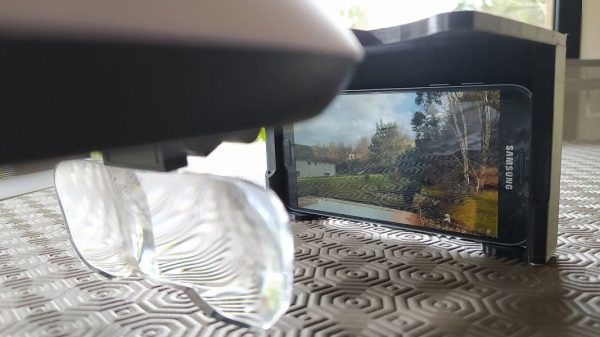
Early experiments involved building a headset on the cheap by using a smartphone combined with a set of simple headset magnifiers. With some simple modifications to off-the-shelf hardware, [JP] was able to build a serviceable headset with  a smartphone serving as the display. Further work relied upon 3D printed blinds added on to a augmented-reality setup for even better results. [JP] also developed methods to use a joystick to fly a real RC aircraft. This was achieved by using an Android phone or ESP32 to interface with a joystick, and then spit out data to a board that produces PPM signals for broadcast by regular RC hardware.

[JP] put the rig to good use, using it to pilot a Parrot Disco flying wing drone. The result is a cheap method of flying FPV with added realism. The first-person view and realistic controls create a more authentic feeling of being “inside” the RC aircraft.

It goes to show that FPV rigs don’t have to break the bank if you’re willing to get creative. We’ve seen some great FPV cockpit builds before, too.

Continue reading “2022 FPV Contest: A Poor Man’s Journey Into FPV”

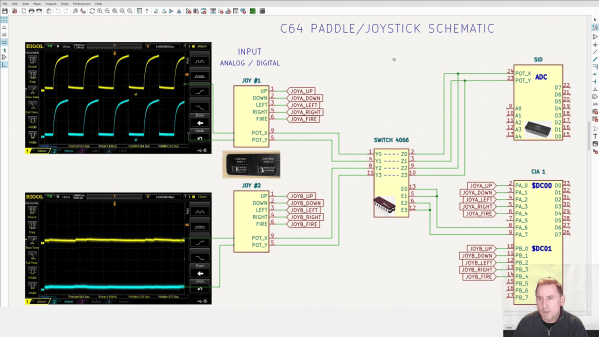
A schematic explaining the workings of the Commodore 64's joystick port

Bluetooth Interface Adds Rumble Feedback To Commodore 64 Games

Nothing says “1980s gaming” like a black joystick with a single red fire button. But if you prefer better ergonomics, you can connect modern gamepads to your retrocomputers thanks to a variety of modern-to-classic interface adapters. These typically support just the directional pad and one or two action buttons, leaving out modern features like motion control and haptic feedback.

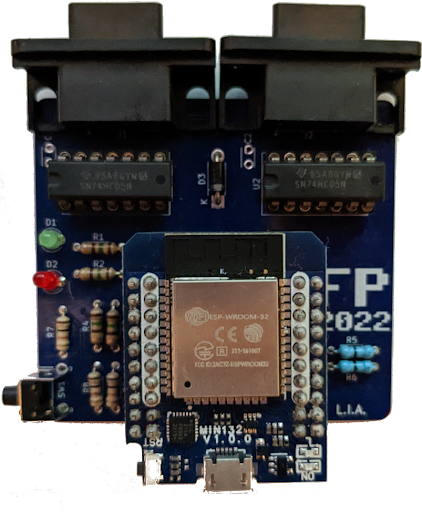
That’s a bit of a shame, because we think it would be pretty cool to feel that shock in our hands whenever Pitfall Harry drowns in quicksand or Frogger gets hit by traffic. We’re therefore happy to report that [Ricardo Quesada] has decided to add rumble functionality to the Bluetooth-to-Joystick-port interface that he’s been working on. He demonstrates the feature on his Commodore 64 in the video embedded after the break.

Naturally, any software needs to be adapted to support haptic feedback, but a trickier problem turned out to be the hardware: joystick ports are input-only devices and therefore cannot send “enable rumble” signals to any connected gamepads. [Ricardo] found a clever way around this, using the analog inputs on the joystick port that were typically used for paddle-type controllers.

The analog-to-digital converter inside the computer works by applying a pulse signal to the analog port and measuring the time it takes to discharge a capacitor. The modern gamepad interface simply detects whether these pulses are present; they can be enabled or disabled through software by toggling the analog readout on the joystick port. This way, the joystick port can be used to send a single bit of information to any device connected to it.

[Ricardo] developed patches for Rambo: First Blood part II and Leman to enable rumble functionality. He describes the process in detail in his blog post, which should enable anyone who knows their way around 6502 machine code to add rumble support to their favorite games.

The adapter works with a variety of retro systems that use the Atari-style joystick interface, but if you’re an Apple II user, you might want to look at this Raspberry Pi-based project that interfaces with its nonstandard joystick interface. If you’re into wireless gaming in general, be sure to also check out our history of wireless game controllers.

Continue reading “Bluetooth Interface Adds Rumble Feedback To Commodore 64 Games”