Print Your Next LED Bezel

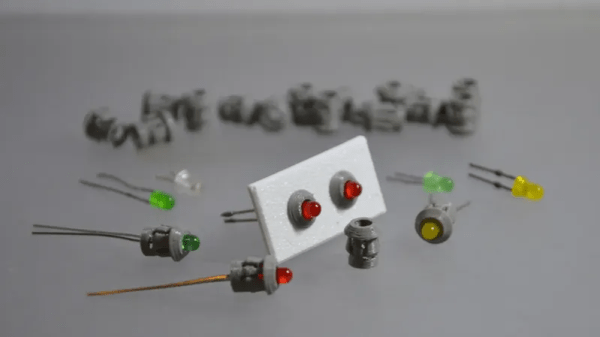
LED bezels (also known as LED panel-mount holders) are great, so how about 3D printing the next ones you need? Sure, they’re inexpensive to purchase and not exactly uncommon. But we all know that when working on a project, one doesn’t always have everything one might need right at hand. At times like that, 3D printing is like a superpower.

Printing a part you find yourself short of can be a lifesaver.

[firstgizmo]’s design is made with 3D printing in mind, and most printers should be able to handle making them. Need something a little different? You’re in luck because the STEP files are provided (something we love to see), which means modifications are just a matter of opening them in your favorite CAD program.

There’s not even any need to export to an STL after making tweaks, because STEP support in slicer programs is now quite common, ever since PrusaSlicer opened that door a few years ago.

Not using 5 mm LEDs, and need some other size? No problem, [firstgizmo] also has 3 mm, 8 mm, and 10 mm versions so that it’s easy to mount those LEDs on a panel. Combined with a tool that turns SVG files into multi-color 3D models, one can even make some panels complete with color and lettering to go with those LEDs. That might be just what’s needed to bring that midnight project to the next level.

Hacking The IKEA OBEGRÄNSAD LED Wall Lamp

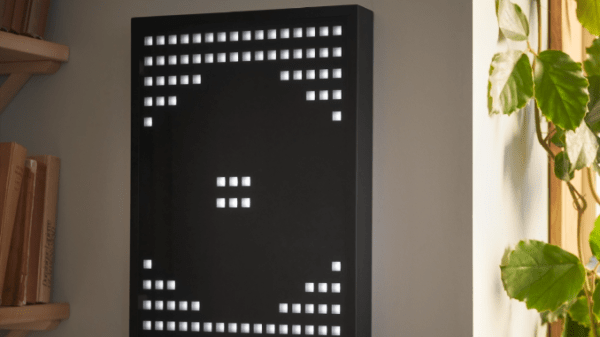
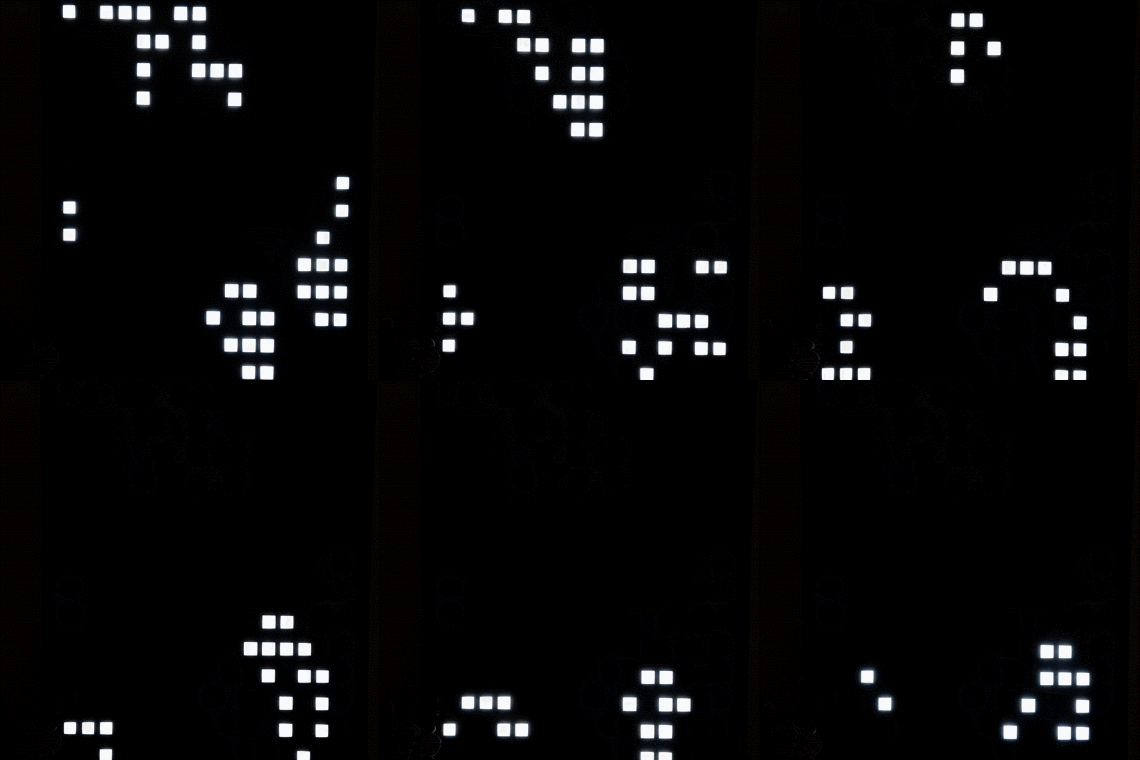
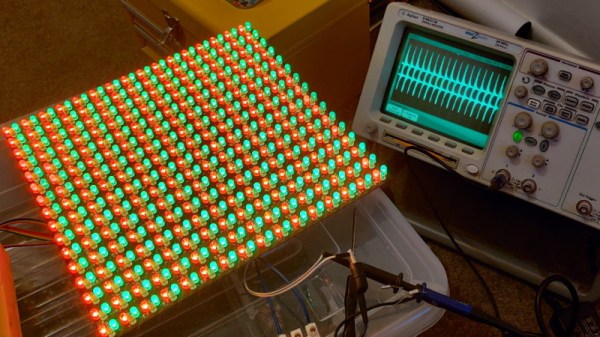
The IKEA OBEGRÄNSAD is a pixel-style LED wall lamp that comes with a few baked-in animations, and [ph1p] improved it immensely with an ESP32 board and new firmware. The new controller provides all kinds of great new abilities, including new modes and animations, WiFi control, and the ability to send your own images or drawings to the panel. All it takes is desoldering the original controller and swapping in a programmed ESP32.

Hacking in a new controller provides a whole new range of capabilities.

Sadly, opening the unit up is a bit of a pain. It seems the back panel is attached with rivets rather than screws, but it will yield to a little bit of prying force.

The good news is that once the back panel is off, the inside of the OBEGRÄNSAD is very hackable. All the parts and connectors are easily accessible from where they are, and a nicely-labeled pin header makes a convenient attachment point for the new ESP32 board. There’s no need to disassemble any further once the back is off, and that’s always nice.

Going a bit smaller, we’ve also seen an IKEA LED nightlight greatly improved by a little hacking, and there are plenty more IKEA hacks where that came from.

Useful Build Tips For Making LED Panel Frames

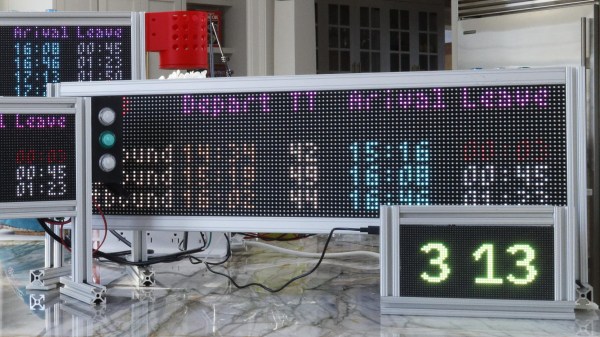
[NotLikeALeafOnTheWind] has created many LED-based display projects, and shares his method for making attractive LED panel frames and mounts. At first glance it may look as though slapping a rectangle of aluminum extrusion around a display is all it takes, there is also the mounting and management of wiring, power supply, and possibly a Raspberry Pi to deal with. The process of building an attractive frame also has a few hidden gotchas that can be avoided with a bit of careful planning.

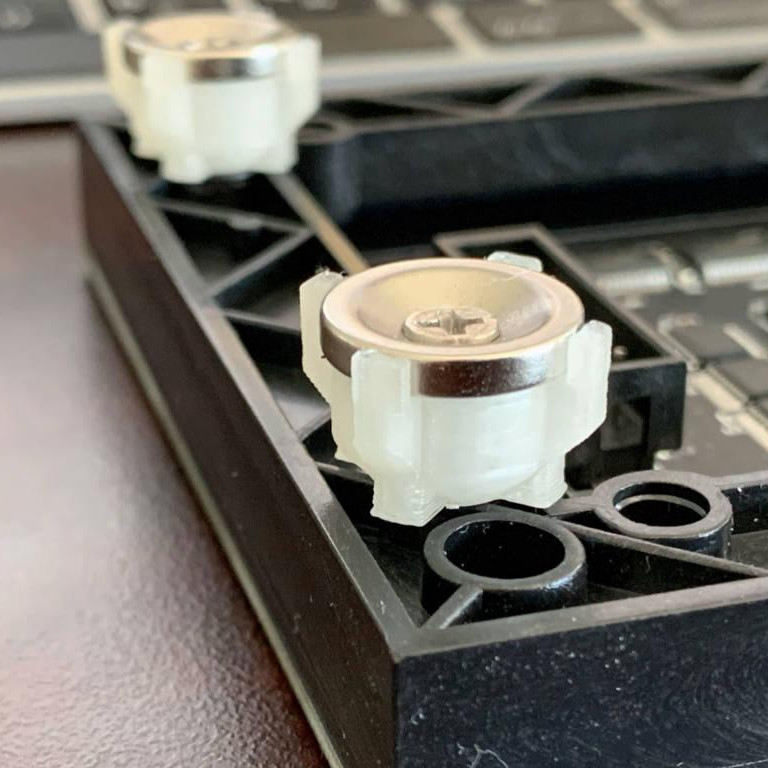
Magnetic feet on the LED panels makes mounting much easier and more flexible.

Here is one tip that will resonate with some readers: don’t rely on specified dimensions of parts; measure the actual parts yourself. There can be small differences between what a data sheet says to expect, and the dimensions of the actual part in one’s hands. It may not be much, but it can be the difference between an ideal fit, and something that looks like a bit of a hack job.

[NotLikeALeafOnTheWind] provides some basic frame layouts, and suggests using two- or three-channel extrusions to provide a flat bezel around the display edge if desired. Mounting the LED panel itself is done with magnetic feet and providing a length of steel bar to which the display can attach. This can provide a flush mount while avoiding the whole issue of screw-mounting the display panels themselves, or sliding them into channels. For mounting all the other hardware, a piece of DIN rail and some 3D-printed parts takes care of that.

The result looks slick and sturdy, and some of the tips are sure to be useful even if the whole process isn’t applied. We like the way the basic design scales and is flexible about the thickness and size of the LED panels themselves, making it a promising way to accommodate perfectly functional oddball panels that end up in the trash.

Reverse Engineering Saves Trashed LED Panels

While out riding his bike, [Hammond Pearce] came across a dumpster overflowing with large LED panels. Despite the fact that the model numbers didn’t reveal anything helpful after some online searching, he decided to pedal off with as many as he could safely carry. The COVID-19 lockdown left him with only a limited set of tools, be he still managed to crack the protocol used to control his e-waste score and document it for our reading pleasure.

Between the helpful labels on the PCB silkscreen and the advice of a friend that used to work on digital road signs, it didn’t take [Hammond] long to get a general idea of what the panels were looking for in terms of power and control. Especially once he noticed the MBI5024 shift registers dotting the board.

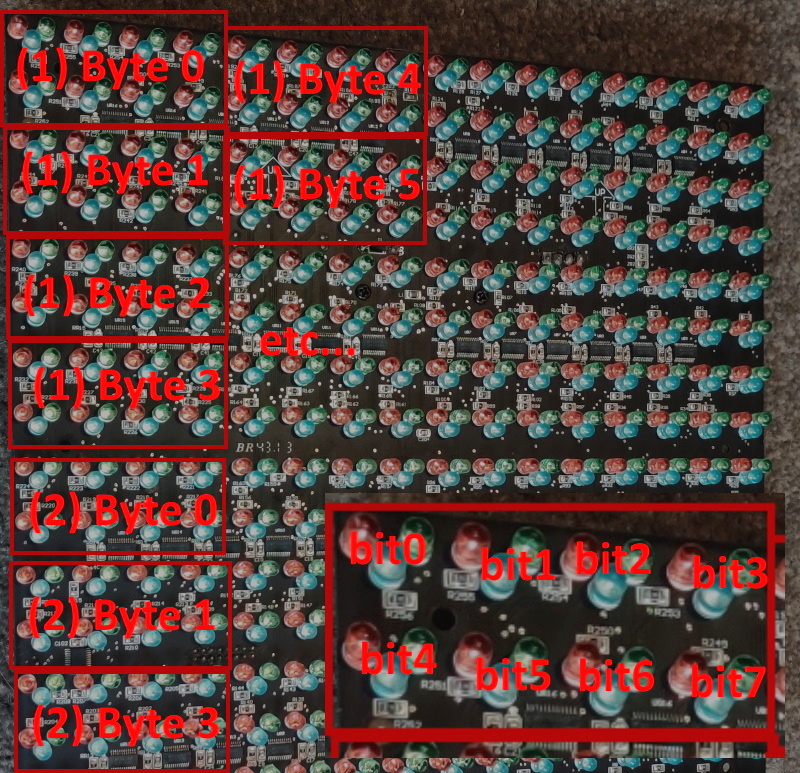
The next step was to take an ATmega328PB based development board and start throwing data at the panel’s input lines to see if he could elicit a response. With careful attention and some custom code, he eventually figured out that each byte of data sent down the line would control a 4 x 2 section of LEDs.

Once he had the basics down, the next step was to start expanding his code to handle things like shapes, text, and daisy-chained panels. After posting some of his work to Reddit, cyber-sleuths determined that the protocol appeared to be some variation of HUB75, which gave [Hammond] hints on what some of the other pins in the connector might be used for. He’s released all of his code online for anyone who might find it useful, but since he still doesn’t know who made these panels and why there’s really no telling how many of them are actually floating around out there.

Figuring out how to talk to an unknown or undocumented piece of hardware can be intimidating, but success stories like these are reminders of why it’s worth putting the effort in. As we’ve seen, the difference between trash and treasure is often a keen eye and a few lines of code.

Make Your Own Flexible Panel Lights

In this day and age, production values are everything. Even bottom-rung content creators are packing 4K smartphones and DSLRs these days, so if you want to compete, you’re gonna need the hardware. Lighting is the key to creating good video, so you might find a set of flexible panel lights handy. Thankfully, [DIY Perks] is here to show you how to build your own. (Video embedded below.)

The key to building a good video light rig is getting the right CRI, or Color Rendering Index. With low CRI lights, colors will come out looking unnatural or with odd casts in your videos. [DIY Perks] has gone to the effort of hunting down a supplier of high-quality LED strips in a range of different color temperatures that have a high CRI value, making them great for serious video work.

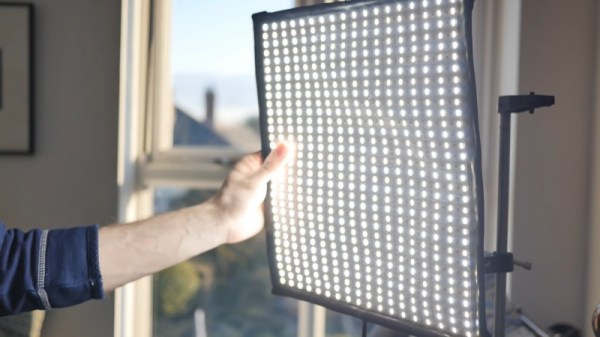
To build the flexible panel, the LED strips are glued onto a fake leather backing pad, which is then given a steel wire skeleton to enable it to be bent into various shapes. Leather loops are built into each corner of the panel as well, allowing the light to be fitted to a stand using a flexible aluminium bracket. The LEDs are slightly under-volted to help them last longer and enable them to run from a laptop power supply.

The build is one that focuses on light quality and usability, rather than just throwing a bunch of bright LEDs at the problem and calling it good. The results are great, with the panel showing a significant improvement on [DIY Perks]’s earlier builds.
Continue reading “Make Your Own Flexible Panel Lights”

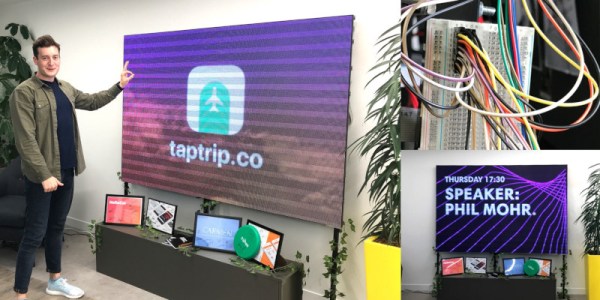
Big Ol’ LED Wall Looks Cool, Can Draw Over 170 Amps

Building giant LED walls comes with a serious set of challenges. Whether they lie in power, cable routing, or just finding a way to clock out data fast enough for all the pixels, it takes some doing to build a decent sized display. [Phill] wanted a statement piece for the office, so rolled up his sleeves and got to work.

The build uses P5 panels, which we’ve seen used before on a smaller scale. Initial testing was done with a Raspberry Pi 3, which started to run out of grunt when the build reached 28 panels. The refresh rate was slow, and anything with motion looked messy. At that point, a dedicated driver was sourced in order to handle the full 48-panel display. Other challenges involved dealing with the huge power requirements – over 170 amps at 5 volts – and building a frame to hold all the panels securely.

The final product is impressive, standing 2 meters wide and 1.2 meters high. Resolution is 384 x 256. With a Mac Mini running video into the display through the off-the-shelf driver, all manner of content is possible. [Phill] even whipped up a Slack channel for users to send GIFs and text messages to the display. Naturally, we’re sure nobody will take advantage of this functionality.

If you’ve got your own giant LED wall, and you’re dying to tell us about it, make sure you get in touch. Video after the break.

Continue reading “Big Ol’ LED Wall Looks Cool, Can Draw Over 170 Amps”

Hackaday Links Column Banner

Hackaday Links: Benchoff Rants On Flying Cars

It’s time for Computex, and that means [Linus] has dropped something. I don’t know what, but he’s dropped something. It’s a meme or something at this point. What were the highlights? Asus announced Project Precog, a laptop with two screens. Yes, a touchscreen keyboard. It’s the 2018 version of the IBM Transnote or whatever that Microsoft thing was called. Why is it called Project Precog? Because AI or whatever. Unimaginative marketing is terrible. Intel is going to launch a 28-core CPU, and AMD is introducing a 32-core CPU. Awesome, core wars. And here’s RGB RAM because stuffing a case full of cold cathode lighting is sooo early-2000s.

Need a reverse engineering challenge? Here’s something from American Science and Surplus. It’s a 48 x 12 LED matrix, loaded up with driver ICs and power regulators. $20 a piece, so stock up and save.

Finally, the main event. The biggest story in aviation this week is that a media embargo has lifted on the Kitty Hawk Flyer. Kitty Hawk is a startup funded by Larry Page, CEO’d by Sebastian Thrun, and has received $6.5 M in funding. The Flyer, a one-man decacopter, was announced to the world through CNN Money and Casey Neistat. It should be noted that in the entire media landscape, these are the two outlets most ignorant of aviation: CNN needs no explanation, and Neistat flies quadcopters through the Hudson River Corridor at 1000 feet AGL. Additionally, Kitty Hawk is not exhibiting at AirVenture next month, which leads me to believe Kitty Hawk is trying to stay out of the aviation industry or simply doesn’t want knowledgeable people asking them questions. But I digress.

The Kitty Hawk Flyer is being promoted by the company as “a personal flying vehicle… to make flying part of everyday life” and a machine that will give you, “a world free from traffic”. It is being billed by CNN and Neistat as ‘a flying car’. Kitty Hawk is just fine with allowing the media to call it as such. Additionally, Sebastian Thrun is making claims about the Flyer that are disingenuous at best, outright illegal at worst, and should draw the ire of any investors.

In the CNN Money piece, Thrun claims the Flyer is capable of traveling at 100 miles per hour, which would be illegal. The Flier is certified as a Part 103 Ultralight, and under that regulation the Flyer “is not capable of more than 55 knots calibrated airspeed at full power in level flight.” The Flyer may also be overweight. The first version of the Flyer was basically a decacopter with a seat, and weighed in at 220 pounds. Part 103 regulations have a limit of 254 pounds, and it’s entirely possible there are more than 34 pounds of chassis and fiberglass on the latest version. I should also mention the safety training, while not required for a Part 103 ultralight, is insufficient: Casey Neistat’s underwater egress training was done in a Chuck E. Cheese-style ball pit. You can breathe in a ball pit, you can’t breathe underwater.

But legality aside, a Part 103 ‘flying car’ is just about the dumbest idea ever. You can’t use it to commute, and you’re welcome to call your local FSDO to confirm that. You’re not going to fly it in New York City or San Francisco because there are airports in the way. At best, this is a ‘flying ATV’ that you would take out on your farm; a toy for rich people. At worst, it’s the latest example of the Silicon Valley philosophy of ‘ignore laws and break things’.