Spinning POV Clock Done Oh-so-right

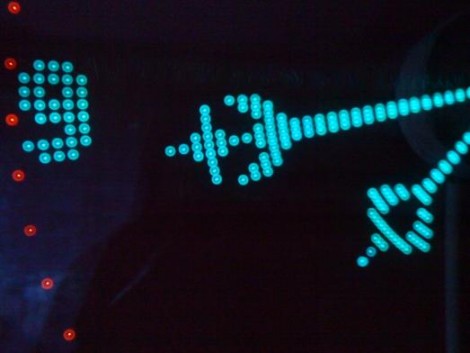
[Kizo] built an extraordinary persistence of vision clock. The design uses a PC cooling fan to spin the propeller-like PCB. As it goes around, a hall effect sensor synchronizes the illumination of the LEDs to draw the display. Power for the rotating electronics is transferred wirelessly via a transformer on the base and coil on the spinning board. The final version uses an ATmega324 microcontroller running at 20 MHz and has an IR receiver for changing the settings. The 3000 lines of code bring a lot of bells and whistles, including a menu system with a huge amount of settings from tweaking the clock display, to font selection for scrolling messages. Take a look at the demo after the break. The double-sided board looks like it’s pretty difficult to etch at home, but as you can see from the forum post (translated), [Kizo] did a great job on this build from start to finish. Continue reading “Spinning POV Clock Done Oh-so-right”
DIY Night Vision Monocle

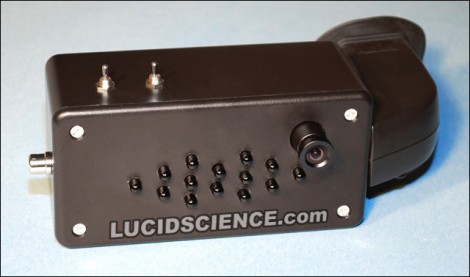
This interesting mashup shows it’s easy to make your own night vision goggles. It makes use of just a few parts; the viewfinder from an old camcorder, a low-light security camera module, and a collection of infrared LEDs.

The low-light camera is capable of detecting infrared light, which is invisible to our eyes. If you shine the right IR LEDs on an object, they will cast enough light for the camera to clearly view the objects around you. The camcorder viewfinder is nothing more than a compact way to display what the camera sees. This would be easy to accomplish with a wearable display. It is also beneficial to have a large IR light source so you may consider modifying that giant LED flashlight you’ve been meaning to build so that it operates in the infrared wavelengths.

This project comes from the same source as the Laser Microphone we looked in on last month. Just like that one, there’s plenty of extra information about this build. There’s suggestions for choosing and focusing a light source. This includes using lasers as the source, and binoculars for long-range viewing.

Disco Drumming With Piezo Sensitive Lighting

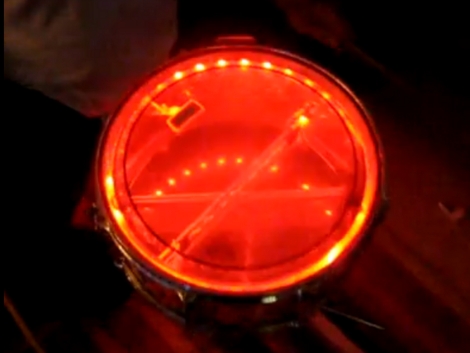
[Wilfred’s] brother outfitted a snare drum with LEDs for Dutch Carnival. They faded through different colors randomly and were a nice addition to the normal looking instrument, but [Wilfred] suggested that the LEDs change color with each drum stroke. He set out to design a controller circuit to provide the functionality and ended with a small package based around an ATtiny2313 microcontroller. A piezo buzzer is used to detect the vibrations inside the drum, each hit triggering a different color combination. The LEDs fade to off after each impact as if dying along with the sound, and when not struck for 30 seconds the system defaults to a red heartbeat pattern. See for yourself after the break.

We’d love to see this feature added to each drum in one of those robotic drumsets. Continue reading “Disco Drumming With Piezo Sensitive Lighting”

Gutting An Air Freshener For The Parts

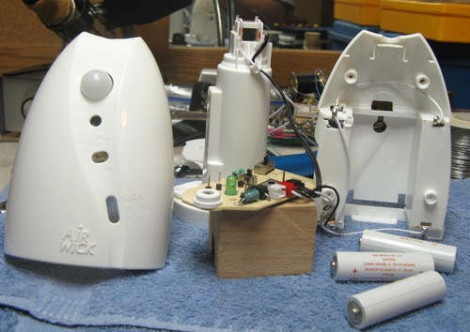
[Doug Paradis] took a good look inside the Air Wick Freshmatic Compact i-Motion and then stole all the parts for other projects. We’ve looked at adding a manual spray button or making air fresheners Internet enabled before. Those models didn’t have parts that were all that interesting, but this one has a passive infrared motion sensor. You’ll also gain three switches, a PNP transistor, and an LED.

Price seems to be all over the map for this model, but [Doug] says you can find it for $8 or less. After showing how to make a tool to bypass the triangular security screws, he explains how to access the PIR sensor. But if you want to be all you can be with the hardware, he details the modifications needed to patch into the analog and digital circuitry on the rest of the board too.

Input Device Using LED And Four Photoresistors

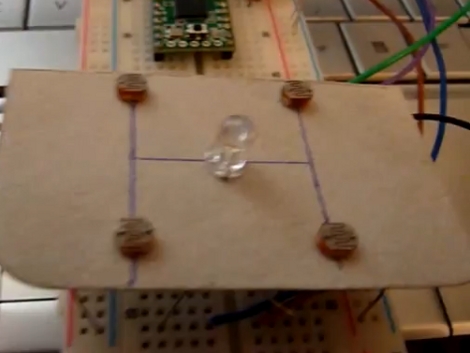
[Julien] built an input device that uses reflected light detected by some photoresistors. Placing your hand above the device will reflect light from the LED back down onto the cadmium-sulfide sensors. The resistance of those sensors is read by four ADC pins on a Teensy microcontroller and translated to mouse movements. In the video after the break you can see that this works rather well in controlling the cursor. The source code is available on pastebin but we’re also going to host the code for posterity.

Continue reading “Input Device Using LED And Four Photoresistors”

Matrix Clock Is A Breadboarding Win

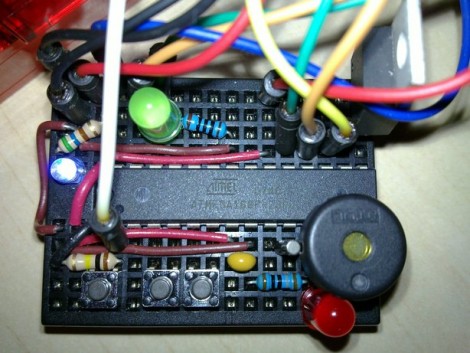
Normally when we feature a clock made with a 32×8 LED matrix we’d load up an image of the display for the banner photo. But this time around we were so impressed by [JB’s] breadboard work we had to use this image. We see an ATmega168, three buttons, three LEDs, a piezo buzzer, 32.768 kHz crystal, smoothing capacitor, and a few resistors; everything he needed to keep time and display it on the matrix module. If this is just going to sit on your bookshelf for a while it’s a great alternative to point-to-point soldering on a protoboard. Nice work fitting it all on there [JB].

Daft Punk Table With IPod Dock

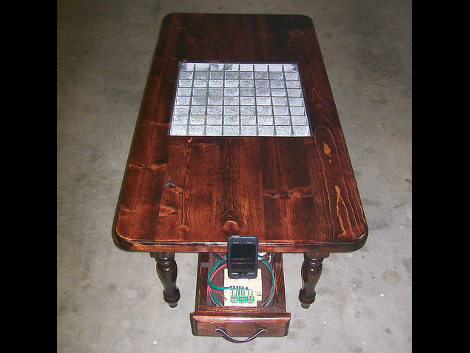
This beautifully crafted Daft Punk table with iPod dock was built by [Dustin Evans]. The table itself was built with the help of a friend in one day with electronics added a bit later. It features an 8×8 grid of boxes with red LEDs mounted inside. The picture above is not quite the finished product, a diffuser will be added later to augment the scattering of light already provided by cutting the tip off of each LED. On the underside you’ll find a power supply and a set of speakers. The system is controlled by an Arduino which resides in the same drawer as the dock. See the final product in the clip after the break.

Continue reading “Daft Punk Table With IPod Dock”