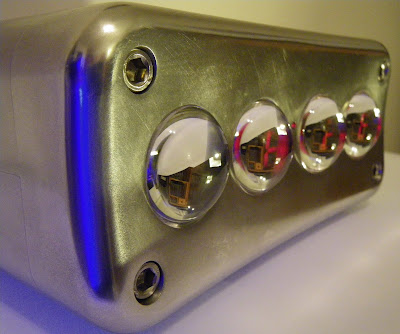
Defocusing LED Clock

[Dennis] has created a well-documented and very beautiful clock in his latest project. This clock stands out from the other clock projects we have covered with its unique display. The seven segment LED displays mounted on a sled that moves them back and forth behind an array of fiber optic lenses, effectively taking the display out of focus at certain points. Currently, a Dorkboard controls the sled, moving it at random intervals. The case is machined and polished aluminium, the top buttons are ball bearings.

BlokClok – Abstract Time Display

blokclok_abstract_time_display

Clocks made from blinking LEDs always make for fun projects. [Earthshine] built a clock that displays time abstractly using an 8×8 RGB LED matrix. The video embedded after the break illustrates how to read the time but here’s the gist of it: One LED is illuminated in the outside box of LEDs and moved in a clockwise motion to approximate seconds. Inside of this, there are four quadrants; upper left indicates hour-tens digit, upper right hour-ones, lower left minute-tens, and lower right minute-ones. This certainly makes for an interesting conversation piece!

There is no schematic and no code available but it’s really the concept that we’re interested in. If you must know, [Earthshine] bases this build around an Arduino. A DS1307 real time clock keeps the time, while four 74HC595 shift registers are utilized to control the three LED colors and the multiplexing.

Continue reading “BlokClok – Abstract Time Display”

Software Pulse Width Modulation

daqq_pwm_schematic

Pulse Width Modulation is a topic that tends to give a lot of beginners trouble. [Daqq], whose nixie plasma ball we covered a few days ago, has a simple but effective PWM project that you should take a look at. The circuit used 9 LEDs clustered together into 3 sets of RGB modules and connected them to an AVR ATtiny2313 through some current limiting resistors. Most of the time the PWM function of the AVR’s timers would be used to generate the signal but this application calls for 9 signals which is more than can be produced by this chip. The workaround is to generate the signals using software PWM. Continue reading “Software Pulse Width Modulation”

8-bit Binary Calculator

binary_calculator

Don’t feel like shelling out $5 for a fancy factory made calculator that won’t even do binary math? [Jeff] decided to prove his mastery of gates and his disdain for base 10 by building a binary calculator using XOR, AND, and OR chips. Calculations can be input in two ways: through digital logic headers or by three banks of DIP switches used to enter the operator and the two operands. Although limited to addition and subtraction, this is a great way to make sure you really understand digital logic. Take a look at the rough design schematics in his album. The design is modular so if you have one of each gate and a few LEDs sitting around you can give this a whirl.

BBox MIDI Drum Sequencer

bbox

We’ve covered sequencers before, but reader [Johan] sent in his latest project that is much more minimalistic approach. Dubbed the BBox, he based his drum generator on an Arduino and an LCD display. Rather than synthesizing sound, the Arduino just outputs MIDI which is then interpreted by his Roland Juno-D. In building the device he used a favorite trick of ours to keep the interface clean. He then found an awesome banana box to use as a case. Although, the project may not be as functional as some of the others out there, it certainly has flair. Video of it in action after the break.

Continue reading “BBox MIDI Drum Sequencer”

Dot Matrix Clock On The Way

sdc10183-1024x768

[Kevin] sent in his almost finished open source dot matrix clock. Sporting a hefty 40 x 16 display powered by a PIC 18F he has complete pixel by pixel control of the graphics. Combined with with a triple buffer he is at least able to output 15fps, with planned 30fps. While this has great potential for a clock, what about going further? Twitter updates, chat messages, weather updates, the current airspeed velocity of an unladen swallow; it will be tough to beat the competition without some more features. Either way, its an awesome project and we can’t wait to see it completed.

Time Lapse Light Sculptures

time_lapse_light_sculptures

[Jared] sent us a feature he posted involving time-lapse photography and an LED. Using a custom built aparatus an LED is moved on two axis’ during a long exposure of around thirty seconds. The frame is wood and PVC with two gearhead motors powered by AA batteries to provide the locomotion. The LED is powered by a 3v button cell and automatically transitions through different colors.