Lego Ziplining Robot Climbs For Claps

The internet has given us plenty of cool robotics projects, but we don’t think we’ve seen one zipline before. At least not until now.

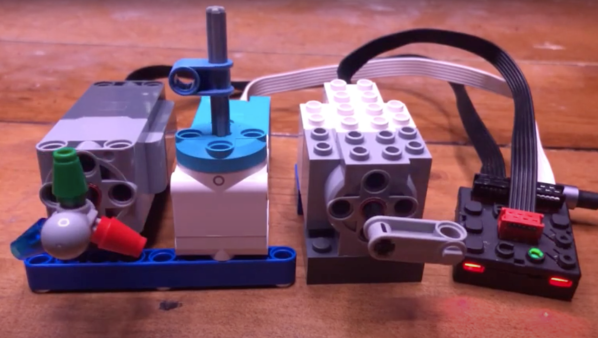
This cool little ziplining robot is courtesy of the folks over at [Tart Robotics]. As they described it, the robot moves using a 4-bar linkage mechanism with the motor’s torque “transferred to the arm mechanisms through a pair of bevel gears and a worm drive.” Even cooler, the robot is activated by clapping. The faster you clap, the faster the robot moves. That’s sure to wow your friends at your next virtual hacker meetup.

They had to do a bit of custom 3D printing work to get a few of the Lego components to connect with their non-Lego off-the-shelf bits, so that took a bit of time. Specifically, they had some cheap, non-branded DC motors that they used that did not naturally mate with the Lego Technic components used to create the rest of the robot’s body. Nothing a few custom 3D printing jobs couldn’t solve.

It always amazes us what cool contraptions you can put together with a few Lego blocks. What’s your favorite Lego project?

Continue reading “Lego Ziplining Robot Climbs For Claps”

Whimsical Solder Stand Moonlights As Toy 3D Printer

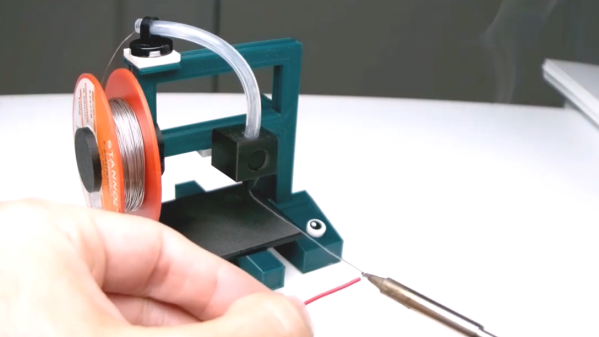
A few Lego pieces provide key functionality, like an articulated dispenser head.

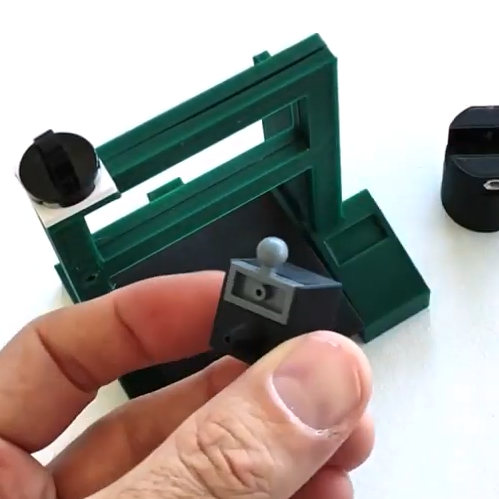
Most of us have bent a length of solder into a more convenient shape and angle when soldering, and just sort of pushed the soldering iron and work piece into the hanging solder instead of breaking out a third hand. Well, [yukseltemiz] seems to have decided that a solder dispenser and a miniature 3D printer model can have a lot in common, and created a 1/5 scale Ender 3 printer model that acts as a solder stand and dispenser. The solder spool hangs where the filament roll would go, and the solder itself is dispensed through the “print head”.

It’s cute, and we do like the way that [yukseltemiz] incorporated a few Lego pieces into the build. A swivel and eyelet guides the solder off the roll and a small Lego ball and socket gives the dispenser its articulation, an important feature for bending solder to a more convenient angle for working. It makes us think that using Lego pieces right alongside more traditional hardware like M3 nuts and bolts might be an under-explored technique. You can see the unit in action in the brief assembly video, embedded below.

Continue reading “Whimsical Solder Stand Moonlights As Toy 3D Printer”

This LEGO Air Conditioner Is Cooler Than Yours

What’s the coolest thing a person can build with LEGO? Well it’s gotta be an air conditioner, right? Technically, [Manoj Nathwani] built a LEGO-fied swamp cooler, but it’s been too hot in London to argue the difference.

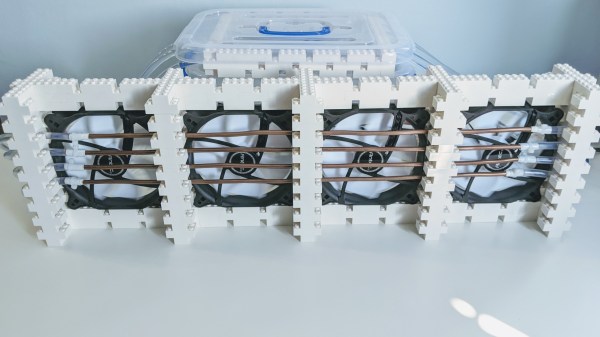
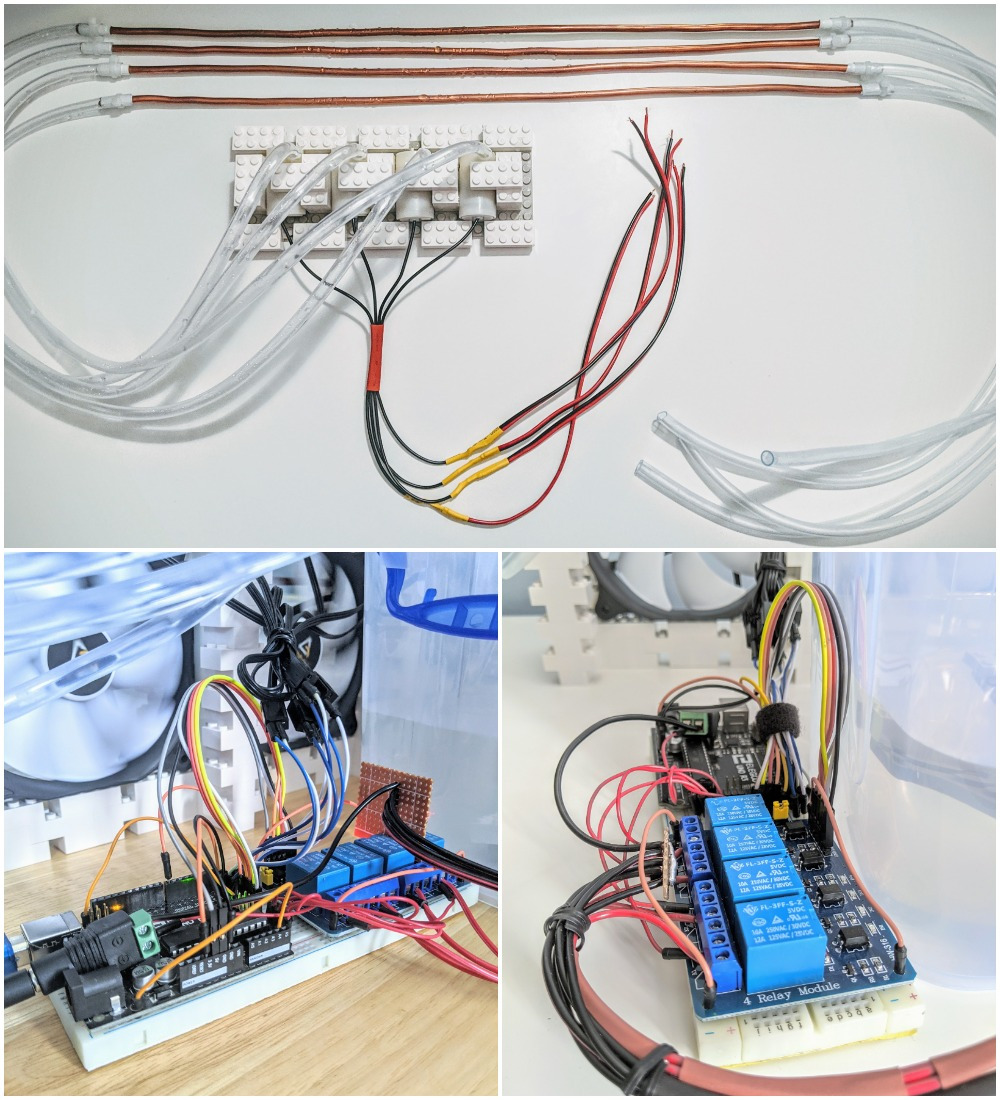
This thoroughly modular design uses an Arduino Uno and a relay module to drive four submersible pumps. The pumps are mounted on a LEGO base and sunk into a tub filled with water and ice packs. In the middle of the water lines are lengths of copper tubing that carry it past four 120mm PC case fans to spread the coolness. It works well, it’s quiet, and it was cheap to build. Doesn’t get much cooler than that.

[Manoj] had to do a bit of clever coupling to keep the tubing transitions from leaking. All it took was a bit of electrical tape to add girth to the copper tubes, and a zip tie used as a little hose clamp.

We think the LEGO part of this build looks great. [Manoj] says they did it by the seat of their pants, and lucked out because the copper and plastic tubing both route perfectly through the space of a 1x1x1 brick.

DIY cooling can take many forms. It really just depends what kind of building blocks you have at your disposal. We’ve even seen an A/C built from a water heater.

A Real Working Lego NES

Lego is an entry into the world of engineering for many a youngster, and an enjoyable pursuit for many more. These days, high quality kits are available to make everything from the Tower of Pisa to Nintendo’s venerated NES console. [TronicsFix] picked up the latter set, and decided it needed to be fully functional.

Consisting of 2646 pieces, the official Lego NES is a faithful recreation of the original, albeit at approximately 80% of the size. After building the kit to spec, [TronicsFix] noted that there was no way a cartridge would fit in the slot.

Given this failing, a ground-up rebuild was in order. Starting with the internals from an original NES, [TronicsFix] set about building an appropriately sized base and working from there. Supports were built to mount the various components, with the controller ports being particularly well done, and the video output and power switches being a little more tricky. The many cosmetic pieces from the official kit came in handy here, giving the final product the aesthetic touches it needed to fit the bill.

The final result is an authentic, functional NES in a LEGO case. [TronicsFix] demonstrates as such, showing the console playing Super Mario 3. Nintendo consoles remain a favorite amongst modders; some going so far as to build fire-breathing creations. Video after the break.

Continue reading “A Real Working Lego NES”

LEGO Delivers Corvette Experience On A Budget

Many dream of tooling around in a high performance sports car, but the cost of owning, maintaining, and insuring one of them make it a difficult proposition. While this LEGO version of the Corvette ZR1 might not be exactly like the real thing, it’s 4-speed manual and electronic gauge cluster can give you a taste of the supercar lifestyle without having to taken out a second mortgage.

Working through the gears.

Built by [HyperBlue], this desktop speedster has more going on under the hood (or more accurately, the roof) than you might expect. While it looks pretty unassuming from the outside, once the top is lifted, you can see all the additional components that have been packed in to motorize it. The functional gearbox takes up almost the entire interior of the car, but it’s not like you were going to be able to fit in there anyway.

But the motorized car is really only half of the project. [HyperBlue] has built a chassis dynamometer for his plastic ride that not only allows you to “start” the engine with realistic sights and sounds (recorded from an actual GM LT1 V8 engine), but put the mini ‘Vette through its paces. With a virtual dashboard powered by the Raspberry Pi, you can see various stats about the vehicle such as throttle position, RPM, and calculated scale speed; providing a real-world demonstration of how the transmission operates.

While a LEGO sports car might not be quite as exciting as getting yourself a real project car, there’s something to be said for being able to rebuild your transmission without getting your hands dirty.

Continue reading “LEGO Delivers Corvette Experience On A Budget”

Manual Larson Scanner Invites You To Crank It

Hasselhoff make Larson Scanners famous. That’s the name for the scanning red lights on the front of KITT, the hero car from the popular 1980s TV series Knight Rider. Despite serving a solely aesthetic role, they remain a fun and popular LED project to this day. Putting a new twist on the old concept, [Pete Prodoehl] whipped up a Larson Scanner that you crank to operate.

Built out of LEGO, the project relies on a hand crank to work. The crank turns a drum, onto which is placed several strips of conductive Maker Tape – a steel/nylon material which we’ve looked at before. Strips of tape running side-by-side are bridge by segments of tape on the drum as it turns. The LEDs are switched on in the requisite pattern of a traditional Larson scanner.

The project has inspired further possibilities, such as using similar techniques to produce an electronic music box or player piano that will change tempo as the user changes the speed with the crank. [Pete] notes that turning the crank is an inherently enjoyable experience, and given the wonder inherent in hand-cranked musical projects like Marble Machine X, we can’t wait to see where this one goes next. Video after the break.

Continue reading “Manual Larson Scanner Invites You To Crank It”

Maybe One Of The Most Adorable Obstacle Avoiding Robots You’ve Seen

We’re all pretty well-acquainted with the obstacle avoiding robot. These little inventions use a proximity sensor to detect an object in front of the robot, then circumvent the object accordingly. Brown Dog Gadgets’ little robot really caught our eye, mostly because it’s kind of cute.

This little robot combines a few LEGO pieces, Arduino, and Brown Dog Gadgets’ own in-house invention, Crazy Circuits. The LEGO pieces make up the body of the robot, craftily enclosing a small portable battery pack used to power the bot. Brown Dog Gadgets uses another home-grown design, their robotics controller board, breaking out a few GPIO pins of an Arduino-compatible microcontroller into LEGO-compatible connections. This makes it easy to interface two of our favorite DIY STEM tools using a solderless connection.

Add a few LEGO wheels and a caster for pivoting and you’ve got a pretty simple, little robot. Fortunately, Brown Dog Gadgets was very thorough in their write-up, so head on over to their Instructable for all the details.

In the meantime, we’ve got a rich history of obstacle-avoiding robots here on Hackaday. Take a look around.