Eating A QR Code May Save Your Life Someday

QR codes are easy to produce, resistant to damage, and can hold a considerable amount of data. But generally speaking, eating them has no practical purpose. Unfortunately the human digestive tract lacks the ability to interpret barcodes, 2D or otherwise. But thanks to the University of Copenhagen, that may soon change.

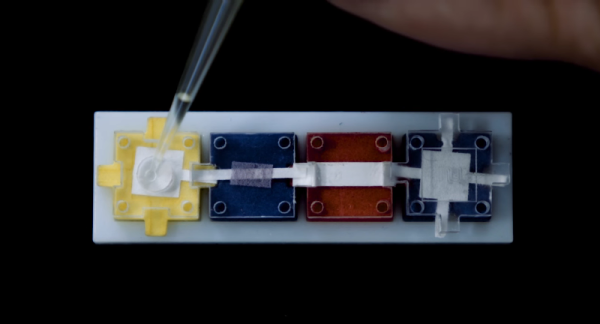
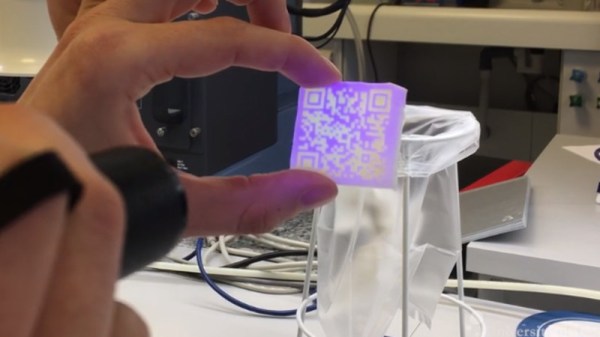
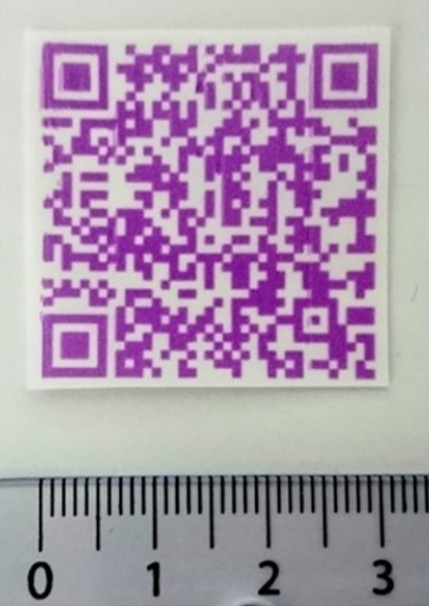
A new paper featured in the International Journal of Pharmaceutics details research being done to print QR codes with ink that contains medicine. The mixture of medicines in the ink can be tailored to each individual patient, and the QR code itself can contain information about who the drugs were mixed for. With a standard QR reader application on their smartphone, nurses and care givers can scan the medicine itself and know they are giving it to the right person; cutting down the risk of giving patients the wrong medication.

The process involves using a specialized inkjet printer to deposit the medicine-infused ink on a white edible substrate. In testing, the substrate held up to rough handling and harsh conditions while still keeping the QR code legible; an important test if this technology is to make the leap from research laboratory to real-world hospitals.

In the future the researchers hope the edible substrate can be produced and sent to medical centers, and that the medicinal ink itself will be printable on standard inkjet printers. If different medicines were loaded into the printer as different colors, it should even be possible to mix customized drug “cocktails” through software. Like many research projects it seems likely the real-world application of the technology won’t be as easy as the researchers hope, but it’s a fascinating take on the traditional method of dispersing medication.

QR codes have long been a favorite of the hacker community. From recovering data from partial codes to using them to tunnel TCP/IP, we’ve seen our fair share of QR hacks over the years.

[Thanks to Qes for the tip]

Continue reading “Eating A QR Code May Save Your Life Someday”

Automate The Freight: Medical Deliveries By Drone

Being a cop’s kid leaves you with a lot of vivid memories. My dad was a Connecticut State Trooper for over twenty years, and because of the small size of the state, he was essentially on duty at all times. His cruiser was very much the family vehicle, and like all police vehicles, it was loaded with the tools of the trade. Chief among them was the VHF two-way radio, which I’d listen to during long car rides, hearing troopers dispatched to this accident or calling in that traffic stop.

One very common call was the blood relay — Greenwich Hospital might have had an urgent need for Type B+ blood, but the nearest supply was perhaps at Yale-New Haven Hospital. The State Police would be called, a trooper would pick up the blood in a cooler, drive like hell down I-95, and hand deliver the blood to waiting OR personnel. On a good day, a sufficiently motivated and skilled trooper could cover that 45-mile stretch in about half an hour. On a bad day, the trooper might end up in an accident and in need of blood himself.

Continue reading “Automate The Freight: Medical Deliveries By Drone”

I’m A Tricorder, Not A Doctor, Jim!

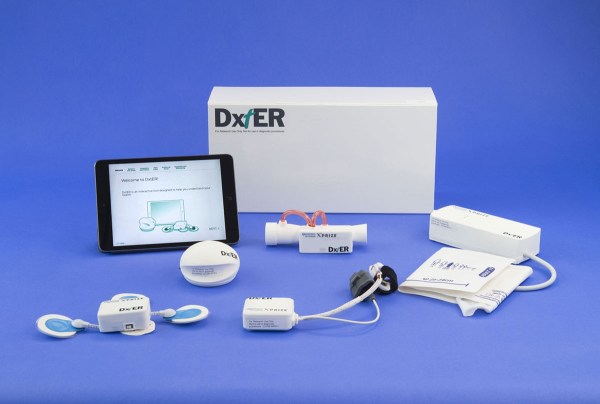
Machine learning and automated technologies are poised to disrupt employment in many industries — looking at you autonomous vehicles — and medicine is not immune to this encroachment. The Qualcomm Tricorder competition run by the X-Prize foundation has just wrapped, naming [Final Frontier Medical Devices]’s DxtER the closest thing available to Star Trek’s illustrious medical tricorder which is an oft referenced benchmark for diagnostic automation.

The competition’s objective was for teams to develop a handheld, non-invasive device that could diagnose 12 diseases and an all-clear result in 24 hours or less without any assistance. [Dynamical Biomarkers Group] took second place prize worth $1 million, with [Final Frontier Medical devices] — a company run by two brothers and mostly financed by themselves and their siblings — snagging the top prize of $2.5 million. DxtER comes equipped with a suite of sensors to monitor your vitals and body chemistry, and is actually able to diagnose 34 conditions well in advance of the time limit by monitoring vital signs and comparing them to a wealth of medical databases and encyclopediae. The future, as they say, is now.

Continue reading “I’m A Tricorder, Not A Doctor, Jim!”

Transcranial Electrical Stimulation With Arduino, Hot Glue

The advance of electronic technology has been closely followed by the medical community over the past 200 years. Cutting edge electronics are used in medical imaging solutions to provide ever greater bandwidth and resolution in applications such as MRI machines, and research to interface with the human nervous system continues at a breakneck pace. The cost of this technology – particuarly in research and development – is incredibly high. Combine this with the high price of the regulatory approvals necessary for devices which deal in terms of life and death, and you’ll find that even basic medical technology is prohibitively expensive. Just ask any diabetic. On the face of things, there’s a moral dilemma. Humanity has developed technologies that can improve quality of life. Yet, due to our own rules and regulations, we cannot afford to readily distribute them.

One example of this is that despite the positive results from many transcranial electrical stimulation (TCS) studies, the devices used are prohibitively expensive, as are treatment regimens for patients. Realising this, [quicksilv3rflash] decided to develop a homebrew, open source transcranial electrical stimualtion device, and published it on Instructables. Yes, that’s the world we’re now living in.

It’s important to publish a warning here: Experimenting with this sort of equipment can easily kill you, fry your brain, or have any number of other awful results. If you don’t have a rock solid understanding of the principles behind seperate grounds, or your soldering is just a little sloppy, you don’t want to go anywhere near this. In particular, this device cannot be powered safely by a wall-wart.

To be honest, we find it difficult to trust any medical device manufactured out of modules sourced from eBay. But as a learning excercise, there is serious value here. Such a project requires mastery of analog design to avoid dangerous currents being passed to the body. The instructions also highlight the importance of rigorously testing the device before ever connecting it to a human body.

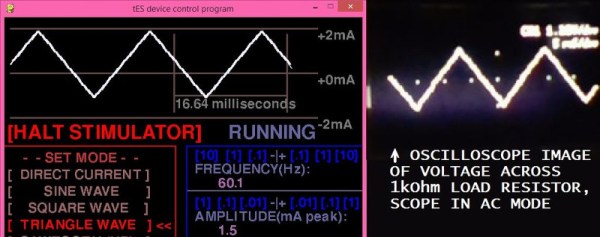
The equipment is based around an Arduino Nano receiving commands from a computer over serial, fed by an application written in Python & PyGame. To think, this writer thought he was being bold when he used it to control a remote control car! The Arduino Nano interprets this data and outputs it over SPI to a DAC which outputs a signal which is then amplified and fed to the human brain courtesy of op-amps, boost converters and sponge electrodes. The output of the device is limited to +/-2.1mA by design, in accordance with suggested limits for TCS use.

It should be noted, [quicksilv3rflash] has been experimenting with homebuilt TCS devices for several years now, and has lived to tell the tale. It’s impressive to see a full suite of homebrew, opensource tools being developed in this field. [quicksilv3rflash] reports to have not suffered injuries from the device, and several devices have been shipped to redditors. We’ve only found minimal reports on people receiving these, but nothing on anyone actually using the hardware as intended. If you’ve used one, get in touch in the comments.

It goes without saying – this sort of experimentation is dangerous and the stakes for getting it wrong are ludicrously high. We’ve seen before what happens when medical devices malfunction – things get real ugly, real fast. But hackers will be hackers and if you were wondering if it was possible to build a TCS device for under $100 in parts from eBay, well, yes. Yes it is.

Yes/No Neural Interface Partly Works

It sounds like something out of a sci-fi or horror movie: people suffering from complete locked-in state (CLIS) have lost all motor control, but their brains are otherwise functioning normally. This can result from spinal cord injuries or anyotrophic lateral sclerosis (ALS). Patients who are only partially locked in can often blink to signal yes or no. CLIS patients don’t even have this option. So researchers are trying to literally read their minds.

Neuroelectrical technologies, like the EEG, haven’t been successful so far, so the scientists took another tack: using near-infrared light to detect the oxygenation of blood in the forehead. The results are promising, but we’re not there yet. The system detected answers correctly during training sessions about 70% of the time, where the upper bound for random chance is around 65% — varying from trial to trial. This may not seem overwhelmingly significant, but repeating the question many times can help improve confidence in the answer, and these are people with no means of communicating with the outside world. Anything is better than nothing?

journal-pbio-1002593-g001It’s noteworthy that the blood oxygen curves over time vary significantly from patient to patient, but seem roughly consistent within a single patient. Some people simply have patterns that are easier to read. You can see all the data in the paper.

They go into the methodology as well, which is not straightforward either. How would you design a test for a person who you can’t even tell if they are awake, for instance? They ask complementary questions (“Paris is the capital of France”, “Berlin is the capital of Germany”, “Paris is the capital of Germany”, and “Berlin is the capital of France”) to be absolutely sure they’re getting the classifications right.

It’s interesting science, and for a good cause: improving the quality of life for people who have lost all contact with their bodies. (Most of whom answered “yes” to the statement “I am happy.” Food for thought.)

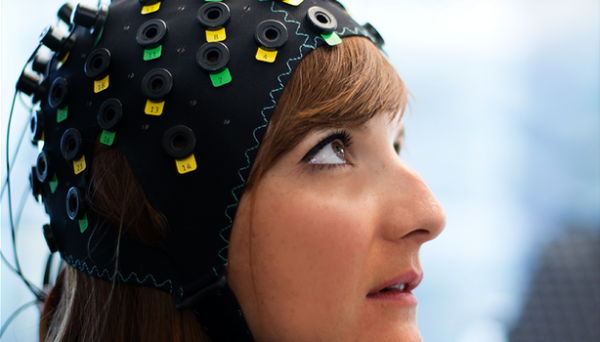
Via Science-Based Medicine, and thanks to [gippgig] for the unintentional tip! Photo from the Wyss Center, one of the research institutes involved in the study.

Riding Rollercoasters With 3D Printed Kidneys, Passing Stones

Citizen science isn’t limited to the nerd community. When medical professionals get a crazy idea, their options include filling out endless paperwork for human consent forms and grant applications, or hacking something together themselves. When [David Wartinger] noticed that far too many of his patients passed kidney stones while on vacation, riding rollercoasters, he had to test it out.

Without the benefit of his own kidney stones, he did the next best thing: 3D printed a model kidney, collected some urine, and tossed a few stones that he’d collected from patients into the trap. Then he and a colleague rode Big Thunder Mountain Railroad sixty times, holding the model in a backpack at kidney height.

Continue reading “Riding Rollercoasters With 3D Printed Kidneys, Passing Stones”

Smart Sutures

Researchers at Tufts University are experimenting with smart thread sutures that could provide electronic feedback to recovering patients. The paper, entitled “A toolkit of thread-based microfluidics, sensors, and electronics for 3D tissue embedding for medical diagnosis”, is fairly academic, but does describe how threads can work as pH sensors, strain gauges, blood sugar monitors, temperature monitors, and more.

Conductive thread is nothing new but usually thought of as part of a smart garment. In this case, the threads close up wounds and are thus directly in the patient’s body. In many cases, the threads talked to an XBee LilyPad or a Bluetooth Low Energy module so that an ordinary cell phone can collect the data.

Continue reading “Smart Sutures”