Ken Shirriff Breaks Open The Yamaha DX7

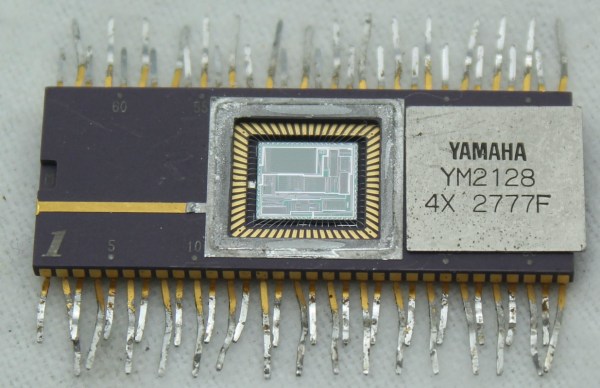
For better or worse, this synthesizer was king in the 1980s music scene. Sure, there had been synthesizers before, but none acheived the sudden popularity of Yamaha’s DX7. “Take on Me?” “Highway to the Dangerzone”?  That harmonica solo in “What’s Love Got to Do With It?”  All DX7. This synth was everywhere in pop music at the time, and now we can all get some insight from taking a look at this de-capped chip from [Ken Shirriff].

To be clear, by “look” that’s exactly what we mean in this case, as [Ken] is reverse-engineering the YM21280 — the waveform generator of the DX7 — from photos. He took around 100 photos of the de-capped chip with a microscope, composited them, and then analyzed them painstakingly. The detail in his report is remarkable as he is able to show individual logic gates thanks to his powerful microscope. From there he can show exactly how the chip works down to each individual adder and array of memory.

[Ken]’s hope is that this work improves the understanding of the Yamaha DX7 chips enough to build more accurate emulators. Yamaha stopped producing the synthesizer in 1989 but its ubiquity makes it a popular, if niche, platform for music even today. Of course you don’t need a synthesizer to make excellent music. The next pop culture trend, grunge, essentially was a rebellion to the 80s explosion of synths and neon colors and we’ve seen some unique ways of exploring this era of music as well.

Thanks to [Folkert] for the tip!

Mechanical Musical Sculpture Recalls The Four Muses

Music was created by humans, but often we find ourselves creating performances with machines. [Alana Balagot] and [Federico Tobon] did just that, constructing the stunning 4 Muses musical sculpture with their combined talents.

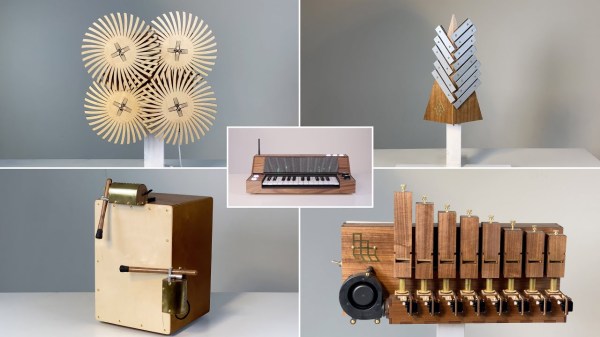
4 Muses is made up of four individual instruments, under the command of a single keyboard controller. The keyboard can be used to play the instruments live, or alternatively, can learn from the player or be used as a sequencer. It can also act as a simple device to play back music using the four instruments.

The pipe instrument uses servo-controlled valves, which allow air from a blower fan to reach several wood pipes. The xylophone instead uses solenoids to play its 13 tines. Percussion is provided by a mechanized cajón drum, using motors to actuate mallets that strike the various sections of the box. Meanwhile, hackers will be familiar with the concept of the motor-noise instrument, which drives stepper motors at different frequencies to generate tones.

Inside, a cavalcade of microcontrollers make everything work, from Arduino Megas and Teensys to NRF24s sending wireless packets from the controller to the instruments. [Alana] and [Federico] go in-depth with their documentation, highlighting the challenges they faced putting together the various instruments and showing how the final build came together.

Built with and brass hardware and sporting a variety of exquisite wood finishes, the final result is a quartet of machines that play beautiful music composed by [Alana] herself. Musical sculptures are often a great example of the artistry possible when putting electrons to work. Video after the break.

Continue reading “Mechanical Musical Sculpture Recalls The Four Muses”

Live Jam Kit Helps Electronic Musicians Stay In Sync

Jamming live with synths and drum machines can be fun, but for [Christian], there was a little something missing. He was looking for a way to keep everyone in the group on the beat and rocking out, and decided to build something to help.

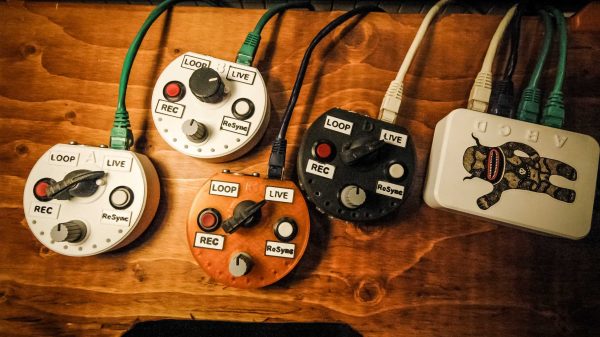
The ethos of the build was to put one person ultimately in charge of the mix using Ableton. This stops the volume race, as each musician turns their own volume up and the jam devolves into a noisy mess. Each musician also gets a sync button they can hit if their instrument has drifted out of time. Everyone in the jam also gets their own monitor signal in their headphones, as well as a looper as well.

Individual players in the electronic jam can whip up a cool little loop, and spit it out to the main controller running Ableton using the looper. Then, they can mix up something else in their headphones without disrupting the main mix, before spitting it out as a loop again.

[Christian]’s demo video does a great job of showing how it all works. We particularly like the sync button, which gets rid of the usual frustrations when a sequencer in the jam trips over the tempo signal.

It’s all built with a Teensy, and seems like a great way to organize a jam with a bunch of different synths and drum machines. We’d certainly love to join in the fun.

We’ve seen other fun jam kits too, like this neat networked solution. Video after the break.

Continue reading “Live Jam Kit Helps Electronic Musicians Stay In Sync”

Cheap DIY Mic Sounds (And Looks) Damn Good

As any musician, podcaster, or youtuber will be quick to tell you, there’s no substitute for a good microphone. They’ll also be quick to tell you all about their favorite microphone, why it’s better than all the others, and how much it cost (oh, and how round it sounds, whatever that means). But what if you could build your own that sounds as good, if not better, and do it for only $30?

That’s what [Matt] from DIY Perks set out to discover when he built his DIY USB-C Microphone. He was able to source the same microphone capsule that can be found in his high-end, $600 CAD E100S, and built a simple pre-amplifier that bumps its quiet output up to line-level. He even connected it to the mic module with some custom cable made from two tiny enameled wires that won’t transmit bumps and vibrations, wrapped inside desoldering braiding which acts as a shield. He fed the output from the pre-amp into a cheap USB audio interface and voilà! — top-notch sound for next to nothing. Make sure you check out the video below to hear a comparison between the mic and its professional counterparts.

Of course, sounding good isn’t quite enough. [Matt] wasn’t satisfied until the piece looked the part as well, which is why he encased the mic module in custom-bent brass mesh shielding and tubing (which also helps to reduce electrical interference). The brass cage sits suspended via rubber o-rings on a beautiful bent brass mount, which sits atop an articulated brass arm of [Matt]’s own design. Finally, the arm is mounted to a wood and brass enclosure that also serves to house the electronics.

And, in true open-source fashion, the video description is full of links to parts, schematics, and templates in case you want to build one of these beauties for yourself. Between this fantastic build and this other, super-overkill scratch-built USB microphone we featured earlier in the year, there has never been a better time to make yourself a mic you won’t have to trade your car for.

Thanks to [RichV] and [BaldPower] for the tip!

Continue reading “Cheap DIY Mic Sounds (And Looks) Damn Good”

Automated musical instrument with LED array

ESP32 Is The Brains Behind This Art Installation

The ESP32 has enabled an uncountable number of small electronics projects and even some commercial products, thanks to its small size, low price point, and wireless capabilities. Plenty of remote sensors, lighting setups, and even home automation projects now run on this small faithful chip. But being relegated to an electronics enclosure controlling a small electrical setup isn’t all that these tiny chips can do as [Eirik Brandal] shows us with this unique piece of audio and visual art.

The project is essentially a small, automated synthesizer that has a series of arrays programmed into it that correspond to various musical scales. Any of these can be selected for the instrument to play through. The notes of the scale are shuffled through with some random variations, allowing for a completely automated musical instrument. The musical generation is entirely analog as well, created by some oscillators, amplifiers, and other filtering and effects. The ESP32 also controls a lighting sculpture that illuminates a series of LEDs as the music plays.

The art installation itself creates quite haunting, mesmerizing tunes that are illustrated in the video linked after the break. While it’s not quite to the realm of artificial intelligence since it uses pre-programmed patterns with some randomness mixed in, it does give us hints of some other projects that have used AI in order to compose new music.

Continue reading “ESP32 Is The Brains Behind This Art Installation”

Modern Tape Echo Made Easy

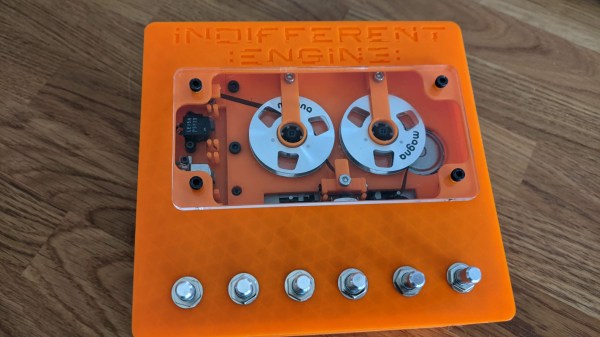
Modern popular music increasingly relies on more and more complicated and intricate equipment and algorithms to generate catchy tunes, but even decades ago this was still the case. The only difference between then and now was that most of the equipment in the past was analog instead of digital. For example, the humble tape echo was originally made by running a loop of magnetic tape over a recording head and then immediately playing it back. Old analog machines from that era are getting harder and harder to find, so [Adam Paul] decided to make his own.

At first, [Adam] planned to use standard cassette tapes in various configurations in order to achieve the desired effect, but this proved to be too cumbersome and he eventually switched his design to using the cassette internals in a custom tape deck. The final design includes a small loop of tape inside of the enclosure with a motor driving a spindle. The tape is passed over a record head, then a read head, and then an erase head in order to achieve the echo sound. All of this is done from inside of the device itself, with 1/4″ jacks provided so that the musician can plug in their instrument of choice just like a standard effects pedal would be configured.

The entire build is designed to be buildable and repairable using readily-available parts as well, which solves the problem of maintaining (or even finding) parts from dedicated tape echo machines from decades ago. We like the sound from the analog device, as well as the fact that it’s still an analog device in a world of otherwise digital substitutes. Much like this magnetic tape-based synthesizer we featured about a year ago.

Continue reading “Modern Tape Echo Made Easy”

ATtiny85 on circuit board with 2n2222, pushbutton, usb-c power connector, LED, and speaker.

Custom Compression Squeezes Classic Computer Choruses Into A Tiny Controller

Geeks of a certain vintage will have fond memories of games that were simplistic by today’s standards, but drew one in all the same. Their low fidelity graphics were often complimented by equally low fidelity music being forced through the afterthought of a speaker that inhabited most computers. Despite the technical constraints of the era, these games didn’t just offer gameplay. They told stories, and they were immersive in a way that some would think wouldn’t be relatable to a younger generation.

That didn’t stop [Thanassis Tsiodras] from sharing the classic “The Secret of Monkey Island” with his niece and nephew when they were young. Excited to see his family after a year of separation due to COVID-19, [Thanassis] wanted to give them a handmade gift: The music from “The Secret of Monkey Island” on a custom player. What an uncle!

[Thanassis] could have just recorded the music and played it back using any number of chips made for the purpose, but being a long time software engineer, he decided to take the scenic route to his destination. First, DOSBox was hacked to dump the speaker output into a file. Python, C, and 30 years of experience were leveraged to squeeze everything into the 8 KB storage of an ATtiny85. Doing so was no small feat, as it required that he create a custom implementation of Huffman compression to get the data small enough to fit on chip. And when it fit, but didn’t work, even more optimization was needed.

The end result was worth it however, with the music from “The Secret of Monkey Island” playing in its original form from a speaker driven by the ever so humble but useful 2n2222. [Thanassis]’ site is replete with details too intricate to post here, but too neat to miss. Watch the video below the break for a demonstration.

Continue reading “Custom Compression Squeezes Classic Computer Choruses Into A Tiny Controller”