TinyTendo Is A Miniscule Yet Real NES

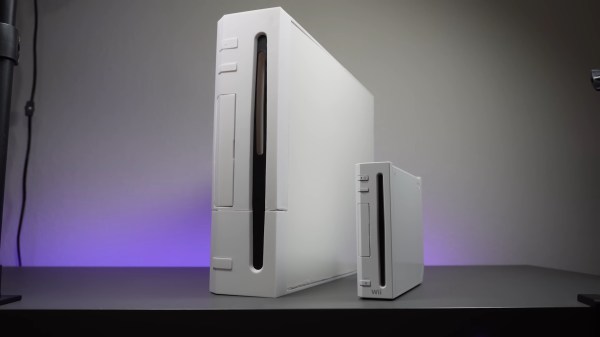
These days, it’s possible to get a single-board computer the size of a stick of gum. This will give you the power to emulate thousands of games and you can run one off batteries inside a handheld of your own devising. [Redherring32] took an altogether more creative and old-school approach with the TinyTendo, however. This is one pocket-sized NES that actually runs on genuine hardware. (Nitter)

The feat was achieved by drastically reducing the size of the original NES hardware to make it fit into a Game Boy style form factor. Key to this work was creating a custom cut-sized motherboard which uses original Nintendo DIP chips that have been machined down to become more like QFN-style surface mount packages. With that done, the chips can be assembled onto the TinyTendo PCB which is even smaller than a contemporary Raspberry Pi 3. It’s all assembled in a custom case, with USB C for charging and a bright and colorful LCD screen.

The TinyTendo is designed to use mini-cartridges created by [Bucket Mouse], a hacker who’s no stranger to impressive custom Game Boy hardware. By virtue of running genuine NES hardware, there’s also the possibility that the TinyTendo could play full-sized NES carts with a simple adapter.

This project has been a long time in the making; we first looked at [Redherring32]’s efforts back in 2021. It begs the question why the original NES was so big when Nintendo clearly had plenty of space to spare in those hefty DIP packages! It’s amazing what can be done with some creativity and perseverance. Continue reading “TinyTendo Is A Miniscule Yet Real NES”

Building The World’s Largest Nintendo 3DS

While the Nintendo 3DS was capable of fairly impressive graphics (at least for a portable system) back in its heyday, there’s little challenge in emulating the now discontinued handheld on a modern computer or even smartphone. One thing that’s still difficult to replicate though is the stereoscopic 3D display the system was named for. But this didn’t stop [BigRig Creates] from creating this giant 3DS with almost all of the features of an original console present.

The main hurdle here is that the stereoscopic effect that Nintendo used to allow the 3DS to display 3D graphics without special glasses doesn’t work well at long distances, and doesn’t work at all if there is more than one player. To get around those limitations, this build uses a 3D TV with active glasses. This TV is mounted to a bar stool with the help of some counterweights, and a second touch-sensitive screen courtesy of McDonalds makes up the other display.

The computer driving this massive handheld console runs Citra, and also handles the scaled-up controls as well. To recreate the system’s analog touch pad, a custom joystick tipped with conductive filament is used to interact with a smartphone hidden inside the case. Opposing rubber bands are used to pull the stick back into the center when it’s not being pushed.

Plenty of 3DS games are faithfully replicated with this arcade-sized replica, and as Citra supports various 3D displays, upscaling of the graphics, and the touchscreen interface, almost everything from the original console is produced here. There are a few games that don’t work exactly right, but all in all it’s a remarkable build and, as far as we can tell, the largest 3DS in the world. Don’t forget that even though this console is out of production now, there’s still a healthy homebrew scene to take part in.

Continue reading “Building The World’s Largest Nintendo 3DS”

Retro Gadgets: Nintendo R.O.B Wanted To Be Your Friend

Too busy playing video games to have a social life? No worries. In 1985, Nintendo introduced R.O.B. — otherwise known as the Robotic Operating Buddy. It was made to play Nintendo with you. In Japan, apparently, it was the Family Computer Robot. We suppose ROB isn’t a very Japanese name. The robot was in response to the video game market crash of 1983 and was meant to keep the new Nintendo Entertainment System (NES) from being classified as a video game, which would have been a death sentence at the time of its release.

Since you might not have heard of R.O.B., you can probably guess it didn’t work out very well. In fact, the whole thing tanked in two years and resulted in only two games.

Continue reading “Retro Gadgets: Nintendo R.O.B Wanted To Be Your Friend”

Breadboarding A Game Boy From Scratch

The original Nintendo Game Boy is a stout piece of hardware in a solid plastic enclosure. [Raphael Stäbler] recreated the popular handheld on a breadboard instead, in a fully-functional way, to boot.

[Raphael]’s build doesn’t rely on a real Game Boy CPU or components. Instead it’s emulated with the aid of a Teensy 4.1 microcontroller. [Raphael] coded up an emulator from scratch, instruction by instruction, something he’s documented on his own blog. The Teensy is placed on a breadboard, and hooked up with a series of 8 buttons to serve as the controls. Audio output is via a LM386 acting as a simple audio amp, hooked up with an original Game Boy speaker for more authentic sound. Display is thanks to a FT81x display driver running a small LCD. Games are loaded via an SD card formatted in the FAT32 file system.

While it’s not as ergonomic as the original Nintendo console, it works, and works well! It’s an impressive project to see the Game Boy recreated from scratch inside a powerful microcontroller. We’ve seen other projects go to similar lengths before. Video after the break.

Continue reading “Breadboarding A Game Boy From Scratch”

Kirby Sucks, Literally

What’s common between one of the most legendary video game characters of all time and a fume extractor ? They both suck. [Chris Borge] is not an electronics hobbyist and only does some occasional soldering. This made his regular fume extractor bulky and inconvenient to position where needed. What could serve him better would be a small extractor that could be attached to a clip or an arm on his helping hand accessory. Being unable to find an off-the-shelf product or a suitable 3d printed design that he liked, he built the Kirby 40mm Fume Extractor.

His initial idea was for a practical design more suited to his specific needs. But somewhere along the way, the thought of a Kirby fan popped up in his head, and it was too good an idea to pass up. Several Kirby fan designs already existed, but none that satisfied [Chris]. Getting from paper sketch to CAD model required quite an effort but the result was worth the trouble, and the design was quite faithful to the original character features. The main body consists of two halves that screw together, and an outlet grill at the back. The body has space for a 40 mm fan and a 10 mm charcoal filter in the front. The wires come out the back, and connect directly to a power supply barrel jack. Arms and eyes are separate pieces that get glued to the body. The feet glue to an intermediate piece, which slides in a dove tail grove in the body. This allows Kirby to be tilted at the right position for optimum smoke extraction.

While Kirby served the purpose, it still didn’t meet the original requirement of attaching to a clip or arm on the helping hand. So [Chris] quickly designed a revised, no-frills model which is essentially a square housing to hold the fan and the filter. It has a flexible stand so it can be placed on a bench. And it can also be attached to the helping hand, making it a more utilitarian design. This design has the charcoal filter behind the fan, but he also has a third design for folks who prefer to have the filter at the front.

He now had a more useful, practical fume extractor, but he couldn’t bring himself to discard his original Kirby. So he printed a couple more 3D parts so that Kirby could fit the end of his vacuum cleaner hose. Now, Kirby sits on his bench, and helps suck up all the bits and bobs of trash on his workbench. We’re sure Kirby is quite pleased with his new role.

Continue reading “Kirby Sucks, Literally”

Java Is Now On The Nintendo 64!

Whether it’s your favorite programming language, or your favorite beverage, there’s no denying Java is everywhere. Now, it’s even on the Nintendo 64, thanks to the valiant efforts of [Mike Kohn]. Even better, he’s coded a demo to show off its capabilities!

The project took plenty of work. [Mike] went all the way down to the assembly level to get Java code running on the N64. The project builds on the work that he did previously to get Java running on the PlayStation 2. Notably, both the Sony and Nintendo consoles do have some similarities — both are based on MIPS CPUs.

The demo itself is a work of art. It features the typical “3 billion devices run Java” screen, followed by some truly chunky bass and wailing guitar sounds. It’s followed by all the dancing shapes, sinusoidal text, and bright colors you could shake a stick at.

For those interested in the nitty gritty, [Mike] delves deep into the details of what it took to get everything running. That includes both using the code in an emulator, as well as how to get it going on real Nintendo hardware, something we’ve looked at before.

Continue reading “Java Is Now On The Nintendo 64!”

DIY Game Boy Games Make The Perfect Christmas Gift

Sometimes, the best gift is the one you make yourself. [Pigeonaut] decided to whip up a few Game Boy games of their very own creation to gift to the special people in their life.

The games were crafted using a platform called GB Studio. It’s a tool that allows the drag-and-drop creation of games for the Game Boy and Game Boy Color handhelds. It’s capable of creating ROM files to run in an emulator, within a web page, or they can be flashed to a cartridge and played on real Nintendo hardware.

For the full effect, [Pigeonaut] went with the latter method. Four games were created: Phantom Shock, Climbing Mount Crymore, Cozy Cat Cafe, and A Tiny Hike. Each was flashed onto a real cart and given a high-quality label to make a lovely tangible gift. Upon gifting, [Pigeonaut]’s friends and partner were able to play their way through their personalized titles on a GameCube running the Game Boy Player accessory.

It’s hard to imagine a more touching gift than a personal game crafted from the ground up. Getting to play it on a real Nintendo is even better, and we’ve seen hardware that can achieve that before. Try out the games in your web browser via the links above, or send us in your own cool homebrew hacks to the Tipsline!