Custom Controllers For PlayStation 3

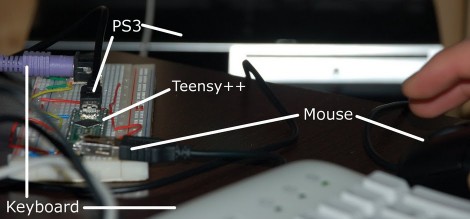
[Matlo] worked out a way to use a PS/2 Keyboard and USB mouse with a PlayStation3. The hard work is handled by a Teensy board, which is becoming a popular choice with controller hacks. It interfaces with the keyboard and mouse, translates their input, and sends joystick button commands to the PS3. He is limited to mapping the inputs from a PS3 controller but that is still enough options to work beautifully with first person shooters, especially if you’re used to gaming on a PC instead of a console. If you want to give this one a try, head over to the google code page to download the source code.

Game Controllers Using USB Host Shield

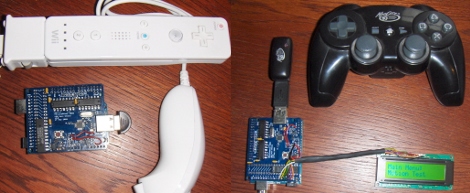
[I-Bot] has put together some libraries that make it easy to use gaming controllers with an Arduino. They interface through the USB host shield. This means that PS3 controllers connect via USB through a cable or a dongle. With the Wii remote things get a little more interesting. A Bluetooth dongle is used to make the connection wirelessly. What we have here is a cheap and easy way to add Bluetooth connectivity to your projects either through the USB Host shield, or by building your own hardware with the schematics and code that are available from Circuits@Home. There are several pages that walk you through the protocols using as well as a demonstration video you can see after the break. Continue reading “Game Controllers Using USB Host Shield”

PS3 Exploit Released

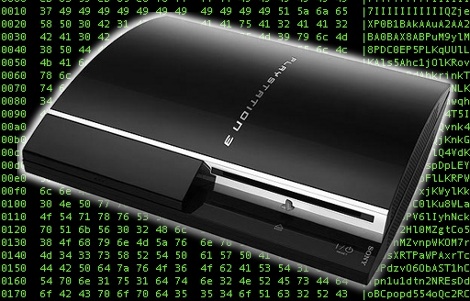
You can now download the exploit package for the PlayStation 3. [Geohot] just posted the code you need to pull off the exploit we told you about on Sunday, making it available on a “silver platter” with just a bit of explanation on how it works. He’s located a critical portion of the memory to attack. By allocating it, pointing a whole bunch of code at those addresses, then deallocating it he causes many calls to invalid addresses. At the same time as those invalid calls he “glitches” the memory bus using a button on his FPGA board to hold it low for 40ns. This trips up the hypervisor security and somehow allows read/write access to that section of memory. Gentleman and Ladies, start your hacking. We wish you the best of luck!

[Thanks Phileas]

Update: Realtime 3D For You Too!

[Kyle McDonald] has kept himself busy working on 3D scanning in realtime. He’s posted a writeup that takes us through the concepts, tools, and assembly of a DIY 3d scanning camera. You should remember a preview of this method posted earlier this month, but now it’s time to build your own. You’ll need a camera, a projector, and some open source software to process the image data. Using these simple tools, [Kyle] turned out much better video than before. Take a look after the break to see his results from scanning at 60 fps using a PS3 Eye. The trick to this setup is getting the correct synchronization between the projector and the camera, something that could be improved with a bit of extra hacking.

Does [Kyle’s] name sound familiar? It should, he’s got a long history of quality hacks that we’ve featured over the years. If you’re looking to use a scanner as a multitouch, add some music to tea time, or play with your skittles his work will give you a shove in the right direction.

Continue reading “Update: Realtime 3D For You Too!”

PS3 Wireless Visual Interface

[Technott’s] at it again, this time extending the Playstation 3 with a wireless interface. This handheld isn’t actually a PS3. It provides a wireless connection to your PS3 to receive audio and video, as well as to manage controller data. Think of it as a wirelessly tethered handheld that allows you to play Playstation when your wife is watching the Real Housewives. This is similar in size to his Xbox 360 WVI but the case shape and appearance are a big step up (not that we disliked that one). We’ve embedded a video tour of the device after the break.

Continue reading “PS3 Wireless Visual Interface”

EyeWriter Is The Fruit Of The KanEye Project

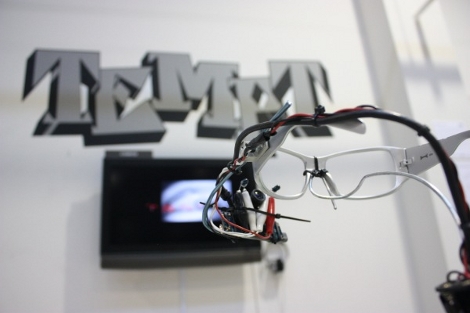
The EyeWriter is an open source eye tracking initiative. This is the mature version of the KanEye project we covered in April. Collaboratively developed by Free Art and Technology (FAT), OpenFrameworks, and the Graffiti Research Lab, they seek to aid a friend of theirs who suffers from the degenerative muscle disease ALS.

They’ve come a long way since we last looked in on the progress. The hardware used is pretty much the same: a set of sunglasses sans lenses with the CCD from a Sony PlayStation 3 Eye mounted in front of one eye. IR LEDs surround the CCD and point at the eye to increase the contrast between pupil and the rest of the eye. The major improvement comes with the software. Eye tracking appears to be extremely precise and they’ve written a custom drawing program to take advantage of their interface. Check in on their developer page for source code and a video walk-through of the software.

After the break you can see video of [Tempt1] using the system to create some tags. We’re thankful for the success this project has seen as this guy can do a lot better with his eye than we can with our hands.

Continue reading “EyeWriter Is The Fruit Of The KanEye Project”

Color Correction Patch For PS3 Eye

ps3-eye-color-correction

[Max] was happy to see that the PlayStation 3 Eye has support in the newer Linux kernels. Having sat in his closet for quite some time, this would give the camera another chance at usefulness. Unfortunately, the driver doesn’t include framerate selection and color correction so he set about writing a patch to control the color settings. As you can see above, his success greatly improves the image quality you get from the device.

We get the feeling that the camera peripherals for Sony’s gaming devices seem like a good idea but don’t have much staying power as a realistic gaming interface. With contributions like [Max’s], they can be re-purposed. The PS2 had its own, the EyeToy, which has long enjoyed driver support for Linux. The NUI Group does a lot of work with multi-touch and recommends the PS3 Eye for use with their projects because they’re inexpensive with high frame rates and decent picture quality.

Great work [Max]. It looks like he’s sent this patch upstream to be considered for incorporation into the kernel’s webcam module.