Robot Security Patrol Brings Skynet Closer

autonomous_atv

The students at the University of Oklahoma have put together a robot that will surely join the other drones in our future robot overlord regime. This autonomous vehicle was produced to replace human security patrols which can be both boring and dangerous. Intent on delivering surveillance to most locations, an all terrain vehicle was used as the base. It can navigate by itself through an obstacle avoidance system and communicate video and audio wirelessly. After the break we’ll take a look at the systems that make this work. Continue reading “Robot Security Patrol Brings Skynet Closer”

Quoth The Raven: Hack Some More

RavenSideCovered_IMG_0009

There are people who buy a cheap sack of candy and dutifully answer the door on Halloween. Then there are people like [Peter] who spend the whole year planning for the next year’s Hollywood-style front yard theatrics.

He added an animatronic raven to his show a few years back. It has been wildly popular and it’s not hard to see why. The bird is well engineered, well built, and the performance is very realistic. [Peter], who is an FX supervisor in the film industry, has posted a build log that takes us through step by step. This creepy performer can move its head up and down, side-to-side, and even rotate at the neck. This all happens while the beak synchronizes with talking. We marvel at the precision machining that was done to make the frame facilitate movement.

The body itself is made of fiberglass covered with feathers. [Peter] covered the completed mechanics with clay in order to sculpt the final body shape. This was used as the mold by covering it with fiberglass release and then fiberglass fabric. This process produced a very light weight and accurate shell with a minimum of effort; something we’ll keep in mind for future projects.

Take a look at a bit of video after the break. You can see the whole show from past years over at [Peter’s] site. We’ll be doing a couple of follow-ups covering his animatronic skeleton (the raven’s partner in crime) as well as the interface he uses to control and sync the voices to stay tuned! Continue reading “Quoth The Raven: Hack Some More”

Pick-and-place Lego Prototyping

[youtube=http://www.youtube.com/watch?v=Ps59Hj9RIG0]

[Ned] tipped us off about his project for a class at Carnegie Mellon. Utilizing a Denso 6-AOF robotic arm they have built a rapid prototyping machine that uses Lego as the building material. LDraw, the open standard Lego CAD program, is used to build a model which is then translated into MATLAB files that the robotic arm can use for placement commands. Right now pieces need to be placed on a template for the robot to find and pick up.

It’s great that Lego pieces are used because they are readily available and inexpensive, but this type of precision robot makes the project unattainable for most tinkerers. Still, the concept is interesting and we could see an end goal being a more widely available machine. It’s not too much of a leap to image a RepRap type machine that takes internal measurements of a circuit board and the components, calculates inside case dimensions, then builds a prototype enclosure from common Lego pieces.

OmniZero.9 Multi Format Biped

[youtube=http://www.youtube.com/watch?v=uqnxt9vGAmE]

There are so many biped bots circulating the web that we tend to overlook them. This one caught our eye this morning due to its interesting ability to change its layout. Named OmniZero.9, this biped can drive on 4 wheels like a car, walk like a biped, and even carry a person. While it certainly doesn’t look like the most comfortable mode of transportation, it looks less awkward than some of the latest “innovations” coming from big names.

[via GetRobo]

Radio Controlled Beetle Flight Footage

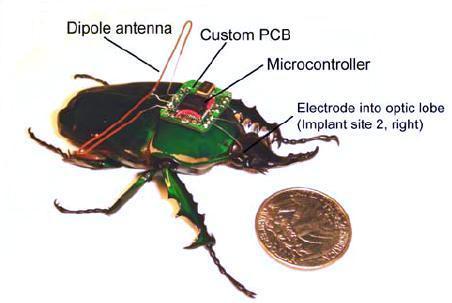
Earlier this year we were amazed when University of California researchers controlled a beetle via electrical implants. The video available at the time of the original report showed beetles tethered in place while electrical stimuli was applied via the chip. New video of free flight is has now been posted. Although the motion is rather sporadic, it is obvious that simple commands to start flight, stop flight, and turn left or right are having their intended effect. Check out this cyborg action after the break. Is DARPA one step closer to unleashing legions of insect warriors on unsuspecting masses? Continue reading “Radio Controlled Beetle Flight Footage”

Vintage Hack – Game Boy Camera

Screenshot

Back in 2005, a member of a French robotics team named [Laurent] wrote a wonderful how-to that we somehow missed on using the Game Boy Camera as a vision device for a robot. The images above are actual shots from his project. The Game Boy Camera features a stunning 128×123 pixel resolution in a gorgeous 4 color gray-scale palette. Possibly the most attractive feature of this hack is that it is still possible to get a hold of these cameras for under ten dollars on ebay.

He connected the camera sensor to an Atmel AT90S4433 using a combination of digital and analog signals, and then used the microcontroller to echo the data back to his PC. His write up includes schematics for wiring up the sensor/microcontroller, the datasheet for the sensor, his C code for the whole project, and an easy to read pin out of the GBC connector. Although his project simply offloaded the image to a computer, it would be entirely possible to have the microcontroller respond to the image or simply just log and store it. It would also be just as easy to replace his Atmel chip with your own favorite microcontroller, as long as it has a couple Digital I/O ports and at least one Analog port (or an external analog to digital converter).

UPDATE: Good catch r4v5, it would require an ADC, not a DAC.

Pool-playing Robot + ARpool

[youtube=http://www.youtube.com/watch?v=AENJxqR0g48]

Enjoy losing at pool? Well the folks at Queen’s University just made it a whole lot easier. The Deep Green robot was created with the purpose of playing a flawless game, allowing it to beat even the most skilled human players. More than a couple of research papers have been written on the project. A ceiling-mounted Canon 350D tracks the position of all of the balls, in addition to another cue-mounted cam (for higher shot accuracy). Using a bunch of calculations, and a computer (probably more advanced than an Arduino), the Deep Green is able to strategize and play. Very well.

On a positive note, another team from Queens is working on a seperate but related project: ARpool (as in augmented reality). It was created to make playing pool easier. The website does not provide much info, but it seems to project different moves onto the pool table, allowing an inexperienced player to tell whether a shot is at all possible.