Tiny Robot Jazz

Microcontroller-based projects don’t have to be fancy to be fantastic. Case in point: [r0d0t]’s “Musicomatic: the random jazz machine“. Clever programming and a nice case can transform a few servos and a microcontroller into something delightful.
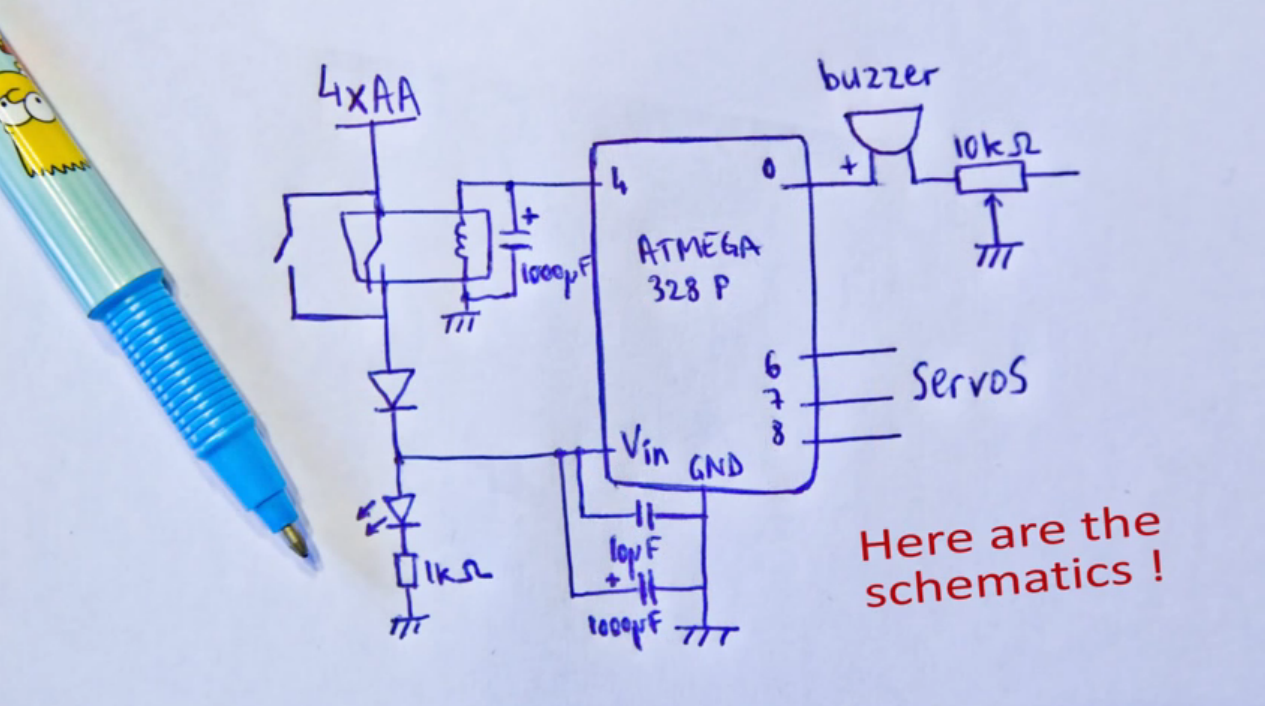
musicomat_schematicsHardware-wise, there’s really nothing to see here; a speaker and some servos are hooked up to an ATmega328. We think it’s cute to have the microcontroller control its own power supply through a relay, but honestly a MOSFET in place of the relay or better still using the AVR’s shutdown sleep mode would be the way to go.

Nope, where this project shines is the programming. Technically, it might make some of you cringe — full of blocking delays and other coding “taboos”. But none of that matters, because [r0d0t] put his work in where it counts: the music. You simply must hear it for yourself in the clip after the break.

The basis of making music that humans like is rhythm, so [r0d0t] doesn’t leave this entirely to chance. The array “rhythms” has seven beat patterns that get randomly selected. The other thing humans like is predictability and repetition, so choruses and “improvs” repeat as well. All of the random notes are constrained to the pentatonic scale, which keeps it from ever sounding too bad. (The secret sauce of Kenny G.)

In short, [r0d0t] packs a lot of basic music theory into a very basic device, and comes up with something transcendent. We’re a bit reminded of the Yellow Drum Machine robot, and that’s high praise. Both projects are testaments to building something simple and then investing the time and effort into the code to make the project awesome.

For another slice of [r0d0t]’s excellent minimalist pie, check out his take on the classic Snake game: Twisted Snake.


Continue reading “Tiny Robot Jazz”

Robot Camel Jockeys

You might think we’re sinking to lowest-common-denominator, click-bait headlines like the rest of the online press. We’re not. The New York Times Video Notebook series has a story on camel racing that you’ve just got to see in the video after the break.

robotPreviously, the camel races in Abu Dhabi had used small children as jockeys because they’re lightweight. Unfortunately, this lead to illegal trafficking of small children, mostly orphans. That won’t do. So they came up with a technological solution.

Strap a cordless drill with a purpose-built whip in the chuck onto the back of your camel. Add a car-remote keyfob to activate, and a two-way radio so that you can shout encouragement into your animal’s ear at just the right times. Now just chase the racers down the highway in an SUV and it’s like you’re there on the camel’s back!

talkingWe love the little silk suits that the drillbot-jockeys get to wear, but we’re not sure that cordless drills with walkie-talkies and remote controls count as “robots” really, because they don’t do anything autonomous. We think they’re more accurately described as “telepresence agents”.

Continue reading “Robot Camel Jockeys”

SPARC: A Voice Controlled Robot Sings Sweetly In DTMF

One of the recurring themes of science fiction is the robot. From such icons as C-3PO and R2D2 in Star Wars to WALL-E and Eve, robots have always had a certain appeal. Inexpensive microcontrollers like the Arduino have opened up the world of robotics to more people. [JohnFin] has done just this. By linking two Arduinos as the brain, he has created a voice controlled robot he calls S.P.A.R.C. (Sentry/Project Assistant/Robot Companion).

It began when he received a robotic arm for Christmas and was disappointed by it. Instead of simply building a better arm, he got “carried away” and built an entire robot instead. The entire project took three months, most of which he spent learning programming.

SPARC has three sonar sensors for detecting obstacles and movement, an arm and a couple of interchangeable hands for holding objects, and an EasyVR Arduino Shield for the voice control. The robot’s “eyes” are an LED ‘KITT’ scanner and an AN6884 VU meter chip that flashes the “eyes” when the robot speaks. It carries an onboard smartphone to look up weather, play music from the phone’s SD card, and GPS functions.

SPARC can respond to a range of commands and games including “follow me” and “singing.” [JohnFin] has also added a “sequencer” function to record and playback a series of commands. A video of this feature can be found after the break.

Continue reading “SPARC: A Voice Controlled Robot Sings Sweetly In DTMF”

The Simplest Quadrupedal Robot Ever

Wheeled and tracked robots are easy mode, and thanks to some helpful online tutorials for inverse kinematics, building quadruped, hexapod, and octopod robots is getting easier and easier. [deshipu] came up with what is probably the simplest quadruped robot ever. It’s designed to be a walking robot that’s as cheap and as simple to build as possible.

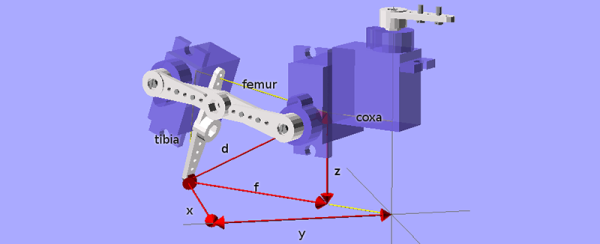
The biggest problem with walking robots is simply the frame. Where a wheeled robot is basically a model car, a walking robot needs legs, joints, and a sturdy frame to attach everything to. While there are laser cut hexapod frames out there, [deshipu]’s Tote robot uses servos for most of the skeleton. The servos are connected to each other by servo horns and screws.

The electronics are based on an Arduino Pro Mini, with a PCB for turning the Arduino’s pins into servo headers. Other than that, a 1000uF cap keeps brownouts from happening, and a 1S LiPo cell provides the power.

Electronics are easy, and the inverse kinematics and walking algorithms aren’t. For that, [deshipu] has a few tutorials for these topics. It’s a very complete guide to building a quadruped robot, but it’s still a work in progress. That’s okay, because [deshipu] says it will probably remain a work in progress until every kid on Earth builds one.

Open Source, DIY Soldering Robot

After [Brian] starting selling his own Raspberry Pi expansion boards, he found himself with a need for a robot that could solder 40-pin headers for him. He first did what most people might do by looking up pre-built solutions. Unfortunately everything he found was either too slow, too big, or cost as much as a new car. That’s when he decided to just build his own soldering robot.

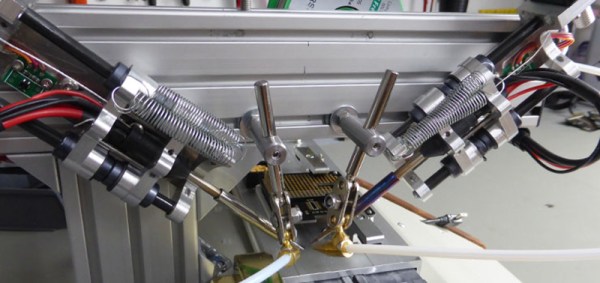
The robot looks similar to many 3D printer designs we’ve seen in the past, with several adjustments. The PCBs get mounted to a flat piece of aluminum dubbed the “PCB caddy”. The PCBs are mounted with custom-made pins that thread into the caddy. Once the PCBs are in place, they are clamped down with another small piece of aluminum. A computer slowly moves the caddy in one direction, moving the header’s pins along the path of the soldering irons one row at a time.

The machine has two soldering irons attached, allowing for two pins to be soldered simultaneously. The irons are retracted as the PCB caddy slides into place. They irons are then lowered onto the pins to apply heat. Two extruders then push the perfect amount of solder onto each pin. The solder melts upon contact with the hot pins, just as it would when soldered by hand.

The system was originally designed to be run on a Windows 8.1 tablet computer, but [Brian] found that the system’s internal battery would not charge while also acting like a USB host. Instead, they are running the Windows WPF application on full PC. All of the software and CAD files can be found on [Brian’s] github page. Also be sure to check out the demo video below. Continue reading “Open Source, DIY Soldering Robot”

Strong Little Robots With Gecko Technology

If you need to build a robot to carry something, you need a bit motor, right? Not so with these tiny robots out of Stanford’s Biomimetic Dexterous Manipulation Laboratory. One of these 12g MicroTugs can drag a 600g mug of coffee across a table, or even a 12kg weight. According to the authors, it’s a, ‘capability … comparable to a human dragging a blue whale.’ Square-cube law notwithstanding, of course.

What makes these little robots so strong? It’s not the actuators; it’s their feet. On the bottom of this robot is a material that uses mechanical anisotropic adhesion, a fancy material that only sticks to flat surfaces when it’s being pulled in a specific direction.

The best description of this material inspired by gecko feet would be this video, also from the Stanford BDML lab. It’s a neat material that we’ll probably find in Post-It notes in a decade, and with a single motor, a tiny robot can lift thousands of times its own body weight.

Videos below. Thanks [Adrian] for the tip.

Continue reading “Strong Little Robots With Gecko Technology”

Robottermilk Pancakes

With a name like that how could we possibly pass up featuring this one? Truly a hack, this pancake making robot was built in under 24 hours. [Carter Hurd], [Ryan Niemo], and [David Frank] won the 2015 Ohio State University Makethon with the project.

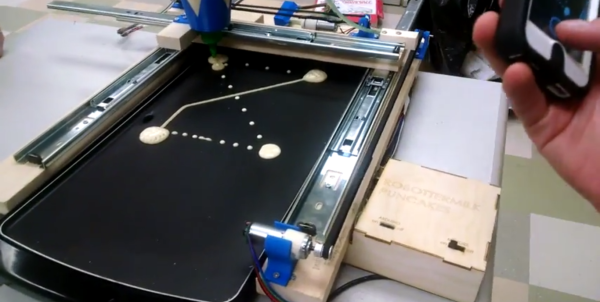
The gantry runs on drawer sliders using belts from a RepRap. The motors themselves are DC with encoders. [Carter] tells us that since most 3D Printers are build on stepper motors this meant they had to scratch-build the control software but luckily were able to reuse PID software for the rest. Get this, the pump driving the pancake batter was pulled from a Keurig and a servo motor is used to kink the tubing, halting the flow. We are amused by the use of a Sriracha bottle as the nozzle.

It wasn’t just the printer being hacked together. The team also built an iPhone app that lets you draw your desired pattern and push it to the machine via WiFi.

Inspired yet? We are! If you’re anywhere near New York City you need to bring this kind of game to our Hackathon on May 2-3. One night, lots of fun, lots of food, and plenty of hardware. What can you accomplish?

Continue reading “Robottermilk Pancakes”