Building A Bandwidth Meter

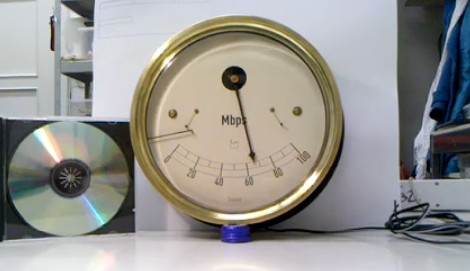
Here’s an analog bandwidth meter made to look like an old pressure gauge. It’s actually new, but the paper showing the graduated scale was stained in a bath of black tea, then dried in an oven to give it an aged appearance. We think it’s quite effective.

The dial itself is a volt meter driven by an Arduino in much the same way as the multimeter clock. Bandwidth data is pulled from a Linux router, filtered down to the target data using ‘grep’, and sent over the serial connection by a Perl script. Since the meter itself is just waiting for serial data, alterations to the router’s scripting make it easy to represent a count of unread emails, tweets, or whatever data your code can scrape.

[Thanks Ben]

Home Automation Without Pulling Wires

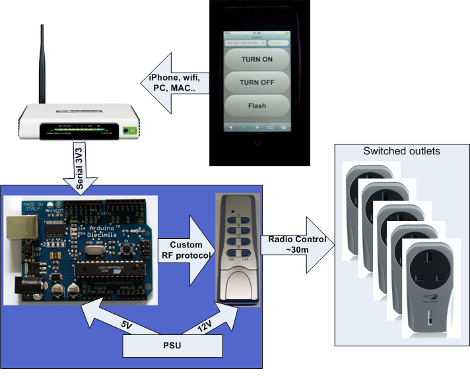
Here’s a bit of simple home automation using hacks with which we’re become pretty familiar. [Mrx23] combined OpenWRT, a microcontroller, and a set of RF controlled outlet switches to add automation to his plug-in devices. An RF remote that controls the switched outlets has been connected to an Arduino. The router communicates with the Arduino via a serial connection. And the router is controlled by a web interface which means you can use a smartphone or other web device to control the outlets.

The best thing about this system is the power that the router wields. Since it has an underlying Linux kernel you have the option of setting CRON jobs to turn lighting on and off, and group settings can be established to set up a room’s lighting level for watching movies, hosting guests, etc. Combine this with the fact that OpenWRT can use port forwarding for Internet control and the possibilities really start to open up.

[Thanks Arpad]

Solar Powered WiFi Repeater

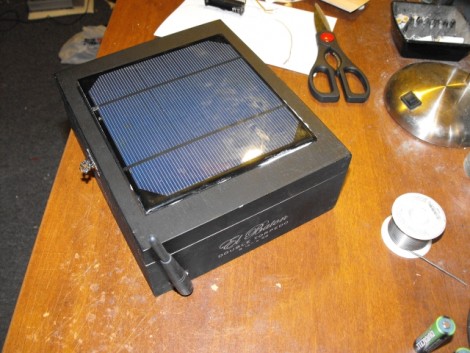
For all those times you need to broadcast your own access point where there’s no outlet [Larry] shows us how to make a solar-powered hotspot. He started by slapping a solar panel on the lid of a cigar box and attaching it to five rechargeable AA batteries inside. These power the mainboard from a router which is the perfect size to friction fit in the opening. It has been flashed with a copy of DD-WRT, and set to scan for open WiFi connections. When it finds one it connects and rebroadcasts its own WiFi signal to the surrounding area. He leaves it in the back window of his car and uses it to get on the net during lunch.

Power Cycling A Problematic Modem

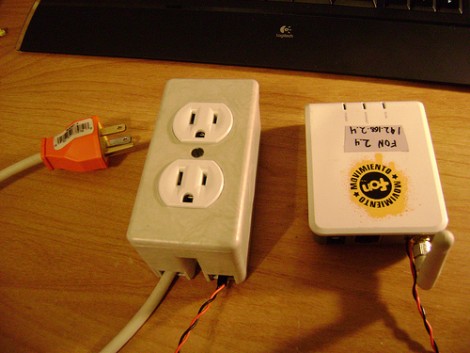
[Gigawatts] struggled against a shoddy Internet connection for quite some time. Changing modems, having the line serviced, and spending far too much time on the phone didn’t do any good. In fact, the only thing that fixed the problem was power cycling the modem once it stopped responding. His solution was to automate the power cycling process. He added a cron task to his router which is running DD-WRT, a favorite firmware alternative for hacked routers. The script monitored the WAN connection and when it went down it would toggle one of the serial port pins. He whipped up an outlet box with a relay in it and used that serial pin to cut the power going to the modem. A workaround yes, but it was the only thing that brought an end to his frustration.

Intelligent Ground Vehicle Competition 2010 Day Two Report

Culture Shock II, a robot by the Lawrence Tech team, first caught our eye due to its unique drive train. Upon further investigation we found a very well built robot with a ton of unique features.

The first thing we noticed about CultureShockII are the giant 36″ wheels. The wheel assemblies are actually unicycles modified to be driven by the geared motors on the bottom. The reason such large wheels were chosen was to keep the center of gravity well below the axle, providing a very self stabilizing robot. The robot also has two casters with a suspension system to act as dampers and stabilizers in the case of shocks and inclines. Pictured Below. Continue reading “Intelligent Ground Vehicle Competition 2010 Day Two Report”

Intelligent Ground Vehicle Competition 2010 Day One Report

The Intelligent Ground Vehicle Competition (IGVC) is the precursor to the DARPA Grand Challenge, and in many ways it is just as difficult. We have the pleasure of being at the competition this year with the Tennessee Technological University Autonomous Robotics Team. The teams at the competition pull off some amazing home-brew robotics, so we’ve decided to do a short section on some exemplary robotic hacking each day of the competition.

Today’s robot comes from the York College of Pennsylvania. The robot, dubbed “Green Lightning”, features an impressive set of custom made hardware.

We interviewed the team, and got a pretty thorough rundown of their robot with pictures after the jump. Continue reading “Intelligent Ground Vehicle Competition 2010 Day One Report”

JTAG Programming Over A Network

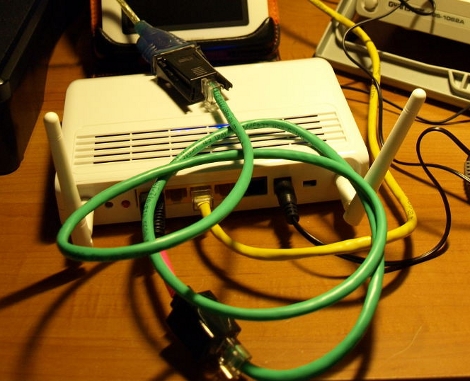
[Matt Evans] was running up against the common programming gotcha caused by disappearing parallel ports. For years he had used a JTAG parallel cable when working with FPGAs but recently realized he no longer owned any machines with that interface available. Instead of shelling out $50 for a USB programmer he a programming interface from an old router.What he’s doing is bit-banging using Linux. In this case it’s a router running a version of Linux which makes his setup Internet friendly but this could be done in the same basic manner on any Linux device with enough available I/O to connect to the device you are programming.