Adding Pan And Tilt To A Webcam

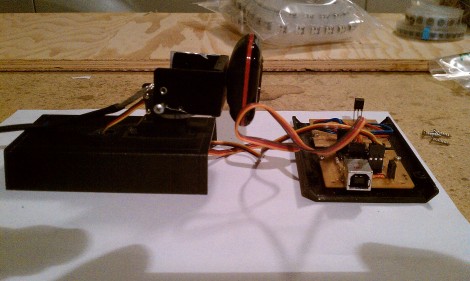
[Brent] and his wife wanted a way to provide more family time for Grandparents that lived far away. They tried a webcam, but their daughter just didn’t oblige by staying in the frame. Instead of chasing her around the room with with the camera he added pan and tilt features to the device. He settled on IR control using a common television remote, similar to our USB remote control receiver tutorial except that it drives servo motors instead of forwarding signals over the serial connection. [Brent] used a Picaxe 08M, connecting two servos together as a base on top of the project box. If you try this yourself there’s a lot of room to grow. Once you’ve assembled the hardware it wouldn’t be too hard to make this web enabled so that Grandpa can click on a web interface to look around the room.
Japanese Micro Planes

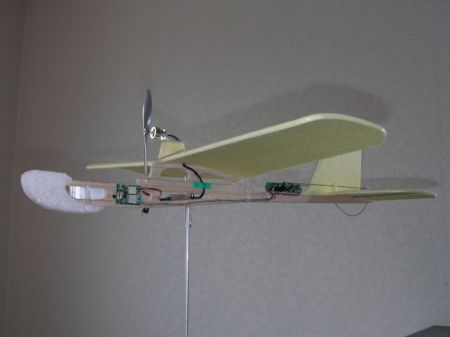
Some very well engineered micro planes(translated) have been buzzing around the net. The goal here is ultra light weight. These suped-up paper planes have a remarkable target weight of around 10 grams (translated). The lighter the micro plane is the slower and more maneuverable it will be leading to some pretty interesting and scary applications. For controls it looks like many of the planes are using infrared receivers/transmitters (much like you would find in a TV remote hint hint). Getting the lightest plane possible has forced the designers to come up with some pretty ingenious tricks. For example, instead of using packaged servos they use a coil of wire wrapped around a rare earth magnet to control the flaps. You can see these home made “servos” in action after the break.

Some have taken a more classic approach and used rubber band power instead of a li-po/motor combo.

[via Make]

Continue reading “Japanese Micro Planes”

Add-on Panel Brings Automated Vents Flaps To A PC

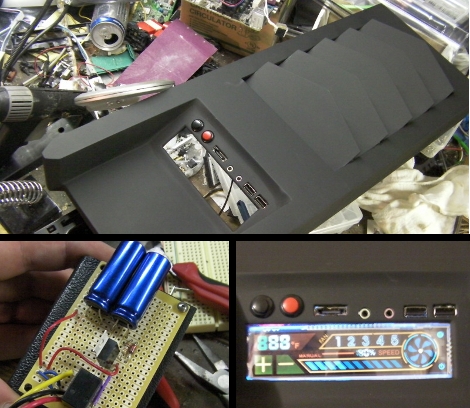
[SXRguyinMA] built a replacement top bezel for his computer case. He wanted to add vents that would automatically open or close based on the cooling needs of the computer. With some careful measurements he modeled the parts in Sketchup and sent out for them to be cut from styrene with a water jet cutter. The parts came back looking great and the assembly of the shutters went swimmingly. The bezel also includes a lighted screen for temperature information, as well as the front USB ports, headphone and mic jacks, etc. Hidden underneath is an Arduino board and servo motor. The Arduino polls the temperature and drives the servo to adjust the fins accordingly. There’s even a supercap in the circuit that will close the vents when the PC powers down or when power is unexpectedly lost. See it in action after the break.

Continue reading “Add-on Panel Brings Automated Vents Flaps To A PC”

Automated Chip Burning

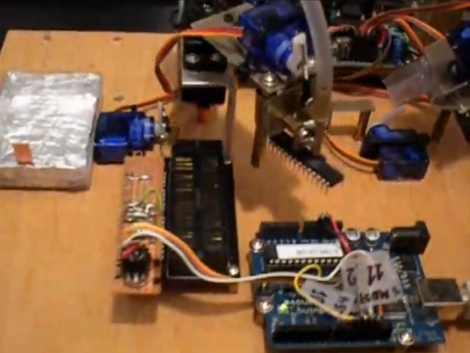
[Alexsoulis] needed to burn the Arduino bootloader to a slew of ATmega328 chips. Instead of sitting there and plugged the chips into a programmer one at a time, he build a robotic microcontroller programmer.

It starts with the DIP package microcontrollers in a tube, with a servo motor to dispense them one-by-one. An arm swings over and picks up the chip with a fish pump powered vacuum tweezers similar to the pick-and-place head we saw recently. From there the chip is dropped into a ZIF socket and programmed by an Arduino. Once the process is complete it is moved to the side and the process repeats.

We’ve reported on using an Arduino as an AVR programmer but we’ve never actually done it ourselves (we use an AVR Dragon programmer). Take a look at the video after the break and let us know if you think the actual programming seems incredibly slow.

Continue reading “Automated Chip Burning”

Darbuka Band

This robotic band has just the right amount of drums. [Liat] and her colleagues fit a group of Darbuka drums with a pair of servo-driven mallets. We’re quite surprised that the servo motors achieve such a successful strike and rebound without dampening the vibrations of the drum head. This is more often accomplished with solenoids because of their quick response and relative strength.

You can listen to a performance of this work-in-progress in the video after the break or make plans to see it live. The installment was built for the Bat-Yam international biennale of landscape urbanism. It will be attached to, and powered by alternative energy producers like solar cells and wind turbines. Continue reading “Darbuka Band”

Autonomous Rover Roams The Halls

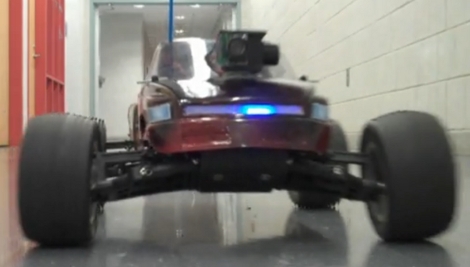
[ESylin] built an autonomous rover that roams the vacant halls of his school. On the hood of the vehicle he’s mounted two Maxbotix sonar sensors that do a great job of keeping the vehicle centered in the hallway. It will follow a wall around a corner (favoring its left side because of the left-facing sensor) and it will stop to correct itself if it gets off course. That’s because when you’re not driving a dsPIC33 is, with a Traxxas XL-5 speed controller and a hobby servo for steering. But this little guy hasn’t lost all his pep. Manual control and be switched on from from an R/C controller so you can burn up the floor tiles. Take a look at the demo after the break, with the manual control demo shown at about 4:10. Continue reading “Autonomous Rover Roams The Halls”

WiFi Controlled Arduino-bot

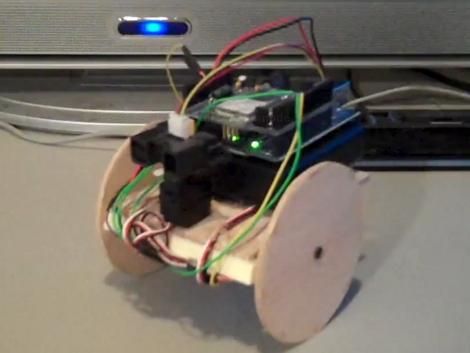
This little robot was built very quickly thanks to the rapid prototyping capabilities of the Arduino. It uses a WiShield 1.0 from AsyncLabs to connect to a wireless network for control via a TCP connection. The body and wheels are wood, with a servo for each motor and a third used to scan a range finder from side to side. We’ve embedded a triad of demo videos after the break that take you through the various feature development of this platform. You’ll see control via a hacked Zipit, as well as joystick control. There’s also a couple of stages of autonomous movement where the distance information comes into play.

Continue reading “WiFi Controlled Arduino-bot”