Big Brother Or Dumb Brother? Bus Drivers In Beijing Are Forced To Wear “Emotional Monitors”

Humans aren’t always great at respecting each other’s privacy. However, common sense says there’s a clear boundary when it comes to the thoughts in one’s own head and the feelings in one’s heart.

For bus drivers in Beijing though, it seems that’s no longer the case. These professional drivers are now being asked to wear emotional monitors while on the job, raising concerns from both legal and privacy advocates. But the devices aren’t really anything more than workout monitors, and whether they can actually make good on their Orwellian promise remains to be seen.

In Your Head, In Your Head!

The monitoring wristbands have been rolled out to some of Beijing’s long-distance bus drivers. Credit: Cypp0847, CC-BY-SA-4.0

When George Orwell wrote 1984, it was only 1949. However, he was able to foresee a world in which surveillance was omnipresent and inescapable. He also envsioned the concept of thoughtcrime, where simply contemplating the wrong things could get you in serious trouble with the authorities.

As we all know, Orwell was way off – these predictions didn’t become reality until well into the 2000s. In the latest horrifying development, technologies now exist that claim to be able to monitor one’s emotional state. Now, China’s transportation sector is rushing to push them on their workforces.

Long-distance bus drivers in Beijing are now being told to wear electronic wristbands when on the job. These wristbands claim to be able to capture the wearer’s emotional state, monitoring it on behalf of the employer. The scheme was the idea of the Beijing Public Transport Holding Group. The state-run organization claims the technology is intended for the safety of the public, and a trial of the wristbands began in July this year. Continue reading “Big Brother Or Dumb Brother? Bus Drivers In Beijing Are Forced To Wear “Emotional Monitors””

Developing A Custom WearOS Watch Face

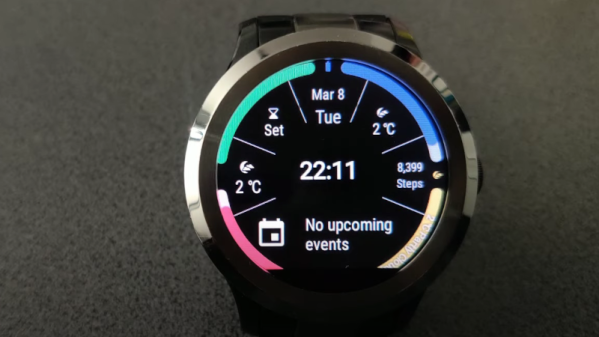
When you think about customizing the face of a smartwatch, you probably imagine something akin to selecting a new wallpaper on an Android device, or maybe tweaking the color scheme a bit. But not [Sebastian SARBU], his plans were a bit grander than all that. So he cracked open Android Studio and started writing a truly custom watch face that would make the most out of the device’s display. Luckily for us, he’s not only released the source code for others to study, but has documented the development process in a series of videos that you can see below the break.

He’s dubbed the new interface his “Pizza Watch Face”, as it breaks the circular screen down into slices complete with a bits of multi-colored “crust” that can show various notifications using the fewest pixels possible. There’s no question the layout is able to pack a lot of information into a relatively small space, and while aesthetics are naturally subjective, we happen to think it looks pretty slick. Continue reading “Developing A Custom WearOS Watch Face”

This Smart Watch Keeps An Eye On Ambient CO2 Levels

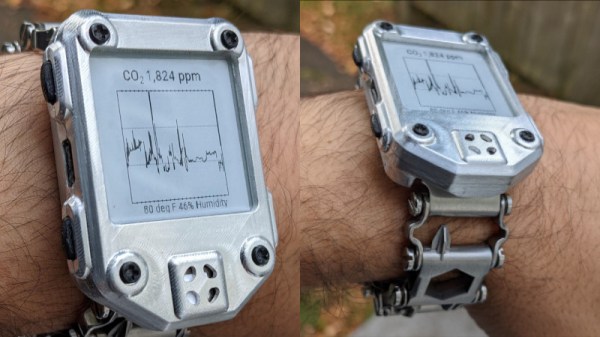
Human respiration takes in oxygen and in turn, we exhale carbon dioxide. Thus, an uptick of carbon dioxide levels around us can indicate we’re in the presence of other humans, and also, perhaps, the pathogens they carry. To explore this phenomenon, [C Scott Ananian] developed a mod for the Watchy open-source smartwatch, which lets it detect carbon dioxide.

The idea behind the build is simple. If you’re around increased CO2 levels, it may be because you’re surrounded by people, and thus more likely to be exposed to COVID-19. To detect CO2, the watch relies on a Sensiron SCD40 or SCD41 sensor. This is read by the Watchy’s ESP32 microcontroller, and results are graphed on the watch’s e-Paper display. The Watchy is also given a nice new aluminum case to fit the additional hardware.

It’s cool having a graph on your wrist of the ambient concentration of CO2, and at the very least, it could make a good talking point next time you’re at a particularly boring party. You’ll also be more than ready to advise other partygoers if the carbon dioxide level is reaching dangerous levels.

We’ve seen similar builds before, which are useful not only for pandemic safety but also for monitoring if you have any leaks from CO2 storage in the house. If you’ve been working on your own ways to track dangerous gases, be sure to drop us a line!

Hackable Smart Watch Is Also Open Source

When they first came to market, many detractors thought that smart watches would be a flop or that there wouldn’t be much use for them. Over the past few years, though, their sales continue to increase as people find more and more niche uses for them that weren’t previously considered. The one downside to most of these watches is unsurprisingly their lack of openness and hackability, but with some willpower and small circuit components there are a few options available for those of us who like to truly own our technology.

This smartwatch is the SMA Q3, the next version of this smartwatch that we saw at the beginning of last year. Like its predecessor, it boasts a sunlight-readible display powered by a Bluetooth SoC, but this time uses the upgraded nRF52840. All of the standard smartwatch features are available, but this version also includes SWD pins on the back, and additionally has support for Bangle.js and can run some of the apps from the app loader. Some details still need to be worked out for this specific hardware, but there are some workarounds available for the known problems.

The project is also on Kickstarter right now but is well past its funding goals. We’re excited to see adoption of an open-source smartwatch like this, and to that end all of the hardware details and software are freely available on the project’s page, provided you can order some of the needed parts from overseas. If you’re looking for something a little more BASIC, though, we have you covered there as well.

A Massive Modular Smartwatch To Match Your Sci-Fi Fantasies

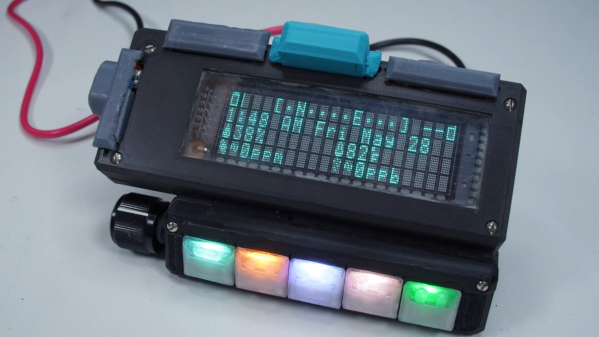
Modern smart watches have some incredible features, but they still don’t stack up to what science fiction promised us, both in size and capabilities. Fortunately, [Zack Freedman] has set out to change that with the Singularitron, a modular wearable computer that is less Apple Watch and more Pip-Boy.

The most striking features of this monstrosity is its size and the out-of-production four-line VFD display. The inputs consist of a row of large RGB-illuminated buttons and a rotary encoder mounted at an angle to curve around the wearers arm. On the inside are a pair of PCBs with an integrated Teensy 3.2, BLE module, motion processing module, haptic driver and power circuitry drawing from a removable 18650 battery. The armband is from a commercial wrist mounted barcode scanner which attaches to the Singularitron with a quick-detach mount.

A major feature of the Singularitron is its modularity. Arrayed around its edges are four slots with spring-loaded contacts for add-on modules. Modules have access to the SPI and I2C busses, two GPIO pins, 3.3 V and 5 V lines. Each module also contains an EEPROM chip to store the module’s ID and any configured settings, allowing modules to be hot swapped and automatically recognised. [Zack] has created a number of modules, like a laser pointer, environmental sensor, OLED display and a Teensy 4.0 to blink an LED. When a module is plugged or inserted, a series of randomly generated status messages flash across the display, thanks to an awesome little library which we are absolutely copying for our own projects. Ironically, keeping the time is one of the Singularitron weak points, since [Zack] wasn’t able to fit a backup battery inside, so the time needs to be reset when the battery dies. Maybe a module with an RTC and backup battery is the perfect solution. Continue reading “A Massive Modular Smartwatch To Match Your Sci-Fi Fantasies”

Commodore Inspired Watch Puts BASIC On Your Wrist

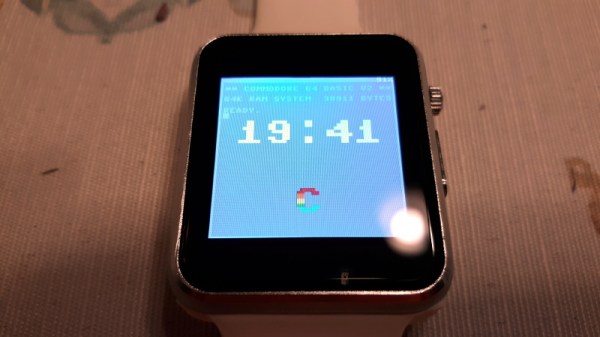
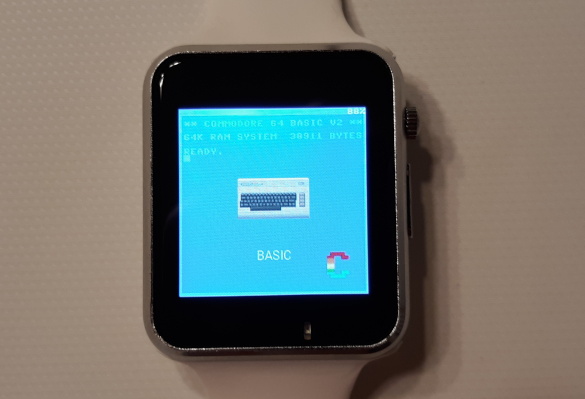
Ask a smart watch owner what their favorite wrist-mounted feature is, and they might say it’s having all their daily information available at a glance, or the ease with which they’re able to communicate with friends and family. If they don’t mention knocking out a few lines in their wearable BASIC interpreter, then you know you aren’t talking to [Nick Bild]. His “C64 Watch” firmware for the LILYGO T-Watch 2020 not only takes some visual inspiration from the Commodore 64, but also lets you relive those early computing glory days with a functional BASIC environment.
Originally [Nick] used a teeny tiny onscreen keyboard to tap out his BASIC programs, but finding the experience to be uncomfortably like torture, he switched over to using USB. Just plug the watch into your computer, open your favorite serial terminal, and you’ll have access to the customized version of TinyBasic Plus running on the watch. To make things  even easier, he’s looking at implementing a web-based terminal over WiFi so you don’t need to plug the watch in.

When you aren’t running BASIC you’ll be treated to a Commodore-themed watch face, complete with the classic READY. prompt. A small battery indicator is hidden up in the top-right corner, and tapping on the rainbow colored “C” will launch the menu. It’s pretty simplistic, but of course what else would you expect given the source material?

Looking ahead, [Nick] says he’d also like to implement a C64 emulator into the firmware so the watch could run original software. We’re a bit skeptical about how practical that would actually be, but we’ll reserve judgement until we see it in operation. He’s also hoping other Commodore aficionados will chime in with their own improvements and new features for the watch.

You might think that a Commodore 64 emulator on your wrist would be the most outlandish way to run your old games and software, but we’d say playing Turrican in a virtual reality microcosm of the 1980s takes the cake.

Continue reading “Commodore Inspired Watch Puts BASIC On Your Wrist”

An Open Source Smart Watch You’d Actually Wear

We’ve seen a number of open source smart watches over the years, and while they’ve certainly been impressive from a technical standpoint, they often leave something to be desired in terms of fit and finish. Exposed PCBs and monochromatic OLED displays might be fine for a trip to the hackerspace, but it wouldn’t be our first choice for date night attire.

Enter the Open-SmartWatch from [pauls_3d_things]. This ESP32 powered watch packs a gorgeous circular 240×240 TFT display, DS323M RTC, BMA400 three-axis accelerometer, and a 450 mAh battery inside of a 3D printed enclosure that can be produced on your average desktop machine. WiFi and Bluetooth connectivity are a given with the ESP32, but there’s also an enhanced edition of the PCB that adds another 4 MB of RAM, a micro SD slot, and a Quectel L96 GPS receiver.

The GPS edition of the PCB

As it’s an open source project you’re free to download the PCB design files and get the board produced on your own, but [pauls_3d_things] has actually partnered with LILYGO to do a run of the Open-SmartWatch electronics which you can pick up on AliExpress right now for just $24 USD. You’ll still need to order the battery separately and 3D print your own case, but it still seems like a pretty sweet deal to us.

On the software front, things are pretty basic right now. The watch can update the time from NTP using a pre-configured WiFi network, and there’s a Bluetooth media controller and stopwatch included. Of course, as more people get the hardware in their hands (or on their wrists, as the case may be), we’ll likely start seeing more capabilities added to the core OS.

While getting our own code running on commercially produced smartwatches holds a lot of promise, the Open-SmartWatch is arguably the best of both worlds. The partnership with LILYGO brings professional fabrication to the open hardware project, and the GPLv3 licensed firmware is ripe for hacking. We’re very excited to see where the community takes this project, and fully expect to start seeing these watches out in the wild once we can have proper cons again.

Continue reading “An Open Source Smart Watch You’d Actually Wear”